Buying a holiday home in Spain follows a fixed sequence: NIE, reservation, independent legal due diligence, the arras contract, completion before a notary, tax, registration. Budget 10–13% on top of the price. Almost everything that goes wrong on this coast goes wrong because somebody signed before a lawyer had read the paperwork.
Sunward Legal · Marbella. Last substantive review: 14 August 2026. Figures are those in force in Andalucía on that date, with their source cited at the end.
What does buying a property in Spain actually involve?
Seven steps, in this order: obtain a Spanish NIE number; sign a reservation; have a lawyer run due diligence on the property and the seller; sign the arras contract with around 10% down; complete before a notary; pay transfer tax or VAT; register the deed. A Spanish bank account is often but not always needed.
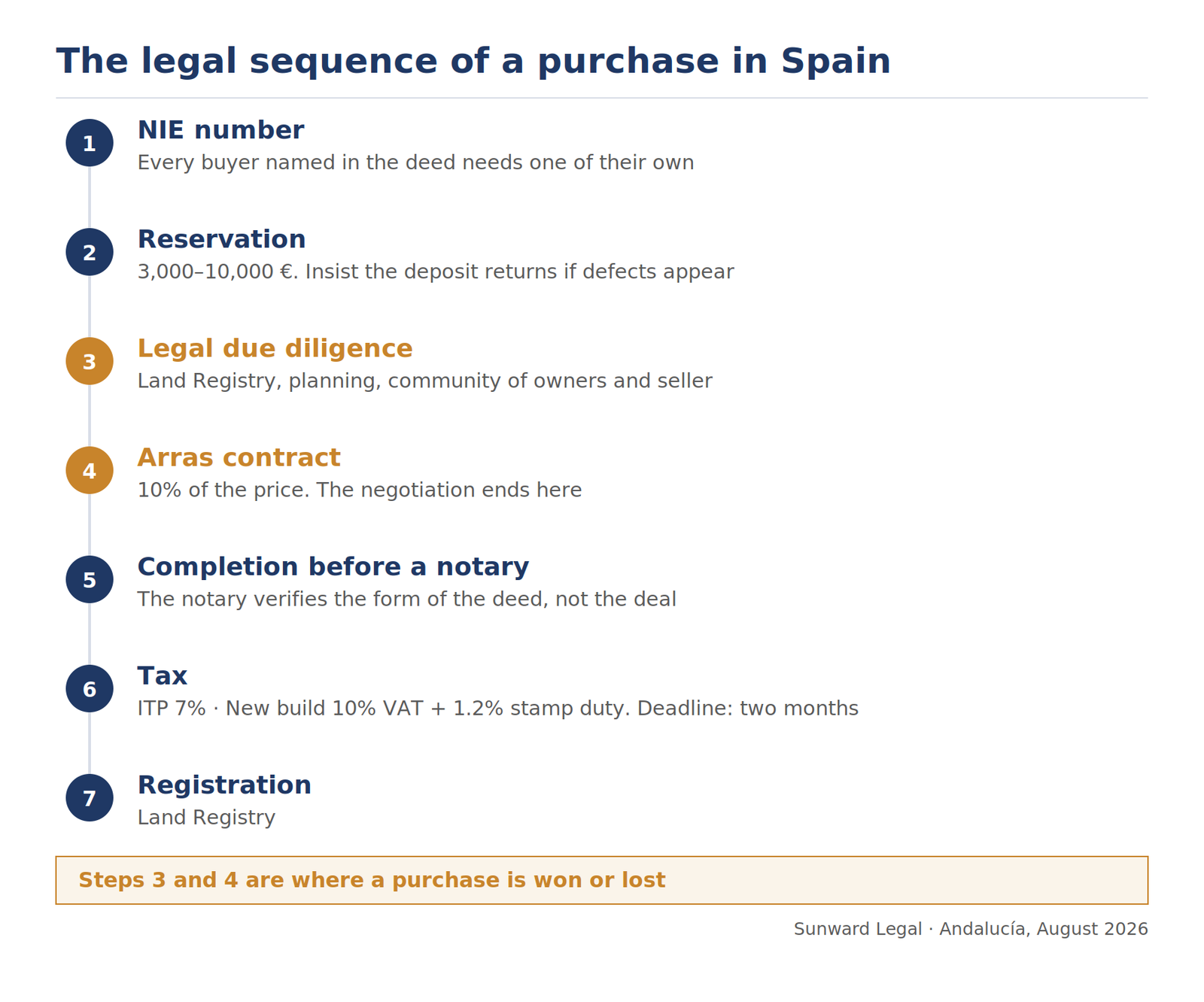
The order matters more than it looks. Each step narrows what you can still negotiate, and by the time you reach the notary the negotiation is finished. The two places where a purchase is genuinely won or lost are the due diligence and the arras contract — the two steps most buyers treat as formalities.
What will it cost on top of the price?
Between 10% and 13% of the purchase price, and the largest single item is the transfer tax. The difference between the tax and that total is the professional cost of the transaction: notary, Land Registry and lawyer. The table below sets out the tax items on a purchase here.
| Item | Resale property | New build |
|---|---|---|
| Transfer tax (ITP) | 7% | — |
| Reduced rate, buyer under 35, main home up to 150,000 € | 3.5% | — |
| VAT | — | 10% |
| Stamp duty (AJD) | — | 1.2% |
Rates in force in Andalucía in August 2026. The rules that set them are cited in full at the end of this article.
Three things that table does not show, and that catch people out.
The tax base is not always your price. Since 1 January 2022 the base for transfer tax is the *valor de referencia*, the value Catastro assigns to the property. If the declared value or the price agreed is higher, the higher figure is used instead under the transfer tax rules. You check that number before signing, not when an unexpected assessment arrives.
The deadline is two months, not one. Transfer tax in Andalucía must be self-assessed and paid within two calendar months from the day after completion, under the Andalusian tax rules. The 30-working-day rule you will find on many websites is the national default, and it stopped applying in Andalucía in 2022.
Financing is not a number anyone can promise you. Lending terms for non-resident buyers are set by each bank, and no public statistic exists that would let anyone tell you in advance what you will be offered. Get a binding offer before you sign the arras, not after.
The notary will not check the things that ruin a purchase
A Spanish notary verifies identity, capacity and the charges shown on the register that day, and confirms that the deed is formally lawful. That is the whole of the role. Planning status, community debts, technical condition, whether the arras clause you signed was one-sided — all of it sits outside what the notary does.
This is the single most expensive misunderstanding among foreign buyers here, and it comes from a reasonable assumption. In much of northern Europe the conveyancing professional and the registration official do overlapping work, so the state official at the end of the process feels like a safety net. In Spain the notary is a guarantor of form, not an adviser to either side.
Which raises the question worth asking about everyone in the room. The estate agent earns a commission if you buy. The developer earns a margin if you buy. The bank earns interest if you borrow. The notary is paid the same whatever the deal is worth to you. Your own lawyer is the only participant whose interest is that the purchase is a good one — which is also why the lawyer should not be the one the agent recommended. What independent legal representation for a buyer covers — and what it deliberately does not — is worth agreeing in writing at the outset rather than assuming.
The arras contract is the real point of no return
The arras contract is the private sale agreement, normally signed with 10% down. Under penitential arras, a buyer who withdraws loses the deposit and a seller who withdraws returns it doubled (art. 1454 of the Civil Code). Everything material is fixed here: price, completion date, what stays in the house, who pays what.
And here is the part that most guides get wrong. Penitential arras are not presumed. The Supreme Court reads art. 1454 restrictively and requires a clear, unequivocal intention by both parties; merely citing the article in the contract is not enough (STS 583/2018 of 17 October). Where the drafting is unclear, the deposit is treated as confirmatory — which means neither side has bought a right to walk away, and the other party can demand that the sale goes ahead.
The practical consequence is uncomfortable. A buyer who believes he has paid for an exit route, and then discovers he has paid a first instalment on a purchase he no longer wants, has a considerably worse problem than losing the deposit.
The reservation contract deserves the same attention for a smaller sum. On this coast the agent will ask for 3,000 to 10,000 € to take the property off the market. Those forms are usually drafted by the agency, they favour the seller, and many declare the deposit non-refundable even if a lawyer later finds a defect. Ask for one sentence before any money moves: the deposit is returned if legal due diligence reveals problems. A seller who refuses that sentence has told you something useful.
Signing a reservation or an arras contract this month? Book a free 20-minute call and we will read the clause that decides whether your deposit is recoverable, before you sign it.
What changes because you are not resident in Spain
Three obligations attach to you specifically as a foreign buyer, and two of them can become your liability rather than the seller’s: withholding part of the price when the seller lives abroad, the municipal capital-gains tax, and an annual Spanish return for the property even in a year you never let it.
You must withhold 3% of the price if the seller is non-resident and pay it to the tax office using form 211 within one month of completion. It is not optional and it is not the seller’s paperwork. The same rule points the other way the day you come to sell as a non-resident yourself, and what comes out of the price when the seller lives abroad is easier to plan for at purchase than at exit.
You may become liable for the seller’s municipal capital-gains tax. Where the seller is a non-resident individual and the sale is for consideration, the buyer is designated as substitute taxpayer for the *plusvalía municipal*. If it goes unpaid, the town hall comes to you. Note the limits: it applies to individuals, not to non-resident companies.
You will file an annual tax return even if you never let the property. Spain imputes a notional rental income to second homes, taxed at 19% for residents of the EU, Iceland, Norway and Liechtenstein and 24% for everyone else, declared on form 210. The deadlines changed this year: income accruing from 2026 onwards is declared between 1 April and 31 December of the following year.
One more, if you are buying for rental income. Since 3 April 2025 a community of owners can approve, limit, condition or prohibit tourist letting in the building by a majority of three fifths of owners representing three fifths of the quotas, under the rules governing communities of owners. The agreement does not apply retroactively to an owner already carrying on the activity lawfully before that date. Read the community statutes and the recent minutes before you buy, not after.
What usually goes wrong
The unlicensed extension. Glazed terraces, pools and additional rooms built without a licence are common along the coast. This rarely kills a deal outright, but it almost always reopens the price — and it can block a tourist-letting licence and complicate a future resale. The buyer who discovers it after signing the arras has lost the leverage to do anything about it.
Off-plan payments with no guarantee. Every amount you hand over before delivery must be secured by a bank guarantee or insurance policy — that is a legal requirement on the developer. This is not a nicety and it is not negotiable: no guarantee, no payment.
The community debt nobody asked about. Unpaid community charges follow the property for the current year and the three preceding ones. A certificate from the administrator is a five-minute request that occasionally saves five figures.
Those three share a shape. Each has a specific legal mechanism behind it and a specific document or sentence that defeats it, and each has to be dealt with before a particular step rather than after it — which is what makes the pitfalls that actually cost money a shorter list than the ones usually published.
Can you buy without coming to Spain?
Yes, in full. A power of attorney signed before a notary in your own country and apostilled — or signed at a Spanish consulate — lets a lawyer obtain your NIE, open a bank account if the transaction needs one, sign the arras and complete the purchase. Most buyers fly out for the keys rather than for the queues.
Questions, answered
Do I need a lawyer if there is a notary?
The notary guarantees the formality of the deed, not the wisdom of the purchase. Planning irregularities, community debts, one-sided arras clauses, the withholding obligations and tax planning all fall outside the notarial role. They are the reason to instruct an independent lawyer.
How long does a purchase take?
A resale with no complications usually runs six to ten weeks from reservation to keys. A mortgage adds time, and so does any planning irregularity the due diligence uncovers and the parties then have to regularise.
Is the reservation deposit ever refundable?
Only if the contract says so. That is precisely why the reservation is reviewed before signing rather than afterwards, and why the clause returning the deposit if due diligence reveals defects is worth insisting on.
Does buying a property give me residency?
No. Residence by real-estate investment — the golden visa — was abolished with effect from 3 April 2025. Non-EU buyers now plan their stays under the 90/180-day rule or apply for a visa on some other basis.
What is the valor de referencia and why does it matter?
It is the value Catastro assigns to each property, and since 2022 it is the starting point for the transfer tax base. If it exceeds the price you pay, you are taxed on the higher figure. It is public and it can be checked before you commit.
Where to start
If you are at the beginning, the useful order is: check the *valor de referencia* of anything you are seriously considering, get your NIE moving, and have somebody read the reservation form before you pay it. Those three things cost almost nothing and they remove most of the ways this goes wrong.
One item belongs on the list for after completion rather than before it. Owning property here is the point at which a Spanish will starts to earn its keep — not because Spanish law requires one, but because Spain has no probate and the Spanish inheritance tax runs from the date of death rather than from the day the English paperwork is finished.
Book a free 20-minute call, in English, Spanish or Swedish. Tell us where you are in the process and we will tell you what the next step actually requires. No cost and no obligation to instruct us.
This article is general information about Spanish law and not advice on your particular transaction. It reflects the law in force in Andalucía on 14 August 2026; tax rates and administrative deadlines change. Sources cited: Ley 5/2021 de Tributos Cedidos de Andalucía; Real Decreto Legislativo 1/1993 (transfer tax), as amended by Ley 11/2021; art. 1454 of the Civil Code and STS 583/2018; Real Decreto Legislativo 5/2004 (non-residents income tax); Real Decreto Legislativo 2/2004 (local finances); Ley 38/1999 as amended by Ley 20/2015; Ley 49/1960 as amended by LO 1/2025; Orden HAC/623/2026.