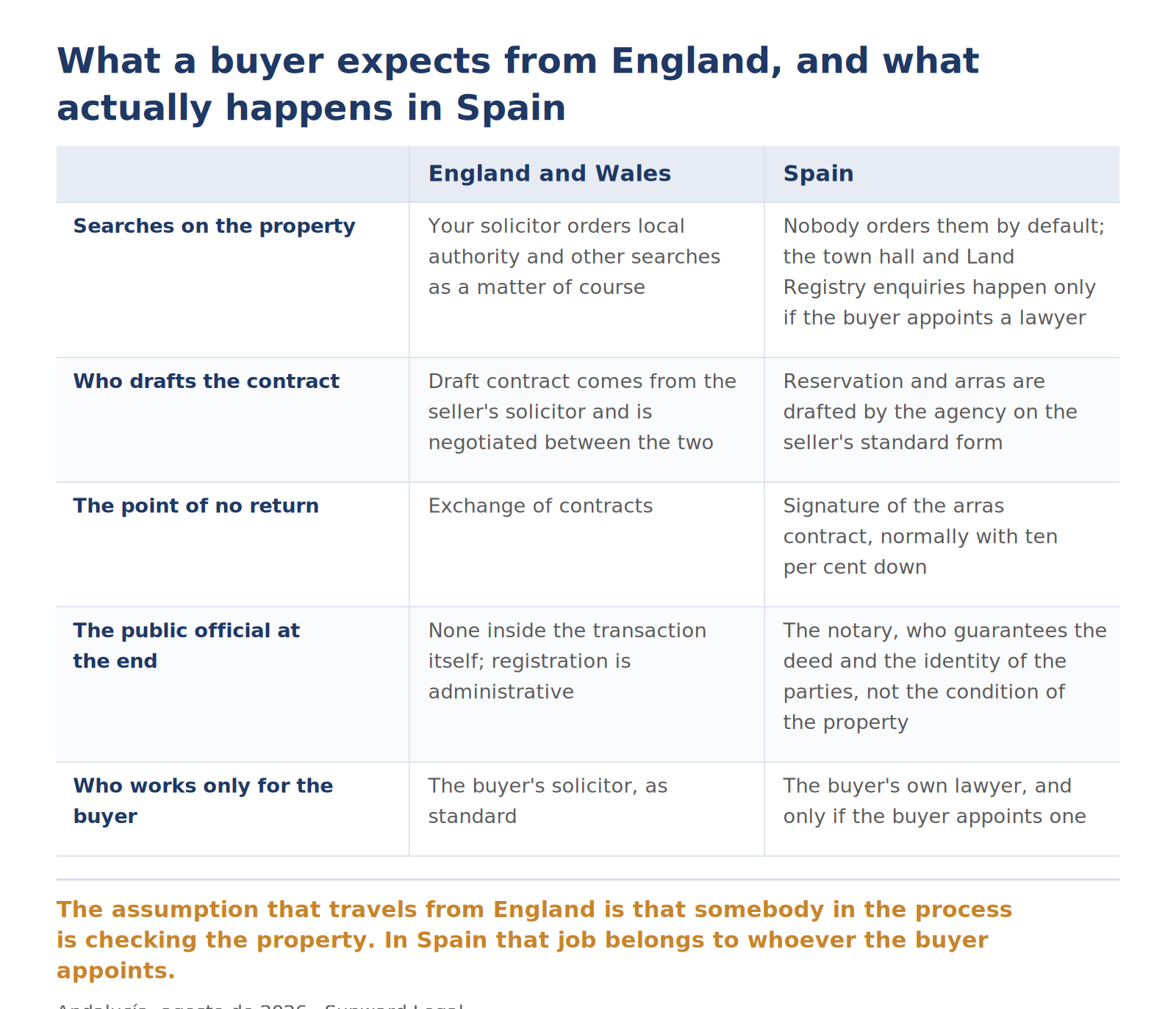
Conveyancing in Spain is not the English process in Spanish. Nobody orders searches by default, the notary guarantees the deed rather than the property, and the estate agent is paid by the seller. The buyer’s own lawyer is the only participant whose work is the purchase itself.
Sunward Legal · Marbella. Last substantive review: 15 August 2026.
What Spanish conveyancing includes
The work covers everything between the property you have chosen and a registered deed in your name: establishing what you are buying, controlling the two contracts that bind you, and closing tax and registration afterwards.
- The reservation form is read before any money moves. On this coast the agent will ask for 3,000 to 10,000 € to hold the property, on an agency form that often makes the deposit non-refundable even if a defect appears, and that clause can still be negotiated.
- Title and charges are checked. A *nota simple*, the informative extract from the Land Registry, shows the registered owner, mortgages, embargoes and fiscal charges. It has one limit: it is purely informative and does not certify the content of the entries.
- The three surfaces and the town hall file are compared. What the Registry says, what Catastro says and what the building measures do not always agree. Then come the licence and whether part of the building sits in the *asimilado a fuera de ordenación* regime, the Andalusian status that tolerates an irregular building without legalising it.
- Debts that travel with the property are traced: the community certificate, the IBI and the supply contracts, none of which appears on the Registry.
- The *arras* contract, the Spanish deposit contract, is drafted or renegotiated. It fixes the completion date, what stays in the house and the penalties, and it is where the financing condition must be written in, because Spanish law does not imply one.
- Completion is closed out: NIE, power of attorney, the deed, the transfer tax return and registration, plus the changeover of IBI, community and utilities.
What this does not include
It is worth saying where this service stops. There are points where somebody else is better placed, and knowing that before you instruct anyone is far cheaper than discovering it after completion.
- Your annual Spanish return as an owner. Spain imputes a notional rental income to a second home, declared on form 210 every year whether or not you let it, and that annual compliance is a separate instruction.
- UK tax. Capital gains tax, inheritance tax and domicile belong to a UK adviser, and a Spanish lawyer improvising on them would do you no favours.
- Valuation, survey and technical certification. Our work is to read the documentation; whether the price is sensible and whether the roof is sound are questions for a valuer, a surveyor or an architect.
- Litigation, mortgage brokering, currency exchange and estate agency. A dispute is a separate instruction with its own cost. We review what a lender puts in front of you, but we do not source the loan, move the money or sell the house.
How it works, step by step
A resale with no complications runs six to ten weeks from reservation to keys. A mortgage adds time, as does any planning irregularity the enquiries turn up.
1. First call, twenty minutes. We go through what you have found, what you have signed and what the seller is asking for. If nothing is signed, this is the cheapest moment in the process.
2. NIE. Every buyer named on the deed needs one, spouses included, and no deed is granted without it: how to get a Spanish NIE number from the UK.
3. Reservation reviewed, then paid. One sentence is worth insisting on: the deposit comes back if the enquiries reveal a problem. A seller who refuses to include it has told you something useful.
4. Enquiries, one to two weeks. Registry, Catastro, town hall and community. This is the last stage at which the price can still move, where most of the pitfalls of buying property in Spain are caught rather than paid for.
5. The arras contract, normally ten per cent down. Under penitential arras a buyer who withdraws loses the deposit and a seller who pulls out returns it doubled (article 1454 of the Civil Code). But penitential arras are not presumed: where the drafting is unclear the deposit is confirmatory, and neither side has bought a right to walk away (STS 583/2018).
6. Completion before the notary. You become the owner on the day of the deed, not on the day it is registered. What registration adds is protection: once you are on the register, it becomes very hard for anyone to dislodge you.
7. Tax and registration. Transfer tax in Andalucía is self-assessed within two calendar months of the deed.
The same sequence is set out at length in the legal checklist for buying a holiday home in Spain, and selling is a different exercise altogether: selling a property in Spain as a non-resident.
Why appoint your own lawyer when there is already a notary
Because the notary’s job is the deed, not the property. A Spanish notary is impartial and must obtain registry information within the four working days before the deed is granted, identify the parties, judge their capacity and record how the price was paid. That is the whole of the mandatory remit.
No rule obliges the notary to check the planning status, whether the works were licensed, what the community is owed, or whether anyone is living there under an unregistered tenancy. The community debt certificate comes from the seller and its contents are not verified. The notary guarantees the title, and checking the building is the job of whoever the buyer appoints.
Which raises the question of who everyone else in the room works for. The estate agent is instructed and paid by the seller and, unlike a Swedish agent, owes the buyer no statutory duty. The *gestoría* handling a new build, the office that files the paperwork and the taxes, is normally the developer’s. Your own lawyer is the only participant whose interest is that the purchase is a good one, which is also why that lawyer should not be the agent’s recommendation.
Two things buyers treat as courtesies are in fact rights. The buyer chooses the notary where the seller sells professionally or on standard terms. On a mortgage to an individual, the mortgage lending rules give ten calendar days between the information pack and signature, plus free notarial advice beforehand. Buy through a company and none of it applies.
What it costs and how it is agreed
The fee is fixed, quoted in writing after the initial consultation and before any work begins, normally within 24 to 48 hours. It is not a percentage of the price: a flat with clean papers is less work than a house with an unlicensed extension.
Taxes and third-party costs are separate and paid by you. As a working figure a resale costs 10% to 13% on top of the price, and the largest single item is transfer tax: 7% in Andalucía on a second home, since the reduced rates require the property to be your main residence. The gap between that tax and the 10–13% total is the professional cost of the transaction: notary, Land Registry and lawyer.
Questions people ask before instructing
Do I have to travel to Spain?
No. A power of attorney signed before a notary in the United Kingdom and apostilled, or signed at a Spanish consulate, lets a lawyer obtain your NIE, sign the arras and grant the deed. The powers are listed and the document is time-limited.
What language will I be dealt with in?
English, Spanish or Swedish throughout. The deed itself is in Spanish because it is a Spanish public document, and its content is explained before signature. A bilingual deed or a sworn translation is arranged in advance.
What happens if the purchase falls through?
It depends on which document you had reached and what it says, which is why the reservation and the arras are read before signature. Where the enquiries reveal the defect, a properly drafted reservation clause returns the deposit.
Do you act for sellers as well?
Yes, and never on both sides of the same transaction. A non-resident seller carries its own obligations, from the 3% withholding to the *plusvalía*, the municipal tax on the increase in land value, so it is a separate instruction. The Spanish-language version of this page is abogado inmobiliario en Marbella.
Next step
If you have found a property, the useful order is short: check its *valor de referencia*, the reference value Catastro assigns to it for tax, start the NIE, and have the reservation form read before you pay it.
Book a free 20-minute call, in English, Spanish or Swedish. Send us the reservation form or the listing and we will tell you what the next step actually requires. No obligation to instruct us.
General information about Spanish law, not advice on a particular transaction. Reflects the position in Andalucía on 15 August 2026; tax rates and deadlines change. Sources: Reglamento Notarial (1944), arts. 126 and 175; Ley Hipotecaria (1946), arts. 34 and 222.5; arts. 609, 1462 and 1454 of the Civil Code and STS 583/2018; Ley 5/2021 de Tributos Cedidos de Andalucía; Real Decreto Legislativo 1/1993, as amended by Ley 11/2021; Ley 5/2019 de contratos de crédito inmobiliario; Ley 7/2021 (LISTA); Real Decreto Legislativo 5/2004; Ley 49/1960 de Propiedad Horizontal.