Spain has no probate. No court appoints anyone, no grant is issued and nothing vests in a personal representative: a Spanish estate passes when the heirs sign a deed of acceptance before a notary, pay the inheritance tax and register the property in their own names. The part that catches British families is the calendar. The Spanish tax falls due six months from the date of death, and an English grant of probate is rarely ready by then.
Sunward Legal· Marbella. Last substantive review: 15 August 2026.
Is there any such thing as probate in Spain?
Not in the sense the word carries in England and Wales. Spanish succession has no court stage, no grant and no personal representative between the deceased and the heirs. The heirs take directly, and what makes that effective is a public deed signed before a Spanish notary.
The checkpoints are different. In England the grant unlocks the estate. In Spain the two gates are the tax office and the Land Registry, and both come after a deed the heirs have to sign, in person or by attorney.
Where the deceased left no will, a notary supplies the missing document as well, through a declaración de herederos — a notarial declaration of who the heirs are and in what shares. Since a reform of 2015 that route covers every class of heir, including brothers, sisters, nieces and nephews; the judge who used to be needed for collateral relatives is no longer in the picture.
What has to happen, and in what order
Six steps: death certificate, search of the register of wills, the title to inherit, the deed of acceptance and adjudication, the inheritance tax return, registration. Only two carry a legal deadline, and the second of those is the one that hurts.
| Step | What it is in Spain | The deadline attached |
|---|---|---|
| Death certificate | The UK certificate, apostilled and translated into Spanish | None of its own; everything else waits for it |
| Certificate from the register of wills | Search of the central register of Spanish wills, at the Ministry of Justice, on form 790, fee code 006 | Cannot be applied for until 15 working days after the death |
| Title to inherit | Authorised copy of the Spanish will, or a notarial declaration of heirs where there is none | None, but it holds up everything after it |
| Deed of acceptance and adjudication | The public deed before a Spanish notary in which the heirs accept and the assets are assigned | In practice, before the tax return |
| Inheritance tax return | Self-assessment on form 650 where the estate is handled by the state tax office | Six months from the death; six more only if applied for within the first five |
| Land Registry | Registration of the deed, so that the heirs appear as owners | None, but no buyer’s lawyer completes a purchase from unregistered heirs |
The fifteen working days are not a formality. That is the earliest moment at which anyone can find out whether the deceased made a Spanish will, and with weekends and holidays it takes roughly three weeks out of a six-month period before the file can properly be opened.
The deed of acceptance is the instrument that does the work: it values the estate, sets out the shares and assigns the property to named people in stated proportions. The tax return, the registration and any later sale are all built on it.
Why the six-month tax deadline is the actual problem
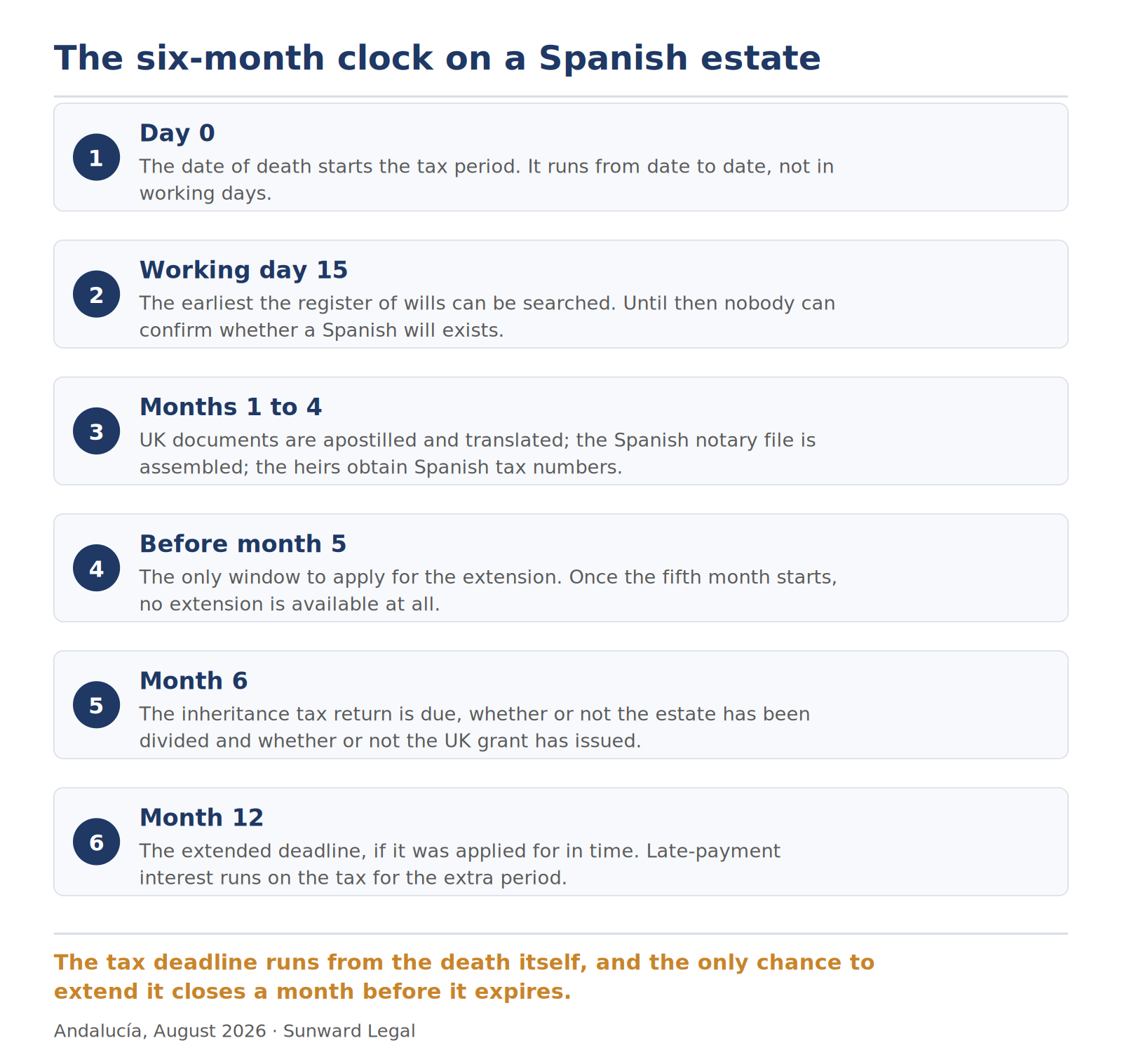
The Spanish inheritance tax return is due six months from the date of death. It is a calendar period counted from date to date, and it does not stop because the estate is undivided, because the heirs are abroad or because the English grant has not issued. That last point is where British estates come unstuck.
There is one extension and it is narrower than it sounds. It runs for a period equal to the original one, six further months. It has to be applied for within the first five months, and it carries late-payment interest. Once the fifth month has begun there is nothing left to apply for.
Put the two rules together and you have the point on which these estates turn. The decision has to be taken in about the fourth month, when the family usually has no idea when the UK grant will come through. So the extension is requested as a precaution rather than as a reaction, and, unlike a deferral in other taxes, it is not free of interest. The inheritance tax regulation sets out both rules.
Where the deceased lived outside Spain the return goes to the state tax office rather than the regional one, even though the regional rules decide the amount. That distinction is the subject of our note on Spanish inheritance tax for non-residents.
Do you need an English grant of probate to register the property in Spain?
No. The grant is not the title to the Spanish property and a registrar cannot demand it. Under English law the title is the will itself; probate is a mechanism for administering and winding up an estate in the United Kingdom, with no equivalent role in the Spanish system.
That is not an opinion. The Spanish Directorate-General that resolves appeals against registrars has said so repeatedly, including in a decision of 15 June 2021 allowing the appeal of a family whose deed had been rejected for want of a grant. The executor, it held, is a key piece of that particular system of winding up an estate, but not of the Spanish one.
The nuance is what separates a file that registers from one that is rejected. Where the English will routes everything through executors who hold on trust, the British documents do become relevant, and they then have to be translated into Spanish registry categories. A decision of 31 July 2025 accepted in principle that executors could appear on the register in that fiduciary capacity, but required the Spanish rules on the property itself to be met: determinate shares and expressly delimited powers. Describing the holding as being “in administration” was not enough.
So the grant is not useless — it is simply not the title. If the will is built around executors, someone has to draft the Spanish deed so that a registrar in Andalucía can see exactly who holds what and what they may do with it.
Which country’s law decides who inherits?
The European Succession Regulation decides, and it applies to a British estate even though the United Kingdom is not bound by it. The default rule is the law of the country where the deceased was habitually resident when they died. The exception is a choice, made expressly in a will, of the law of their nationality.
Here is the point most articles get backwards. The United Kingdom never took part in the Regulation — an original opt-out exercised when it was adopted in 2012, not a consequence of Brexit. And it makes no difference to a Spanish notary, because the Regulation applies universally: a Spanish authority applies the law it points to even when that is the law of a non-member state, such as English law.
So a British citizen who lived in England and died owning a flat in Marbella will normally have the whole estate governed by English law, Spanish flat included. One who had moved to Spain and died habitually resident here falls under Spanish law instead, unless English law was chosen in a will. That brings in the legítima, the reserved share that gives children two thirds of the estate under the Civil Code — which governs in Andalucía, though not in the regions with a civil law of their own. How that choice of law is worded is the subject of our note on whether an English will covers your Spanish property.
And a warning against a shortcut that circulates widely: the Spanish flat does not fall back under Spanish law “because the property is here”. Where the will validly chooses English law, the Regulation itself closes off that route back.
Is there a six-month date already running? Book a free 20-minute call. Tell us the date of death and what documents exist, and we will tell you what has to be filed and by when.
Accepting outright, or with a beneficio de inventario?
An heir in Spain can accept pure and simple or a beneficio de inventario, with the benefit of an inventory. Accepted pure and simple, the heir answers for the debts and charges of the estate not only with what they inherit but with their own assets. With the benefit of inventory, liability stops at what the estate contains.
For a British family that is counter-intuitive. In England the executor pays the debts out of the estate and a beneficiary never becomes personally liable for the shortfall. Spanish acceptance produces the outcome nobody expected: sign the deed, take a flat worth less than the mortgage and arrears attached to it, and the difference is yours.
That is what the benefit of inventory is for. Not for tidy estates with a clean flat and a bank account, but for the ones where nobody can say with confidence what is owed — an old Spanish mortgage, unpaid community charges, a tax history nobody has looked at.
It is a procedure, not a form of words, and since the 2015 reform it runs before a notary rather than a judge. The notary summons the known creditors and legatees and, where they cannot be identified, posts a notice on the municipal notice boards for a month. The inventory itself must begin within thirty days of that summons and be closed within sixty, extendable for good cause up to a year. The window to claim that protection is short, and it depends on whether the heir is already holding the estate assets, so the point to settle early is not how the inventory runs but by when the election has to be made.
Those dates run alongside the six months for the tax, not instead of them, which is why the decision belongs before the deed is signed rather than after.
What goes wrong
The family waits for the grant. A death in January, a grant issued in September, no extension applied for because in April nobody was thinking about Spanish tax. In Andalucía the tax may come out at almost nothing after the reliefs for close family, but a late return still opens a file in the heirs’ names and carries a surcharge on whatever tax there is. What that surcharge costs is in our note on what to do when you have already inherited.
The deed is drafted in English categories. Executors, holding “in administration”, no shares stated. Nothing looks wrong until the registrar rejects it, and by then a buyer has often been found. Correcting it means a fresh deed and another cycle of apostilles.
Nobody applies for a Spanish tax number. Every heir filing a return needs one, and it is a separate application with its own timing — the smallest step in the process, and a common reason for a missed deadline.
Questions, answered
Do the heirs have to travel to Spain to sign the deed?
No. It is common for heirs abroad to grant a power of attorney to a lawyer in Spain, signed before a notary where they live and apostilled, so the deed can be signed without anyone flying in. The power should cover the tax filing and the registration too, not only the deed.
Is a European Certificate of Succession any use for a British estate?
Rarely. The certificate takes effect in the member states bound by the Regulation, and the United Kingdom is not one of them; its use is optional in any case and it does not replace national documents. For a British estate with a Spanish property, the instrument that does the work is the Spanish deed.
What if the deceased left no will at all?
A notary issues the declaration of heirs. The competent notary is the one at the deceased’s last domicile or habitual residence, where most of their estate lies, or where they died, provided that place is in Spain, at the applicant’s choice. For a Briton who died in England, the workable connection is usually where the Spanish assets are.
Does the six-month clock stop while the UK grant is pending?
No. It does not stop for the grant, for an undivided estate or for heirs who live abroad. The extension is the only lever, it must be applied for within the first five months and it carries interest. That is why it is normally requested before anyone knows whether it will be needed.
Where to start
If a death has just happened, the order is short: obtain several copies of the UK death certificate and have them apostilled, search the register of wills once the fifteen working days have run, and put two dates in the calendar — the five-month date for the extension and the six-month date for the tax.
One structural point is worth stating plainly. The notary attests the deed, the tax office collects, the registrar checks the title; none of them acts for the heirs. The only person at that table whose sole client is the family is the lawyer the family instructs. The same logic carries into the conveyancing process if the estate ends in a sale, and the ground is covered in Spanish in la herencia de un no residente.
Book a free 20-minute call, in English, Spanish or Swedish. Tell us the date of death, where the deceased lived and what they owned in Spain, and we will map the sequence and the dates that apply to it.
General information about Spanish law, not advice on a particular estate. It reflects the rules in force in Andalucía on 15 August 2026; tax rules and administrative practice change. Sources: Reglamento (UE) 650/2012, arts. 20, 21, 22, 34 and 62, and recital 82 on the position of the United Kingdom; Ley 29/1987 del Impuesto sobre Sucesiones y Donaciones, disposición adicional segunda; Real Decreto 1629/1991, arts. 67 and 68; Orden HAP/2488/2014, approving form 650; Ley 5/2021 de Tributos Cedidos de Andalucía; arts. 55, 56, 67 and 68 of the Ley del Notariado, as drafted by Ley 15/2015 de la Jurisdicción Voluntaria, on the declaration of heirs and on the notarial formation of the inventory; Hague Convention of 5 October 1961 on the Apostille (BOE-A-1978-24413); Resolutions of the Dirección General de Seguridad Jurídica y Fe Pública of 15 June 2021 (BOE-A-2021-11271) and 31 July 2025 (BOE-A-2025-21885). Official guidance: the register of wills certificate, the apostille procedure and applying for probate in the United Kingdom.