If you live abroad and sell a Spanish property, the buyer is legally obliged to keep 3% of the price and pay it to the tax office in your name, and the town hall can pursue that same buyer for a tax that is yours. Neither is negotiable, both are manageable, and both are missing from most of what is published about Spanish property, which is written for the other side of the table.
Sunward Legal · Marbella. Last substantive review: 15 August 2026.
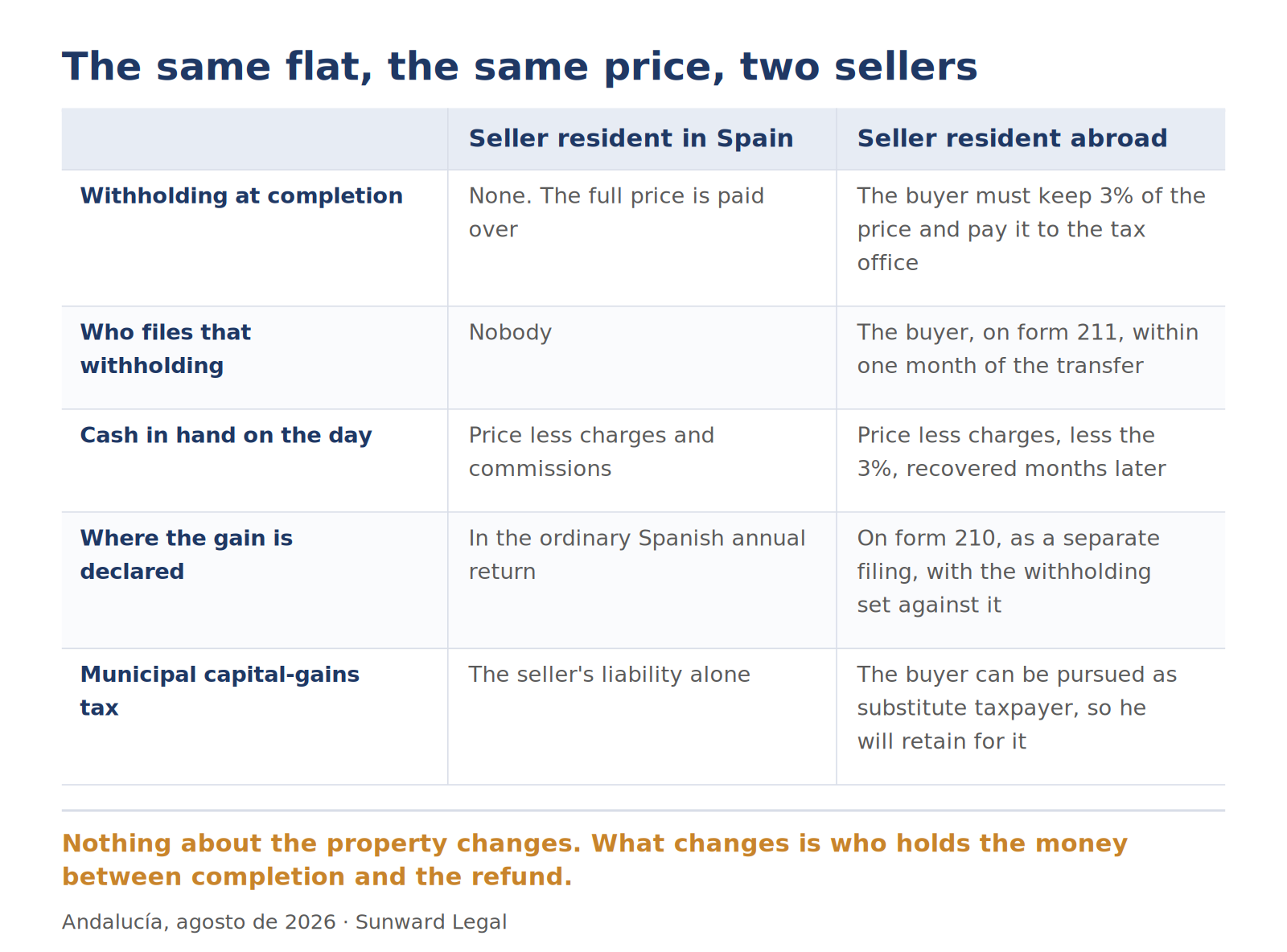
What actually changes when the seller does not live in Spain
Three things, and all three concern money rather than the property. The buyer becomes a collector of your tax. The town hall gains a second person to chase. And your gain is settled in a separate filing after completion instead of inside an annual return.
None of that alters what you are selling or how the deed is signed. It alters the arithmetic of the day. The 3% is not a cost — it is a payment on account of your own tax and any excess comes back — but it is money you do not have while it is out.
What comes out of the sale price, and when
| What leaves the price | When |
|---|---|
| 3% of the agreed price, withheld by the buyer | At completion; the buyer files form 211 within one month of the transfer |
| Any outstanding Spanish mortgage | At completion, redeemed out of the price before the balance reaches you |
| Community charges and IBI brought up to date | At or before completion; the community certificate is produced at the deed |
| Plusvalía municipal | Declared to the town hall after completion, and normally retained from the price at it |
| Non-resident income tax on the gain | Later, on form 210, with the 3% already paid set against what is due |
Obligations in force in Andalucía in August 2026. The rules behind each line are cited in full at the end.
The table leaves out the professional cost of a sale — agency, lawyer and the release of a mortgage — invoiced alongside the price rather than deducted from it.
The 3% the buyer keeps: what it is, and how the excess comes back
It is a payment on account, not a tax. Whoever acquires the property, resident or not, must withhold 3% of the agreed consideration and pay it to the Treasury on form 211, within one month of the transfer. It is credited against the non-resident income tax you owe on the gain.
The buyer hands you a copy of the filed form 211, and that copy proves the payment was made in your name: ask for it at completion, not afterwards. Recovery is not automatic — you claim it by filing form 210 for the gain, and any excess over the tax due is refunded.
That filing has a calendar of its own. The return for the gain is presented within three months once the one-month period allowed to the buyer has elapsed: the window opens a month after the transfer and closes four months after it, and it applies whatever the outcome — tax to pay, tax to reclaim, or nothing due at all. Sales sit outside the quarterly deadlines and the direct-debit arrangements that govern the rest of non-resident income, so a seller working to the calendar used for rent is working to the wrong clock, and the surcharge for filing late is calculated on a figure the size of a property gain.
The 3% is on the price, not on the gain: sell for less than you paid and it still leaves the table that day, coming back through the filing rather than at the notary. If the buyer fails to withhold, the exposure lands on him, because the property answers for the seller’s tax — one of the pitfalls of buying property in Spain seen from the other side.
How the gain is worked out, and what you have been paying meanwhile
The gain is taxed at 19%, and the 3% already withheld is set against it. Where two people own the property, each is a separate taxpayer and files separately.
That 19% does not depend on where you live. It is the same rate for a seller resident in the United Kingdom, in the United States or in Germany. Gains on the transfer of assets have a rate of their own in the non-resident tax, separate from the general rate that splits by country of residence.
What is taxed is the gain, not the price, and neither side of that subtraction is the figure on a deed. From the sale value you take off the expenses and taxes inherent to the sale that you bore, which for most sellers means the municipal capital-gains tax and the agency’s commission. To the purchase value you add the cost of improvements and refurbishment — not repairs and upkeep, which do not count — together with the expenses inherent to the purchase you paid at the time, notary, registry, *gestoría* and commissions, and the tax you paid on acquiring it, transfer tax and stamp duty, VAT, or inheritance tax where the property came to you through an estate. Interest is excluded. If the property has ever been let, you then take off depreciation, and the minimum depreciation comes off whether or not you ever claimed it.
Keep the invoices from the purchase and from every reform; nobody reconstructs them twenty years later.
Two reliefs stop at the EU border, and a British seller should not budget for either. The exemption for reinvesting the proceeds in a new main home reaches only sellers resident in the EU or the EEA. The reduction for property acquired before 1995 belongs to the personal income tax rules that the non-resident act extends to that same group.
The 19% on the gain is worth isolating, because it is not the rate you have been paying as an owner. A non-resident with a Spanish home declares an imputed income every year on form 210 whether or not it is ever let, and there the rate does turn on where you live: 19% for residents of the EU, Iceland, Norway and Liechtenstein, 24% for everyone else, which since Brexit includes the United Kingdom. Letting income follows the same split, and only the first group deducts expenses. A June 2026 order has reorganised the filing calendar for those categories, so a rental deadline you used two years ago may no longer be right.
Had an offer and not worked out your net? Book a free 20-minute call and we will map what leaves the price on the day and what comes back later, before you commit to a completion date.
Plusvalía municipal, and the two limits nobody mentions
The *plusvalía municipal* is the town hall’s tax on the increase in the value of the urban land between the two transfers, and on a sale the seller pays it unless the contract says otherwise. What matters to a non-resident seller is that the buyer is not a bystander.
Where the seller is a non-resident, the buyer is designated substitute taxpayer: if the tax goes unpaid, the town hall comes to him. Two limits define that, and almost no guide mentions either. The substitution operates only on transfers for consideration — not on a gift or an inheritance — and only where the seller is an individual. A non-resident company selling does not put its buyer in that position.
The calculation is friendlier than sellers expect. There are two methods, and the taxpayer picks: an objective one, land value multiplied by a coefficient depending on the years elapsed, currently from 0.14 to 0.45; and the real increase in the land value, where that is lower. Where there was no increase at all, the transfer falls outside the tax — but not automatically. It must be declared and proved with both deeds, and the comparison uses the values stated in the titles without counting the expenses and taxes of either transaction. Sellers routinely assume their costs of buying and selling turn a small gain into a loss. They do not. In Spanish: plusvalía municipal y el sustituto del contribuyente.
What the notary and the buyer’s lawyer will ask you for
A Spanish notary checks the registry immediately before the deed, identifies the parties and records how the price is paid. What the notary does not do is assemble the seller’s file. That comes from you, and the buyer’s lawyer will ask for it before fixing a completion date.
- The previous deed and the details of any mortgage to be cancelled.
- The community certificate stating what is owed, issued by the secretary-administrator. The buyer may waive it, and some do — which does not extinguish the debt: unpaid community charges follow the flat.
- The last IBI receipt. The property answers for the municipal tax years not yet time-barred, whoever ran them up.
- Evidence of your tax residence, because the 3% turns on residence, not nationality.
- The energy performance certificate. The seller must hold one, and it has to be lodged with the Andalusian register of energy certificates: what goes annexed to the sale contract is the registered copy with its label. It lasts ten years — five where the rating is G, which much of the coastal resale stock is, so a certificate issued six years ago may already be dead. Its absence neither invalidates the sale nor prevents the deed, but it is a sanctionable breach.
Nobody asks you about the buyer’s tax position, and it is worth knowing anyway: in Andalucía a resale is taxed at 7% on the higher of the price and the valor de referencia assigned by Catastro.
Selling without flying to Spain
A power of attorney signed before a notary in the United Kingdom and apostilled, or signed at a Spanish consulate, lets a lawyer in Spain grant the deed for you. It is the ordinary way a non-resident sale completes: the powers are set out specifically and the document has a time limit.
Draft it for the sale you are actually doing — the property named, a minimum price, receipt of the price, cancellation of any mortgage, the tax filings that follow. And keep your Spanish tax number and banking arrangements alive until the refund arrives: closing everything the week after completion is a familiar way to spend months chasing your own money.
What tends to go wrong
Two constructed situations, shown for the mechanism rather than taken from any real transaction.
The seller who budgeted the net wrongly. A flat bought in 2007 sells in 2026 for less than it cost. No gain, no tax — and the buyer still withholds 3% of the price at completion. It comes back by filing, not by arguing at the notary, and the seller had already committed those funds to a purchase elsewhere with a fixed date.
The retention nobody was entitled to. A property held through a non-resident company is sold, and the buyer’s side asks to retain against the plusvalía because the seller is a non-resident. The substitution does not reach a corporate seller — but only somebody on the seller’s side is going to say so.
Questions, answered
Do I still lose 3% if I sell at a loss?
You do not lose it, but you do part with it. The withholding is a percentage of the price, not of the gain, so it is taken whatever the outcome. Where no tax is due, or less than the amount withheld, the excess is refunded once the gain is declared on form 210.
Who really pays plusvalía municipal, me or the buyer?
You do, as seller. The buyer is only the substitute the town hall may pursue if it goes unpaid, and only where the seller is an individual and the transfer is for consideration. In practice the buyer retains the amount from the price and pays it, which protects both sides.
Does the price we agree affect the buyer’s tax?
Only upwards. His transfer tax is charged on the higher of the agreed price and the reference value published by Catastro, so a price below that value does not reduce what he pays. The value is public and can be checked before either of you negotiates.
The buyer has a lawyer. Do I need my own?
The buyer’s lawyer is protecting the buyer, and on this transaction the buyer’s main exposures are your withholding and your municipal tax. Nobody at that table is checking whether the sums retained from you are the right ones, whether the substitution applies at all, or whether your gain has been calculated in your favour. That is the work of a lawyer acting only for you.
Where to start
Before you accept an offer, establish three things: the reference value of the property, whether any part of the building was ever built without a licence, and what the community certificate will say. The first decides your buyer’s tax, the second whether he asks for a discount at the last moment, the third whether completion slips. All three are covered from the buyer’s side in the legal checklist for a Spanish holiday home. If what you are selling came through an estate, start with an inherited Spanish property instead.
Book a free 20-minute call, in English, Spanish or Swedish. Tell us the property, the price on the table and where you are tax resident, and we will tell you what leaves the price on the day and what comes back later. No obligation to instruct us.
General information about Spanish law, not advice on a particular transaction. Position in Andalucía on 15 August 2026; rates and filing calendars change. Sources: Real Decreto Legislativo 5/2004, texto refundido de la Ley del IRNR, arts. 24.4, 24.5, 25.1.a) and 25.1.f) and disposición adicional séptima, and Real Decreto 1776/2004, art. 14.4; Orden EHA/3316/2010, de 17 de diciembre, art. 5, in the wording given by Orden HAC/623/2026, de 12 de junio (BOE-A-2026-13573), and AEAT note on form 210 filing periods; Real Decreto 390/2021, de 1 de junio, arts. 3, 6, 13, 17 and 21, and Real Decreto Legislativo 7/2015, disposición adicional duodécima; Real Decreto Legislativo 2/2004, texto refundido de la Ley Reguladora de las Haciendas Locales, arts. 104.5, 106.2 and 107, as amended by Real Decreto-ley 26/2021; Real Decreto Legislativo 1/1993, art. 10, as amended by Ley 11/2021; Ley 5/2021 de Tributos Cedidos de Andalucía; Ley 49/1960 de Propiedad Horizontal, art. 9.1.e; Reglamento Notarial (1944), art. 175; Ley del Notariado, art. 24.