Yes. Spanish law puts no nationality condition on owning property, and as at 22 August 2026 no special purchase tax on non-EU buyers has been enacted — the one announced in early 2025 never became law. What buying does not do is give you any right to live here: the residence-by-investment route was repealed in April 2025, and a U.S. passport holder remains limited to 90 days in any 180.
Sunward Legal · Marbella. Last substantive review: 22 August 2026.
Is there any restriction on Americans buying in Spain?
Not on ownership. You can buy a home in Marbella on the same legal terms as a Spanish or French buyer: no permit, no quota, no minimum investment, no requirement to be resident.
Two things are worth knowing rather than worrying about.
The announced non-EU purchase tax. In early 2025 the Spanish government announced a charge aimed at property purchases by non-resident buyers from outside the EU, widely reported as a “100% tax”. As at 22 August 2026 nothing creating such a charge has been published in the official gazette. It is an announcement, not a law, and until that changes there is nothing to plan around. If it ever is enacted, it will be enacted with a date, and buyers will be able to see it coming.
The defence-zones rule. A 1975 statute on land in areas of interest for national defence requires prior military authorisation for acquisitions by non-EU nationals in certain designated zones — islands, border strips and a small number of coastal areas defined by regulation. EU citizens are exempt; Americans are not. This is a check that is run against the specific location of the property, not a general obstacle, and it is one of the reasons a purchase on this coast should begin with the land registry rather than with the listing. You can read the 1975 defence-zones law if you want the framework.
Buying does not give you residence
This needs saying clearly because a great deal of older content still implies otherwise. The golden visa — residence in exchange for a qualifying investment, including property — was repealed with effect from 3 April 2025. There is no property-based route to Spanish residence today, at any price.
What you have as an owner is what any visa-exempt visitor has: up to 90 days in any rolling 180-day period across the Schengen area. Since October 2025 that count has been recorded biometrically at the border under the EU’s Entry/Exit System, fully operational since April 2026, which replaced the passport stamp with an automatic calculation. In practice, the 90/180 limit is now enforced by arithmetic rather than by a border officer’s reading of ink.
If you want more than that, you apply for a residence permit on its own merits — and that decision has tax consequences that the purchase does not. Both are set out in what happened to Spain’s golden visa and moving to Spain from the U.S..
What you need before you can buy
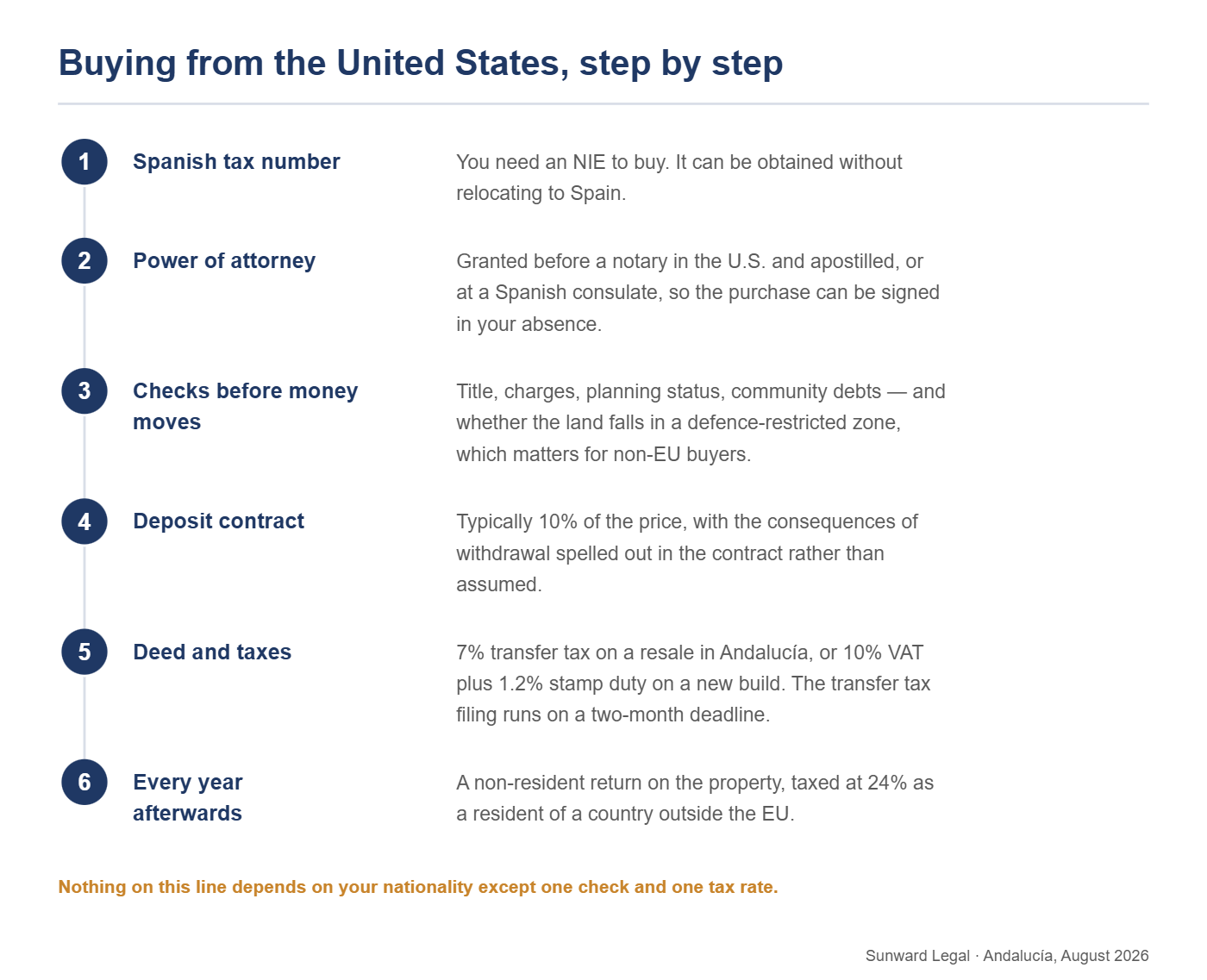
An NIE. The Spanish foreigner identification number is your tax identity here. Nothing — deed, tax filing, utility contract — happens without it, and it can be obtained without relocating.
A route for the money, and the evidence behind it. Spanish banks and notaries are both subject to anti-money-laundering obligations: they identify you, establish the beneficial owner where a company is involved, and need to understand where the funds come from. The means of payment are then recorded in the deed itself. Documenting the source — sale of a U.S. property, a documented savings history, a business sale, a properly evidenced gift — before the funds move is the single best way to avoid a delay at completion.
A power of attorney, if you are not flying over. You can confirm any country’s position on the Hague Apostille Convention status table. The United States and Spain are both parties to the Hague Apostille Convention, so a power granted before a U.S. notary needs an apostille and never consular legalisation; alternatively it can be granted directly at a Spanish consulate, which produces a document already in Spanish. Either way, the text should be drafted in Spain for this transaction, and it should cover the tax filings and registration as well as the signature. The mechanics are the same as for any remote buyer and are set out in the remote purchase.
Looking at a property from the U.S.? Book a free 20-minute call before you sign anything, and we will tell you what the checks on that specific property should cover. No cost, in English or Spanish.
What it costs
| Item | Resale | New build from a developer |
|---|---|---|
| Transfer tax (Andalucía) | 7% of the taxable base | — |
| VAT | — | 10% |
| Stamp duty (Andalucía) | — | 1.2% |
| Filing deadline for transfer tax | Two months from the transaction | — |
Two points about the base. Spanish transfer tax is not calculated on the price alone: the base is the reference value assigned to the property, and where the declared value or the agreed price is higher, the higher figure is taken. A price negotiated below the reference value does not reduce the tax.
As a market rule of thumb, budget 10–13% of the price on top for the whole purchase. That figure is an orientation rather than a legal rate, and it varies with the property and with financing. The difference between the tax percentages in the table and that total is the professional cost of the transaction — the notary, the land registry and your lawyer.
What you owe every year afterwards
This is the part American buyers most often do not know exists, and it has a rate attached that depends on where you live.
Spain taxes a second home that sits empty. The law imputes a notional income to a property at your disposal — 1.1% of the cadastral value where that value comes from a general revision in force in the last ten tax periods, and 2% otherwise — and taxes it. For a resident of a country outside the EU and the EEA, the rate is 24%. There is no deduction against it, and it is due whether or not you visit.
If you let the property, the same 24% applies, and here the non-EU position bites harder: expenses are not deductible. An owner resident in the EU deducts mortgage interest, community charges, IBI, insurance and repairs and pays 19% on the profit; an American owner pays 24% on the gross rent. The rules are on the Spanish tax agency’s page for non-resident landlords.
When you eventually sell, the gain is taxed at 19% — the same rate for every non-resident, regardless of country — and the buyer is required to withhold 3% of the price and pay it to the tax office on account of your tax. The whole annual picture is set out in the non-resident property tax return.
What goes wrong
The buyer who paid a reservation fee before anyone had seen the title. A property is held with a payment made on the spot, days before the paperwork is reviewed. If the title turns out to be encumbered, or an extension turns out to be unpermitted, the money is already committed and the negotiation is happening from the wrong side.
Debts that come with the property. Unpaid community charges attach to the flat itself for the current year and the three preceding calendar years, and unpaid local property tax attaches to the property too. The community’s certificate of debts must be produced before the deed can be authorised — but only someone acting for you will read it against what the seller said.
Assuming the notary is checking the deal. In a Spanish purchase the notary is impartial by design: they identify the parties, attest the deed and record the means of payment. They do not act for the buyer, do not negotiate and do not tell you whether the price or the property is a good idea. The agent is paid on completion and the developer is selling. The only person at that table working solely for the buyer is a lawyer the buyer instructs — which matters more, not less, when the buyer is on a different continent.
More of these are collected in the pitfalls of buying property in Spain.
Questions, answered
Do I need to be in Spain to buy?
No. The purchase can be completed by an attorney acting under a power of attorney granted in the United States and apostilled, or granted at a Spanish consulate. Most American buyers visit to see the property and complete remotely afterwards.
Do I need a Spanish bank account?
In practice yes, or at least a payment route that satisfies the notary and the utilities. The account also matters for the ongoing costs — community charges, local property tax, utilities — which are normally paid by direct debit in Spain.
Can I rent the property out on a short-term platform?
Subject to two layers of rules: a national registration number is required to advertise short-term rentals on platforms, and Andalucía has its own regime for tourist accommodation, with municipalities able to restrict it by area. On top of that, since April 2025 a community of owners can approve, condition or prohibit the activity by a qualified majority — and starting the activity now requires the community’s express prior approval. Check all three before buying with letting in mind.
Will buying property help a future visa application?
Not as a qualification. It may help incidentally — as evidence of accommodation, or as documented income if it is let — but no Spanish permit is granted because you own a home. Whether you need advice on the immigration side is addressed in do you need a Spanish immigration lawyer?.
Is there a tax when I bring the money into Spain?
No tax on the transfer of your own funds. What there is is scrutiny: the bank and the notary must be satisfied as to identity, beneficial ownership and source of funds, and the means of payment appear in the deed. The evidence is the work, not the tax.
Where this leaves you
The purchase itself is unremarkable, which is the reassuring part: no nationality barrier, no special tax in force, no minimum investment, and a process that can be run entirely from the United States through a properly drafted power of attorney.
Two things deserve your attention rather than the question you came here with. First, the checks on the specific property — title, charges, planning status, community debts, and the defence-zone question that only applies to non-EU buyers — all of which belong before the first payment, not after it. Second, the annual tax at the non-EU rate, which is small per year and unpleasant when discovered ten years late. Build both into the plan and the answer to “can Americans buy property in Spain” becomes a straightforward yes.
Book a free 20-minute call, at no cost, in English or Spanish. Send us the listing and tell us how you plan to pay, and we will tell you what to check before you commit anything.
General information on Spanish law, not advice on a particular transaction. It reflects the rules in force on 22 August 2026; rates and thresholds change. Sources: Ley 8/1975 de zonas e instalaciones de interés para la Defensa Nacional, arts. 16 and 18, and Real Decreto 689/1978, art. 32, on areas restricted to acquisition by foreign nationals, together with the disposición adicional added by Ley 31/1990 exempting EU nationals; Ley Orgánica 1/2025, repealing residence by investment with effect from 3 April 2025; Regulation (EU) 2018/1806, Annex II, and Regulation (EU) 2017/2226 (Entry/Exit System); Real Decreto 1155/2024, art. 205, on the NIE; Hague Convention of 5 October 1961 (Apostille); Ley 10/2010 de prevención del blanqueo de capitales, arts. 2 to 5, and Ley del Notariado, art. 24, on the identification of the means of payment; Ley 5/2021 de Tributos Cedidos de Andalucía, arts. 41, 43, 50 and 69; Ley 37/1992 del IVA, art. 91.Uno.1.7.º; Real Decreto Legislativo 5/2004 (TRLIRNR), arts. 13.1.h), 24.1, 24.6, 25.1.a), 25.1.f).3.º and 25.2; Ley 35/2006 del IRPF, art. 85.1; Ley 49/1960 de Propiedad Horizontal, arts. 7.3, 9.1.e) and 17.12; Real Decreto Legislativo 2/2004 (TRLHL), art. 64; Real Decreto 1312/2024, on the single registry for short-term rentals; Decreto 28/2016 of Andalucía, as amended by Decreto 31/2024. The announced purchase tax on non-EU buyers was verified as not enacted on 22 August 2026. The 10–13% total purchase cost is a market estimate, not a legal rate.