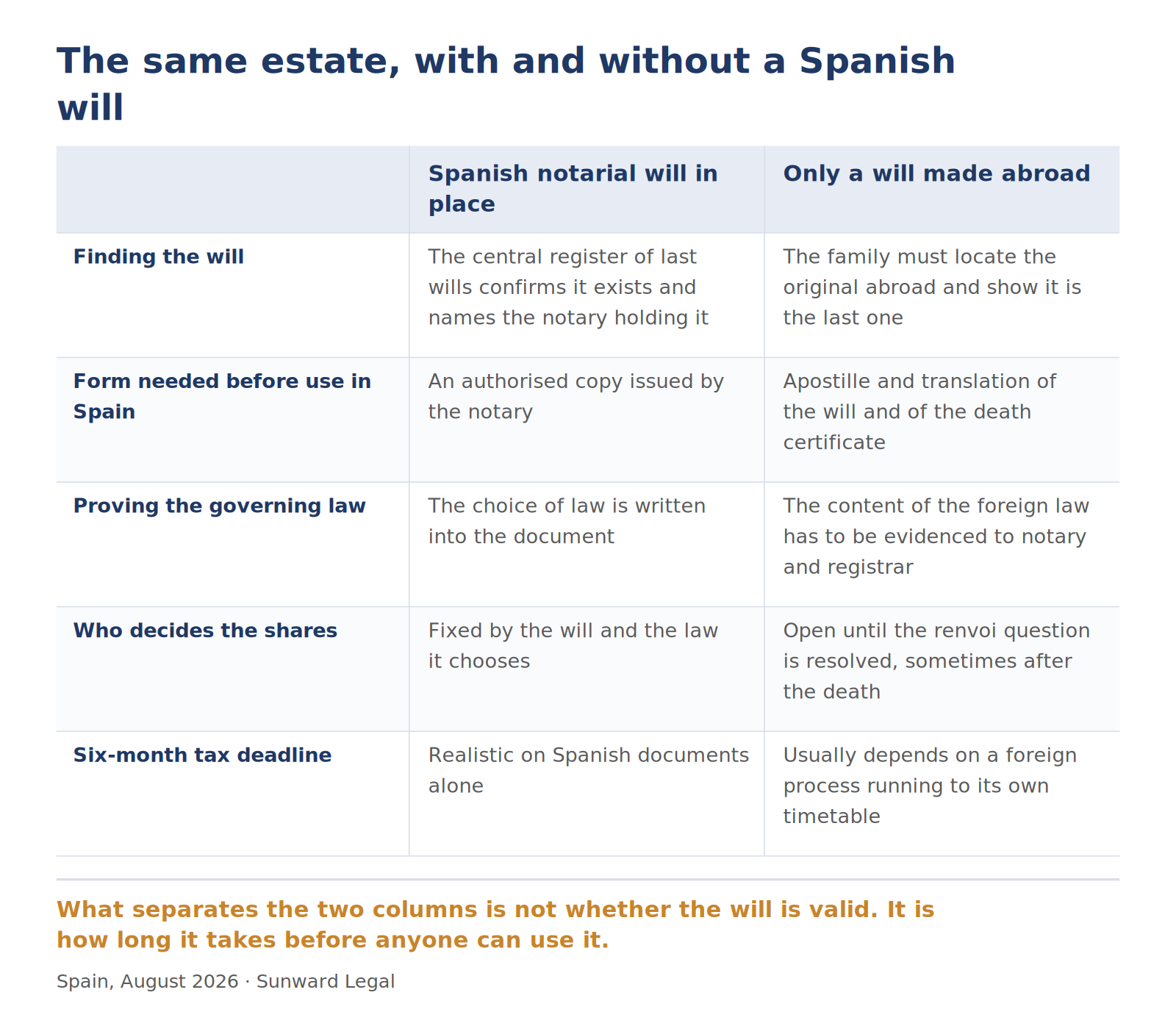
Nothing in Spanish law obliges you to make a Spanish will for a property in Spain: a will made in England can pass that flat to your children perfectly well. What a Spanish will changes is how long it takes them to prove it — and Spanish inheritance tax runs from the date of death, not from the day the English paperwork is done.
Sunward Legal · Marbella. Last substantive review: 15 August 2026.
Do you need a Spanish will if you own property in Spain?
No, not as a matter of law. Spain does not require a separate Spanish will, and a foreign will can transfer a Spanish property into your heirs’ names. The case for making one is practical: it is located within days, needs no apostille or translation, and it is where you record which law governs your estate.
Two questions get run together. Whether the will is valid in Spain is a matter of form, and one properly executed in England normally clears that bar. Whether it is usable is what your family meets: the months and certified documents between the death and the deeds changing hands.
So: optional in law, worth having in most cases. Spanish wills for non-residents cover only assets in Spain, and that limitation is the point of them. When one adds nothing is set out in the companion piece on English wills and Spanish property.
What is a testamento abierto, and what does the register of last wills do?
The usual form is the testamento abierto, an open will drafted and authorised by a notary, who keeps the original in his protocol and notifies the central register of last wills. Your heirs never hold the document: they obtain an authorised copy.
That register is what British owners underestimate. After a death, anyone with a legitimate interest obtains a certificado de actos de última voluntad, stating whether the deceased made a Spanish will and before which notary, on form 790, fee code 006. It cannot be requested until fifteen working days after the death, and those three weeks come out of the six months your family has to declare the tax.
A notarial will is also a Spanish public document, so it feeds into the deed of acceptance with no apostille, no translation and no foreign law to prove to a notary and a registrar. The official European description of Spanish succession procedure treats it as the ordinary way of making a will.
Why the six-month tax clock decides this
Spanish inheritance tax is self-assessed within six months of the date of death, counted date to date. Not six months from probate, nor from the day the family instructs a lawyer in Spain. An unadministered estate stops nothing.
| Point in the timetable | What it means |
|---|---|
| Date of death | The six months start, date to date, not in working days |
| Fifteen working days later | Earliest the certificate of last wills can be requested |
| First five months | The only window to ask for an extension |
| The extension | A further six months, carrying late-payment interest |
| Filing late, no demand | Surcharge of 1% plus 1% per full month; 15% plus interest after twelve |
Deadlines in force in August 2026 under the Spanish inheritance tax regulation and the general tax rules. The extension buys time; it does not stop interest.
The extension catches families out, because it has to go in before anyone knows how long the English side will take. What the tax itself costs is covered in Spanish inheritance tax for non-residents; in Andalucía children, spouses and parents take a 99% reduction of the bill on top of a €1,000,000 allowance each, so what is really at stake in being late is the file it opens, not the money.
Can you choose English law, and what does that choice actually do?
You can direct that the law of your nationality governs your whole estate, and a Spanish will is the natural place to say so. That choice does something less obvious than picking a legal system: it switches off the mechanism that would otherwise send your Spanish property back to Spanish law.
The default first. Under the European succession regulation, your estate is governed by the law of the country where you were habitually resident when you died — not your nationality, and not where the property is.
Now the finding worth more than anything else here. The United Kingdom never took part in that regulation, and this has nothing to do with Brexit. It opted out at the outset, under the protocol that kept it outside this area of European cooperation, and used that opt-out in 2012. Spain applies the regulation anyway, because it is universal: a Spanish notary applies whatever law it designates, including that of a non-member state.
What you may choose is narrower than most people assume:
- The law of a nationality you hold, when you choose or when you die. Dual nationals may take either.
- Not the law of where you live or where the property sits. A British national who is not also Spanish cannot choose Spanish law — and if he lives in Spain, Spanish law applies by default anyway, so his only choice is the reverse one.
- The choice must be express in the will, or clear from its own terms. A letter of wishes will not do it.
Then the part that is genuinely mis-told. Where nobody chose a law and English law applies because the deceased lived in England, the regulation takes English private international law into account too, and the conflict rule understood to apply there sends immovable property to the law of the place where the land is — back to Spain. Hence the line you read everywhere: choose English law, and Spanish law claws the house back anyway. It is wrong for the very case it is attached to. Where the choice of law is express, the regulation shuts that return route off, and English law governs the Spanish property with no bounce back. Renvoi belongs to the no-choice scenario, and even there the Spanish Directorate-General has resisted a renvoi that would split one estate into two governing laws.
One caveat, plainly: that description of the English conflict rule is settled in Spanish practice rather than in a British statute we can point you to, and a solicitor in England should confirm it. The Spanish notary will not, because he is impartial by office — authorising a valid document is not the same job as working out which system leaves your family better off.
Does choosing English law get rid of the Spanish forced share?
Largely yes, with a reservation nobody should hide. The regulation gives the governing law authority over both the freely disposable part of an estate and any reserved shares, so if English law governs, the reserved shares of the Spanish Civil Code do not apply. What stays open is the public policy limit.
Under the Spanish Civil Code, two thirds of the estate are reserved for children and descendants: one third is the strict share, split equally between them, and the other is the tercio de mejora, which the parent may share out among children or descendants unequally. The remaining third is free. A surviving spouse who is not separated takes a life interest, a usufructo, over one third where there are children, half where there are only ascendants, and two thirds where there are neither. Those are Civil Code rules, which govern in Andalucía; several regions have their own succession law, where the reserved share is very different or barely exists.
Now the honest part. The regulation lets a court disapply the designated law only where applying it would be manifestly incompatible with Spanish public policy, and that word is doing deliberate work. The exception also may not be used against the Charter of Fundamental Rights, non-discrimination in particular, which steers it towards foreign rules that discriminate by sex, birth or religion rather than towards a system that simply has no reserved share.
What we have not found is a Spanish Supreme Court ruling settling whether the reserved share forms part of Spanish international public policy. Much published material states confidently that it does not. That is a well-argued position, not a closed point of law, and a disinherited adult child who litigates is arguing where more than one reading is reasonable.
Not sure whether your will chooses a law at all? Book 20 minutes and we will read it and tell you what it does to the Spanish property. Free, in English, Spanish or Swedish.
How do you keep the Spanish will from revoking the English one?
With an express scope clause, and it is the most important line in the document. A Spanish will drafted without one can revoke every earlier will you have made, including the English will covering your house, your pension and your children’s inheritance.
The clause has two limbs and both are needed. The first states that the will governs only assets situated in Spain. The second states that it does not revoke dispositions made over assets outside Spain. Boilerplate reciting that all previous wills are revoked achieves the opposite of what the testator wanted, and it does so silently: nothing goes wrong until he is dead and cannot explain what he meant.
So whoever drafts the Spanish will needs a copy of the English one in front of them, not a recollection of it. The reverse risk — an English will rewritten later that carries away the Spanish one — is dealt with in the article on holding two wills over one estate.
What happens if you leave no will at all?
The property still passes to someone. You simply do not choose who, it takes considerably longer, and the renvoi question opens up because there is no choice of law to close it.
The heirs need a declaración de herederos, a formal declaration of who inherits, drawn up by a notary as an acta de notoriedad. Since a reform of Spanish voluntary jurisdiction procedure in 2015 this is notarial in every case, brothers, nephews and nieces included; the claim that collateral relatives need a court in Spain has been out of date for a decade.
There is a jurisdictional trap in it. The notary who can act is the one where the deceased last lived, or where he died, or where the greater part of his estate lies — in Spain. Someone who lived and died in England may satisfy none of those except the last, so the connecting point becomes where his Spanish assets are. The full sequence is in Spanish probate.
What tends to go wrong
Two situations, constructed to show the mechanism rather than taken from any real estate.
The choice of law nobody made. An owner living in England leaves everything to a second wife, with two adult children from a first marriage, and his will chooses no law. English law is designated by his residence, but for the Spanish flat renvoi is live: if the return to Spanish law is accepted the children have a claim over it, and if it is refused as fragmenting the estate they do not. One line in the will would have removed the question.
The extension nobody asked for. Death in January, the English administration running its normal course, and a family assuming the Spanish deadline waits for it. It does not, and by the time anyone looks the five-month window has closed. In Andalucía the cash consequence is modest; what matters is the file it opens with the tax office.
Common questions
Can I choose Spanish law for my estate instead of English law?
Only if you hold Spanish nationality. The regulation lets you choose the law of a nationality you have, at the time of choosing or at death, and nothing else. If you are habitually resident in Spain, Spanish law already applies to your whole estate by default, and the choice open to you is English law.
Does a Spanish will have to be written in Spanish?
The notarial record is kept in Spanish. If the notary does not speak your language, an interpreter chosen by you translates your dispositions, and the will is written out in both languages, noting which one you used. In a will that double text is required even where the notary does speak your language. In other deeds a two-column version is a right you may ask for, whether or not you speak Spanish.
If I move to Spain permanently, does my English will stop working?
It does not stop being a will. What changes is the law governing your estate: once you are habitually resident in Spain, Spanish law applies to all of it unless the will chooses English law expressly. A will drafted on the assumption that English law applies is then read against a system with reserved shares.
Can I make a Spanish will if I do not live in Spain?
Yes. Residence is not a requirement, and most Spanish wills made by British owners are granted by non-residents over Spanish assets only. It is done at a notary’s office in Spain, so in practice it is fitted into a trip that was happening anyway — often the same one as completion on the purchase itself.
Where to start
Find out whether the will you already have makes a choice of law, and what it says about scope. Decide which system you want governing the estate and record that expressly, rather than leaving it to be reconstructed after your death. Then make the Spanish will limited to Spanish assets, drafted so both documents can live together. There is a Spanish-language article on wills granted outside Spain for a family member who would rather read it in Spanish.
Book 20 minutes, free, in English, Spanish or Swedish. Bring the will you have and the deeds to the Spanish property, and we will go through what a Spanish will would change for your family — and what it would not.
General information on Spanish law, not advice on a particular estate. It states the position in force on 15 August 2026; tax rates, deadlines and administrative requirements change. Sources: Regulation (EU) No 650/2012 on succession, arts. 20, 21, 22, 34 and 35; Código Civil, arts. 684 and 808 and the provisions on the surviving spouse’s life interest; Reglamento Notarial, art. 150, as drafted by Real Decreto 45/2007; Real Decreto 1629/1991, Inheritance and Gift Tax Regulation, arts. 67 and 68; Ley 58/2003, General Tributaria, art. 27; Ley 5/2021 of Andalucía on assigned taxes; Ley del Notariado, arts. 55 and 56, as amended by Ley 15/2015 on voluntary jurisdiction; Resolution of the Directorate-General of 2 March 2018 (BOE of 20 March 2018).