If you have inherited a property in Spain, the first job is not to find an estate agent. It is to start the paper chain and put one date in the calendar: the Spanish inheritance tax falls due six months from the date of death, and that period runs whether or not the estate has been divided and whether or not the English grant of probate has come through. Everything below is arranged around that date.
Sunward Legal· Marbella. Last substantive review: 15 August 2026.
What to do in the first three weeks
Five things, and none of them costs much. Order several copies of the death certificate and have them apostilled. Find out whether there is a Spanish will. Start the application for a Spanish tax number for every heir. Keep the property’s bills paid. And fix the six-month date in writing.
The search of the Spanish register of wills sets the pace, because it cannot be requested until 15 working days have passed since the death. With weekends and holidays that is about three weeks gone before anyone knows whether the deceased made a Spanish will — and that single fact decides whether the next step is an authorised copy of a will or a notarial declaration of heirs. The request goes to the Ministry of Justice on form 790, fee code 006, with the death certificate attached.
The Spanish tax number is the step people leave until last and regret: no heir can file an inheritance tax return without one. If you are applying from the United Kingdom, the routes and their realistic timings are in our note on getting a Spanish NIE number from the UK.
Which documents you need from the UK, and which need an apostille
Three documents travel from the United Kingdom, and each needs an apostille and a Spanish translation before a Spanish notary or registrar will look at it: the death certificate, the will, and — where the estate is being administered through executors — the grant of probate.
The apostille is the certificate that makes a foreign public document usable abroad, under a 1961 convention to which both countries are party; Spain’s side of it is described by the Ministry of Justice. There is one shortcut that British papers cannot use: the EU rules exempting certain public documents from legalisation between member states do not cover documents issued in the United Kingdom.
Then the translation into Spanish. Who may produce it — a sworn translator, or another route the notary will accept — is worth confirming before you pay for it, because a translation that has to be redone costs weeks rather than money.
A point that saves families a great deal of time: you do not need the grant of probate to inherit the Spanish property. Spanish practice treats the will as the title and the grant as a British administrative step. Where the will is built around executors, the British documents do matter, and they have to be turned into Spanish registry language. The case law behind that is in our note on Spanish probate.
The bills that keep arriving: IBI, community and the frozen account
Nothing stops because the owner died. The IBI, the annual municipal property tax, falls due on its usual date. The comunidad de propietarios, the owners’ association of the building, goes on levying its periodic charges. Spanish banks will normally block the deceased’s account once they are told of the death, so the direct debits that used to pay both simply start bouncing.
The result is a quiet accumulation of arrears against a property nobody has yet inherited, and it surfaces when a buyer’s lawyer asks the administrator for a certificate of debt. Somebody has to keep those bills paid from another source meanwhile, and keep the receipts. It is also worth giving the administrator a contact who reads the post.
The tax date, and what happens if the six months have gone
The return is due six months from the date of death. Under the inheritance tax regulation it can be extended once, by a further six months, but only if the extension is applied for within the first five months, and it carries late-payment interest. From the first day of the fifth month there is nothing left to apply for.
If that date has already passed, the position is better than most people fear, and the reason is that a late return filed before the tax office asks for it attracts a surcharge, not a penalty.
| When the return is filed | Surcharge on the tax | Late interest |
|---|---|---|
| Within the six months | None | None |
| Late, before any request from the tax office, up to twelve months | 1%, plus 1% for each complete month of delay | None |
| Late, more than twelve months after the deadline | 15% | Yes, from the end of the twelfth month |
Two things that table does not show. The surcharge is reduced by 25% if the surcharge and the tax are paid within the periods given and the assessment is not appealed. And the scale changed in 2021: the old one, of 5%, 10%, 15% and 20% by tranches, is still republished on a good many websites and is out of date.
Now the part that matters here. These surcharges are percentages of the tax due — and for close family in Andalucía the tax due is often very small, because of the reductions and the 99% relief explained in our note on Spanish inheritance tax for non-residents. A late filing there costs little in euros. What it does is open a file in your name at a tax office you have not yet dealt with.
One fear behind that question deserves a direct answer, because it is what stops people filing at all. The Andalusian rules do not make the 99% relief conditional on filing within the six months. Neither the regional legislation nor the Junta’s published material on inheritances attaches any such condition — while the same material does spell out the formal conditions on the parallel relief for lifetime gifts, which must be made by public deed with the origin of the money evidenced in it. That contrast is a strong indication rather than a sentence anyone can quote at you, so treat it as the working position and not as a guarantee. What filing late certainly costs is the surcharge in the table above, and the extension you can no longer ask for.
Has the six-month date already passed? Book a free 20-minute call and we will tell you what filing late now actually involves in your case, and in what order to do it.
Several heirs, and one of you does not want to sell
The deed of acceptance is signed by all the heirs, in person or through an attorney. There is no majority in it: one heir who will not sign is enough to stop the deed, and without the deed nobody is registered as owner and nothing can be sold.
The two problems are separate, though, and it helps to keep them apart. Each heir has their own tax return and their own six-month deadline, and those deadlines run whether or not the family agrees on what to do with the flat. One heir’s refusal to sell does not suspend another heir’s filing obligation.
Where a deadlock is real, the cheapest resolution is usually the one nobody proposes first: one heir buys out the others at a valuation both sides accept. It is worth pricing that early, because contentious routes are slow and the property still has to be maintained while they run.
Can you renounce? And what renouncing actually does
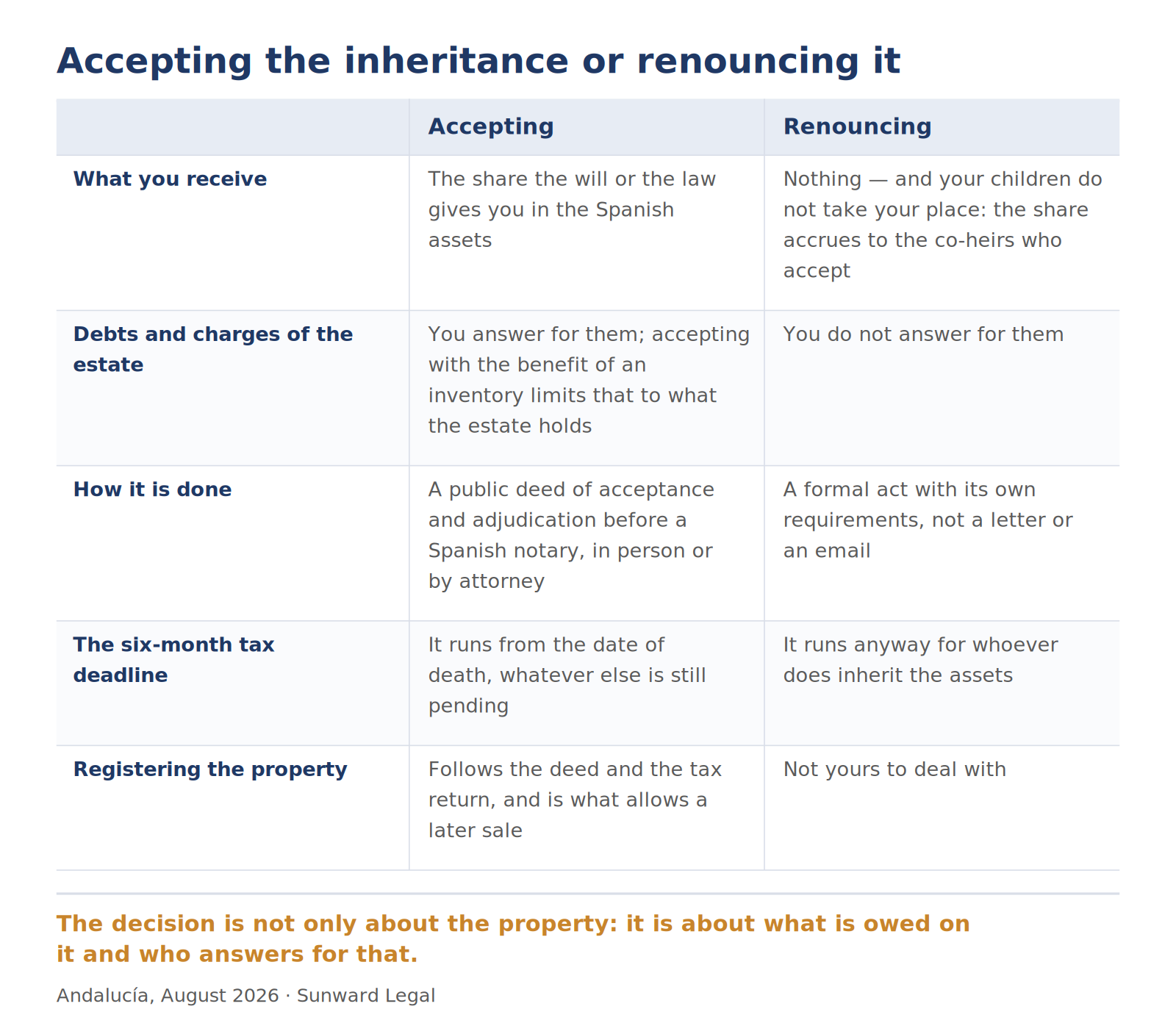
Yes. Nobody is obliged to accept an inheritance, and renouncing is a genuine option when what is attached to the property is worth more than the property. What it is not is a gesture: renouncing is a definitive act that puts you outside the succession altogether, and it binds your line as well as you. It also has to be done in the form the law requires — a renunciation is not something that can be left in an email — so agree how it will be documented before anyone commits to it.
Two consequences catch people out, and both are settled. Your children do not step into your place. The share you give up does not pass down to your descendants by representation, which operates where an heir is disinherited or is incapable of inheriting, not where he renounces of his own accord. The share accrues to the co-heirs who do accept, and it does so by their own right. Renouncing “in favour of the children” therefore does not do what the phrase suggests.
And renouncing *in favour of a named person* is not a renunciation at all. Designating a beneficiary is read as accepting the inheritance first and then giving it away — with the tax and registry consequences of two operations rather than one. Which of the two you have signed is decided by the wording of the clause, not by what you meant.
Before renouncing, though, it is worth knowing that Spanish law has a middle option, and that it is usually the one the situation actually calls for. An inheritance can be accepted a beneficio de inventario, with the benefit of an inventory, and then the heir is not obliged to pay the debts and charges of the estate beyond what the estate itself contains. Accepted pure and simple, by contrast, the heir answers for those debts with their own assets too.
That is the outcome British families do not see coming, because in England the executor settles the debts out of the estate and the beneficiary never becomes personally liable. The benefit of inventory has short time limits and strict formalities, so it is a decision to take before signing anything, not after.
Questions, answered
Do we have to travel to Spain?
No. It is normal for heirs abroad to sign a power of attorney before a notary where they live, have it apostilled and send it to Spain, so that the deed of acceptance, the tax return and the registration can all be handled without a flight. Make sure the power covers all three, not just the deed.
Can we sell the property to pay the inheritance tax?
Not before the estate is wound up. A buyer acquires from whoever appears on the Land Registry, so the heirs have to be registered as owners first, and that comes after the deed and the tax return. If the family will be selling afterwards, the sequence is set out in our note on Spanish conveyancing.
Do we pay Spanish tax on the whole estate or only the Spanish part?
Only the Spanish part, where neither the deceased nor the heir lived in Spain. Spain then taxes by what is called real obligation: the assets situated in Spain, typically the property and any Spanish bank accounts. The house in Surrey and the UK pensions are outside the scope of the Spanish tax.
The property has a Spanish mortgage. What happens to it?
It does not disappear on death, and it stays attached to the property. This is the clearest case for taking advice on the benefit of an inventory before accepting, and for finding out what is actually outstanding before anybody signs a deed.
Should we now make a Spanish will of our own?
If you end up owning property in Spain, yes — it is the difference between an heir signing a deed within the six months and an heir waiting on apostilles. The reasons, and what such a will should and should not say, are in our note on Spanish wills.
Where to start
For a UK resident inheriting property in Spain, two things decide how smoothly this goes: the calendar and the paperwork. If the death was recent, the order is: apostilled death certificates, the register of wills once the fifteen working days have run, a Spanish tax number for each heir, and a decision in month four on the extension. If it was some time ago, the question is a different one — what the position is now, and whether filing before anyone asks is better than waiting, which it almost always is.
And one thing worth saying plainly. The notary attests, the tax office collects, the estate agent sells, the community administrator answers to the building. None of them acts for the heirs; that is the job of the lawyer the heirs instruct.
Book a free 20-minute call, in English, Spanish or Swedish. Tell us the date of death, what is in Spain and what stage the UK side has reached, and we will set out the order of work and the dates that bind you.
General information about Spanish law, not advice on a particular estate. It reflects the rules in force in Andalucía on 15 August 2026; tax rules and administrative practice change. Sources: Real Decreto 1629/1991, arts. 67 and 68, on the six-month period and the extension; art. 27 of the Ley 58/2003 General Tributaria, as drafted by Ley 11/2021, on surcharges for late filing without prior request — see the General Tax Act; Ley 29/1987 del Impuesto sobre Sucesiones y Donaciones, arts. 6, 7 and 8 and disposición adicional segunda; Ley 5/2021 de Tributos Cedidos de Andalucía, art. 39, on the 99% relief in acquisitions mortis causa; Código Civil, arts. 929 and 985, on representation and on the accrual of a repudiated share; Hague Convention of 5 October 1961 on the Apostille (BOE-A-1978-24413); Reglamento (UE) 2016/1191, which does not extend to documents issued in the United Kingdom; Resolutions of the Dirección General de Seguridad Jurídica y Fe Pública of 15 June 2021 (BOE-A-2021-11271), 31 July 2025 (BOE-A-2025-21885), 17 December 2025 (BOE-A-2026-6834) on the effects of repudiation, and 19 February 2026 (BOE-A-2026-12774) on renunciation in favour of a named person. The tax authority’s own guidance for non-residents on inheritance tax is published by the AEAT.