Both halves of that question have the same answer, and it is the less useful half. An English will is normally valid in Spain as to form; a Spanish will covering only Spanish assets never has to be produced in England. What decides your family’s next six months is whether the will can be used here, and whether one of them quietly cancelled the other.
Sunward Legal · Marbella. Last substantive review: 15 August 2026.
Is a Spanish will valid in the UK, and is an English will valid in Spain?
Usually yes in both directions, and that settles less than it seems to. Form is governed by an international convention that binds both countries, and it validates a will on so many alternative grounds that most foreign wills clear the bar comfortably. Who inherits, and how long it takes, are other questions entirely.
Under the 1961 Hague Convention on the form of testamentary dispositions, a will is formally valid in Spain if it complies with the internal law of any of several connections: where it was made, the testator’s nationality, domicile or habitual residence — each tested when he signed or when he died — and, for immovable property, where the property is. An English will signed in England by a British national living there satisfies four at once. Nothing in Spanish law requires a separate Spanish will. The convention also covers the revocation of earlier wills, which comes back below.
And that convention is not a Spanish peculiarity, which answers the other half of the question directly. The United Kingdom has been bound by it since 5 January 1964 — twenty-four years before Spain, whose own entry into force was 10 June 1988. Brexit changed nothing here: this is a Hague Conference treaty, not an EU instrument. So a Spanish notarial will is formally valid in the United Kingdom on the same alternative connections, and no separate British test of form has to be satisfied. The point rarely comes up in practice, because a Spanish will made by a non-resident disposes of Spanish assets only and is not lodged in England, but the answer is a straight yes rather than an open question. Both ratifications appear in the convention’s official status table.
Valid is one thing. Usable is what your family meets
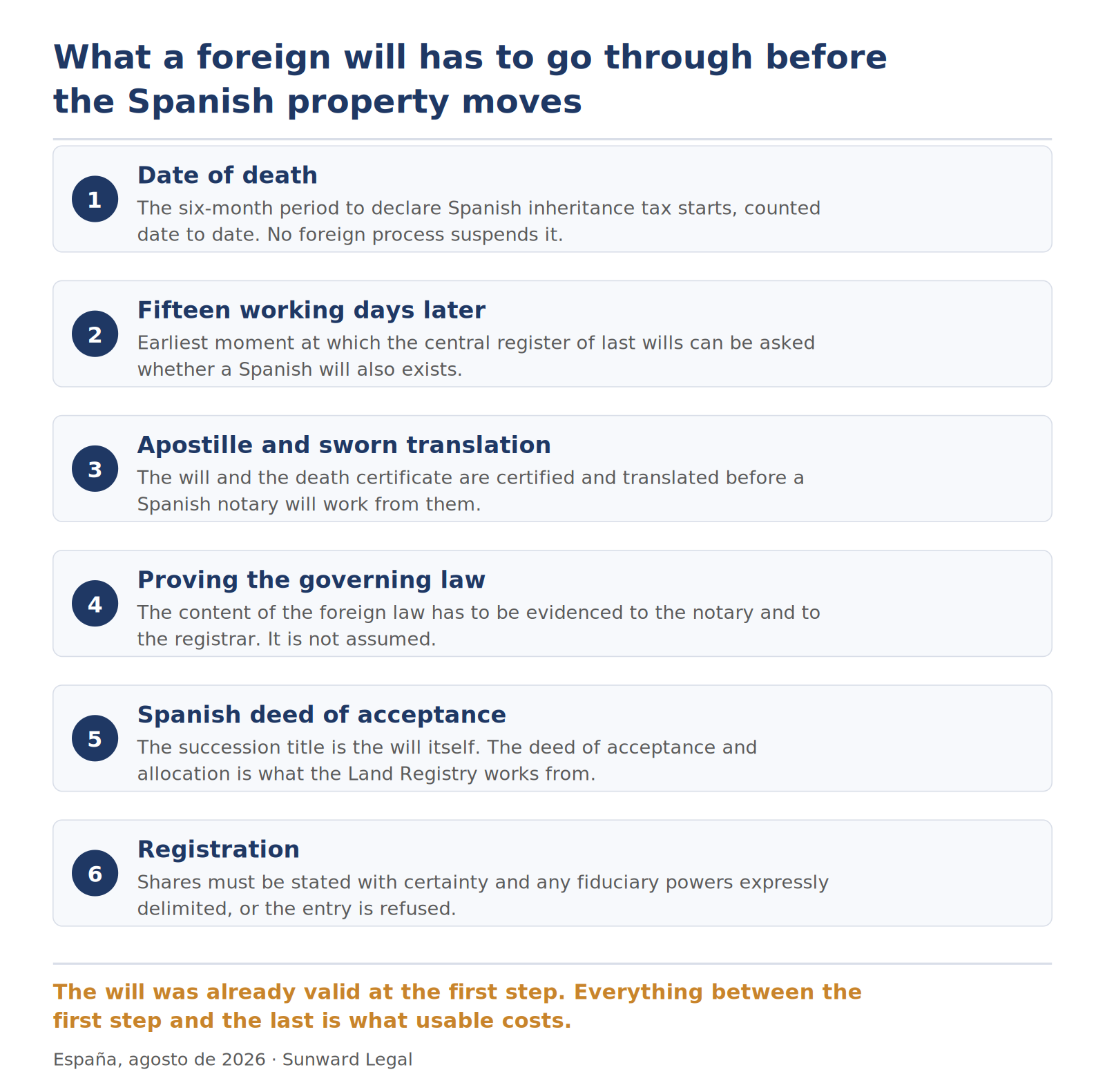
Usable means a Spanish notary will draw a deed from the document and a registrar will accept it. That is a different bar, and clearing it takes weeks while the tax deadline runs — six months from the death, counted date to date.
Four things stand in the way. The will and the death certificate must be apostilled and translated. The content of the governing foreign law must be evidenced to notary and registrar, neither of whom is expected to know it. The estate must be accepted and allocated by a Spanish public deed. And first the family checks whether a Spanish will also exists — a request to the central register of last wills that cannot be made until fifteen working days after the death.
That list is what each Spanish official separately requires, and is a professional assessment rather than a line in a statute. The calendar is not: an unadministered estate stops nothing, and an extension must be applied for within the first five months or not at all. Timetable and surcharges in Spanish probate.
Does the Spanish Land Registry need an English grant of probate?
No. The Spanish Directorate-General responsible for the Land Registry has held repeatedly that in English law the succession title is the will, and that probate winds up the estate in the United Kingdom in a way with no counterpart here. A registrar cannot require the grant, nor an English executor’s intervention.
That doctrine is often taken further than it goes: it does not say the grant is useless, it says the grant is not the title. Where the English will works through executors holding on trust — ordinary English drafting, alien to Spanish conveyancing — the British documents do matter. In a decision of 31 July 2025 the Directorate-General accepted that the executors’ fiduciary ownership could in principle be registered, then imposed the Spanish conditions: shares determined beyond doubt, powers expressly delimited. “In administration” was not enough.
The practical consequence is the one nobody mentions: families routinely wait for the English grant before instructing anyone in Spain, and the Spanish property never needed that wait. Whether the English side can move first is for a solicitor there.
Holding an English will and a Spanish deed, unsure how they fit? Book 20 minutes, free, in English, Spanish or Swedish. Send us both and we will tell you what the Spanish property actually needs.
Two wills over one estate: when they live together, and when one kills the other
They live together when both say so expressly, and only then. The risk is not that a court declares one invalid. It is that a standard revocation clause in the later document wipes out the earlier one silently, and nobody finds out until the testator is dead and cannot explain what he meant.
The convention that saves the form of a foreign will is equally generous to revocations. A later English will revoking “all former wills and testamentary dispositions” can revoke a Spanish will made three years earlier, and the English side has no reason to spot it: the Spanish will sits with a notary here and in the register of last wills, not in the file of whoever drafted the replacement. The mirror image is Spanish boilerplate carrying away the English will covering house, pension and children.
Both are prevented by the same two sentences: each will is limited to the assets of its own country, and each says expressly that it does not revoke dispositions elsewhere. Whoever drafts the second needs the first in front of him, and neither the notary in Spain nor the solicitor in England is reading the other document unless somebody puts it there — the one job at the table which belongs to the family rather than to a transaction. In Spanish: el testamento otorgado fuera de España.
Your English will may already choose a law, even if it never says so
By default your whole estate is governed by the law of the country where you were habitually resident when you died, under the European succession regulation, which Spain applies to a British estate whatever law it designates. What you may choose instead is narrow: the law of a nationality you hold — not where you live, and not where the property sits.
The choice must be express in the will or clear from its own terms, and that second limb is where an old document surprises people. Choices made before the regulation began to apply on 17 August 2015 were carried over, and the Directorate-General has found an implied choice of English law in a will granted in Spain in 2004 by a British national, on the strength of how it was drafted. A will written when none of this existed may already contain the most important decision in it — or nothing, which is a different problem and not a smaller one. What choosing English law does to the Spanish reserved shares is worked through in the companion piece.
The difference shows up as *renvoi*, the return of a question to another legal system. With no choice made and English law applying by residence, the English conflict rule is understood to send immovable property back to the law of the place where the land is, and the Spanish authority must take that return into account. An express choice shuts the route off. One caveat: that description of the English rule is settled in Spanish practice rather than in a British source we can hand you.
What tends to go wrong
Two constructed situations, not drawn from any real estate.
The replacement will nobody cross-checked. A Spanish will is made in 2011 over an apartment in Andalucía. In 2024 the English will is rewritten after a second marriage, on a precedent revoking all earlier dispositions. On the death the register of last wills reports a Spanish will, and the family finds it was revoked from another country. At best a delay, at worst an intestacy over the flat.
The will that leaves everything to the executors. An English will leaves the residue, Spanish flat included, to two executors on trust until the youngest child is twenty-five. Formally valid, impossible to register as drafted: no fixed shares, powers in general terms. The deed is redone after the six months have gone.
Questions, answered
Does making a Spanish will revoke my English one?
Only if it says so — and standard revocation wording says so by default. A Spanish will limited expressly to Spanish assets, stating that it does not affect dispositions elsewhere, leaves the English will intact. Without those words the risk surfaces too late to fix.
Can the Spanish property be dealt with before the English grant issues?
For Spanish registration purposes, yes: the grant is not the succession title and cannot be required. The Spanish deed is drawn from the will itself, apostilled and translated. Whether the executors can act on the English side beforehand is a question for a solicitor there.
Can my English executors sign the Spanish deed?
They can take part, but the deed must state certain shares and set out their powers expressly rather than describing an administration. Reproducing the English wording and stopping there is a common reason registration is refused.
My English will was made before 2015. Is it out of date for Spain?
Not automatically, and it may be better than a newer one. Choices of governing law made before 17 August 2015 were carried over, so a will drafted then can carry an implied choice that still works. Nobody knows which yours does until it is read.
When a Spanish will earns its keep, and when it adds nothing
It earns its keep when there is a choice of law to record, when there are several beneficiaries or unequal shares, when the English will works through trusts or executors that will not map onto a Spanish registry entry, and whenever the alternative is your family reconstructing your intentions from a foreign document.
It adds nothing in a narrower case than most people are told: one flat, one adult beneficiary taking it outright, an English will that already chooses a law and limits its scope. There a Spanish will saves certification, translation and proof of foreign law — real weeks — but it does not change who inherits and does not reduce the tax. Anyone who tells you a Spanish will is compulsory is wrong, and was wrong when the property was bought too.
Book 20 minutes, free, in English, Spanish or Swedish. Bring the will you already have and we will tell you whether it chooses a law, whether it covers the Spanish property, and whether a second will would change anything — including when the answer is that it would not.
General information on Spanish law, not advice on a particular estate. Position on 15 August 2026; deadlines and requirements change. Sources: Convenio de La Haya de 5 de octubre de 1961 sobre los conflictos de leyes en materia de forma de las disposiciones testamentarias, arts. 1 and 2 (BOE-A-1988-20377), and the HCCH status table for that convention (United Kingdom: ratified 6 November 1963, in force 5 January 1964; Spain: in force 10 June 1988); Convenio de La Haya de 5 de octubre de 1961 suprimiendo la exigencia de legalización de documentos públicos extranjeros (BOE-A-1978-24413); Reglamento (UE) 650/2012, arts. 20, 21, 22, 34, 35 and 83.2; Resoluciones de la DGSJFP de 15 de junio de 2021 (BOE-A-2021-11271) y de 31 de julio de 2025 (BOE-A-2025-21885); Resolución de la DGRN de 2 de marzo de 2018 (BOE de 20 de marzo de 2018); Real Decreto 1629/1991, arts. 67 and 68; Ley del Notariado, arts. 55 and 56, redacción de la Ley 15/2015 de la Jurisdicción Voluntaria.