Spanish succession tax is not a version of UK inheritance tax. It is charged on each heir, not on the estate, and what each heir pays depends on how closely they were related to the deceased and on the region where the assets are. And the point most articles still get wrong: a person resident in the United Kingdom can apply the Andalusian rules, Brexit notwithstanding — which for close family is usually the difference between a large bill and almost none.
Sunward Legal · Marbella. Last substantive review: 15 August 2026.
How is succession tax in Spain different from UK inheritance tax?
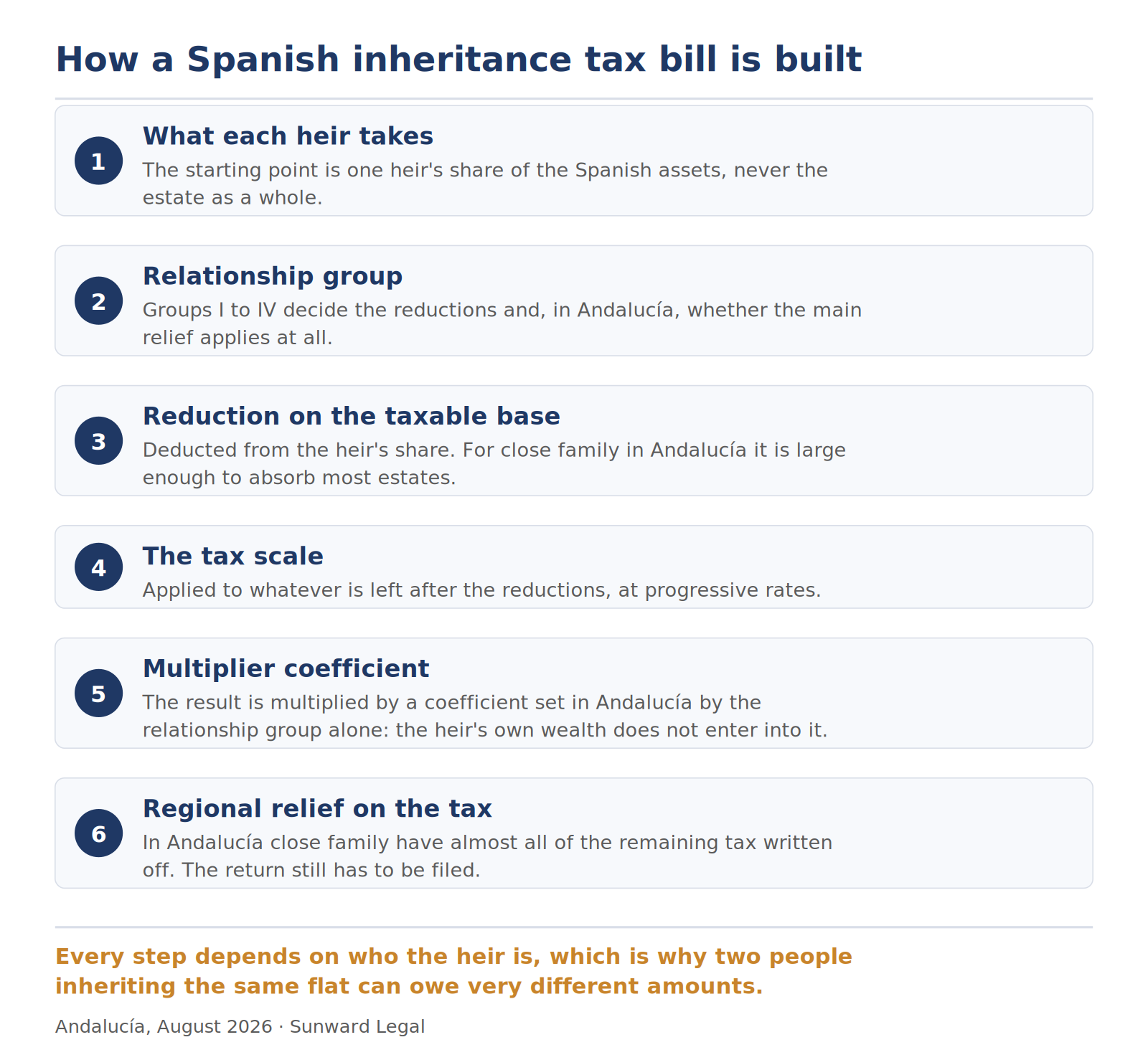
The structural difference is who the taxpayer is. In the United Kingdom the estate is taxed and the personal representative settles it before anything is distributed. In Spain there is no such thing as a tax on the estate: each heir is assessed separately on what they receive, and two people inheriting equal shares of the same flat can owe very different amounts.
| Inheritance tax in the UK | Succession tax in Spain | |
|---|---|---|
| What is taxed | The estate as a whole | What each heir individually receives |
| Who files and pays | The personal representative, out of the estate | Each heir, in their own name |
| Who the beneficiary is | Relevant to certain exemptions, but the tax remains the estate’s | Decides the reductions, the multiplier and the regional relief |
| Reliefs | Applied at the level of the estate | Applied heir by heir, plus a regional relief on the resulting tax |
| Where the return goes | HMRC, filed by the personal representative | The Spanish state tax office, filed by each heir, even where regional rules apply |
This note does not state UK thresholds or rates; those are set out by HMRC and change with each Budget. What it does set out is the Spanish side, which is the side most British families have never had to look at.
One practical consequence of that difference deserves stating on its own. Because each heir files, each heir needs a Spanish tax number, and each heir has their own deadline: six months from the date of death, extendable by six more only if the extension is applied for within the first five months, with interest.
Can a UK resident really apply the Andalusian rules?
Yes. A person resident in the United Kingdom — a third country since Brexit — applies the rules of the relevant Spanish region on the same terms as a resident of Spain or of the EU. That is what the law says today, and it is the single most misreported point in this area.
The reasoning matters, because it is what makes Brexit irrelevant. The equal treatment does not rest on EU citizenship or on free movement of persons, which the United Kingdom did leave. It rests on the free movement of capital, which the Treaty extends to movements between member states and third countries. A judgment of the Court of Justice in September 2014 condemned the discrimination against non-residents; the Spanish Supreme Court held in February 2018 that the same reasoning applied to residents of third countries — the case concerned a resident of Canada — and the legislature wrote it into the statute in 2021.
So the two claims that circulate most widely are both wrong. “Since Brexit, British heirs have lost the regional rules” is wrong. “The 2014 European judgment already solved it for everybody” is also wrong: until the 2018 rulings the Spanish administration went on refusing the benefit to residents outside the EU and the European Economic Area.
There is a corollary worth knowing. Anyone who paid Spanish inheritance tax as a resident of a third country under the state rules, when the regional rules would have given a better result, may have a route to recover the excess. The Supreme Court channelled it through the liability of the State as legislator, and it has time limits of its own, so it is a question to put quickly rather than eventually.
Whose rules apply, and where you file: two different questions
These are the two things that get conflated, and conflating them causes rejected filings. The applicable rules are those of the Spanish region in which the greatest value of the deceased’s assets in Spain is located. The competent administration, where the deceased was not resident in Spain, is the state tax office — the Oficina Nacional de Gestión Tributaria of the AEAT — and not the regional one.
So the heir of a British parent who owned a flat in Marbella files with the state tax office, using form 650, and applies Andalusian law when doing so, including the Andalusian relief. Filing with the Junta de Andalucía instead is a common error, and the tax authority’s own guidance for non-residents is explicit about where the return goes.
What Andalucía actually gives, and to whom
Two benefits, applied one after the other and not as alternatives. First a reduction of up to 1,000,000 € on the taxable base for each heir in Groups I and II. Then a 99% relief on whatever tax remains. Both are in force in Andalucía in August 2026 under the regional tax legislation.
Who is in which group decides everything:
- Groups I and II — children and other descendants, the spouse, parents and other ascendants. These are the groups that get the 1,000,000 € reduction and the 99% relief.
- Group III — brothers and sisters, nephews and nieces, uncles and aunts, and relatives by affinity. Andalucía raised the state reduction for this group from 7,993.46 € to 10,000 €. There is no 99% relief.
- Group IV — cousins, more distant relatives and unrelated beneficiaries. No reduction for relationship at all.
Whether an unmarried partner falls into the close groups depends on the regional rules and on whether the partnership is registered. It is checked, not assumed.
Two warnings about the 99%. It is a relief on the tax, not an exemption: 1% survives, and so does the obligation to file the return within the six months. “In Andalucía you don’t pay inheritance tax” is the sentence that produces late filings. And it does not reach Groups III and IV, which is why the gap between what a child pays and what a nephew pays on the same flat is not a matter of degree but of order of magnitude.
What does apply to those two groups is worth setting out, because it is commonly got wrong in the harsher direction. Andalucía has legislated its own scale and its own multipliers, and the state ones are only a fallback for regions that have not. For deaths from 2022 onwards the regional scale runs in sixteen bands, from 7% to 26%, with the top band reached at 800,000 € of taxable base — and the multiplier depends only on the relationship group: 1.0 for Groups I and II, 1.5 for Group III and 1.9 for Group IV. The heir’s own existing wealth, which drives the multiplier under the state rules and can take it to 2.4, does not enter the Andalusian calculation at all. Band by band, the scale itself should be read off the current form 650 instructions rather than an older regional schedule that is still in circulation: the range and the top band are what the regional tax agency publishes, but the full table could not be confirmed article by article.
Do you know which group you are in and which rules apply to you? Book a free 20-minute call and we will work through it with the facts of your case, before anything is filed.
A worked example
The following is a constructed example, not a client’s file. It exists to show the mechanics, and the figures are the ones that make the mechanics visible.
A British national who lived in England dies on 12 March 2026. In Spain he leaves an apartment in Marbella valued at 420,000 € and a Spanish bank account holding 30,000 €: 450,000 € of Spanish assets. His will leaves his estate in equal shares to his two adult children, both living in England. He also owned a house in Surrey and a pension; neither is in the Spanish tax base, because where neither the deceased nor the heir is resident in Spain, only the assets situated in Spain are taxed.
Each child therefore takes 225,000 € of Spanish assets. Each files a form 650 with the state tax office by 12 September 2026, applying Andalusian rules because that is where the Spanish assets are. Each is in Group II, so the reduction of up to 1,000,000 € on the taxable base absorbs the whole of a 225,000 € share. The taxable base falls to zero, and with it the tax.
Two lessons come out of that. The first is that for most British families in this position the 99% relief is never even reached: the reduction has already done the work. The second is that a nil bill is still a bill you have to file for — the reduction is not automatic, it is claimed in a return, in the six months, by a taxpayer with a Spanish tax number.
Change one fact and the picture changes completely. If the same 450,000 € had gone to a nephew, he would be in Group III, with a reduction of 10,000 € rather than 1,000,000 €, no 99% relief, and a multiplier of 1.5 on the resulting tax. How the property is valued for tax purposes is a separate question with rules of its own, and it is not simply what an estate agent would list it for.
Questions, answered
When is the tax due, and can the deadline be extended?
Six months from the date of death. One extension is available, for a further six months, but it has to be applied for within the first five months and it carries late-payment interest on the tax. Once the fifth month begins there is nothing left to apply for, which is why the request is usually made as a precaution.
Do I file with the Junta de Andalucía or with the state?
With the state, where the deceased was not resident in Spain: the return goes to the AEAT’s Oficina Nacional de Gestión Tributaria. You still apply Andalusian law in the calculation. The competent administration and the applicable rules are separate questions and they have different answers here.
Does the 99% relief mean there is nothing to pay and nothing to do?
No. It is a relief on the tax, not an exemption, and it does not remove the duty to file within six months. In many estates the tax is already nil because of the reduction on the base, and the return still has to be filed by each heir, each with a Spanish tax number.
Will I be taxed twice, in Spain and in the UK?
Where neither the deceased nor the heir was resident in Spain, Spain taxes only the assets situated in Spain, which limits the overlap to that part of the estate. There is no treaty between Spain and the United Kingdom on inheritance tax — Spain has three such treaties in force and none of them is British. Relief therefore depends on each country’s unilateral rules, so what credit the UK gives for the Spanish tax is a question to put to a UK adviser in parallel, not afterwards.
Do I need a fiscal representative in Spain?
For this tax, a UK-resident heir does. The tax authority requires heirs who live outside the European Union and the European Economic Area to appoint a person or company resident in Spain to represent them before it; heirs resident in an EU or EEA state are not obliged to. That is stricter than the rule for non-resident income tax, where owning or selling a Spanish property does not in itself create the obligation. A Spanish tax number you need in every case.
Where this leaves a British family
The figure that matters is not “the Spanish inheritance tax rate”. It is the combination of who inherits, what they inherit in Spain, where those assets are and what rules the heir is entitled to apply. For close family with an apartment on this coast, that combination is usually favourable, and the real risk is procedural: missing the six-month date, or filing in the wrong place.
Worth saying plainly, too: the notary attests, the tax office collects and the estate agent sells. None of them is working out which rules a UK-resident heir may claim. That is the job of the lawyer the heirs instruct themselves.
The sequence that produces the return — death certificate, register of wills, deed of acceptance, registration — is set out in our note on Spanish probate, and what to do when the six months have already passed is in inherited property in Spain. Whether an English will can carry the Spanish flat at all is dealt with in our note on English wills and Spanish property, and the same ground in Spanish is in la herencia de un no residente. Selling the flat afterwards is a separate exercise with its own checks, covered under Spanish conveyancing.
Book a free 20-minute call, in English, Spanish or Swedish. Tell us who inherits, what there is in Spain and the date of death, and we will tell you which rules apply, where the return goes and what the deadline is. No cost and no obligation to instruct us.
General information about Spanish law, not advice on a particular estate. It reflects the rules in force in Andalucía on 15 August 2026; tax rules change and regional benefits are amended frequently. Sources: Ley 29/1987 del Impuesto sobre Sucesiones y Donaciones, arts. 6, 7, 22 and 23 — the last on unilateral relief for international double taxation, there being no Spain–United Kingdom convention on inheritance tax; the three in force are with France, Greece and Sweden — and disposición adicional segunda, as amended by Ley 11/2021; art. 10 del Texto Refundido de la Ley del IRNR (Real Decreto Legislativo 5/2004), as amended by Ley 11/2021, and AEAT guidance on inheritance tax for non-residents, on the appointment of a fiscal representative; STJUE of 3 September 2014, case C-127/12; STS 242/2018, of 19 February 2018 (ECLI:ES:TS:2018:550); Ley 5/2021 de Tributos Cedidos de Andalucía, on the 1,000,000 € reduction for Groups I and II and the 99% relief on the tax, and arts. 37 and 38 on the regional scale and the multiplier coefficients; Real Decreto 1629/1991, arts. 67 and 68; Orden HAP/2488/2014, approving form 650 and designating the Oficina Nacional de Gestión Tributaria. Also consulted: the Ministry of Finance’s survey of regional tax measures and the Junta de Andalucía’s page on the tax.