For a good number of Spanish immigration steps you do not need a lawyer at all: an NIE appointment, a padrón registration and a straightforward renewal are administrative errands. You need one when the application involves a judgement call — evidencing income that is not a salary, a family member with a different status, a refusal to answer, or a move that quietly changes where you pay tax.
Sunward Legal · Marbella. Last substantive review: 22 August 2026.
When you do not need a lawyer
Say this plainly, because most pages on this subject will not. A significant part of what people pay for could be done by the applicant.
Booking and attending an appointment for an NIE. Registering on the padrón at the town hall once you have an address. Opening a bank account. Collecting a residence card once the permit is granted. Renewing a permit where nothing has changed — same income, same family, same address, documents already in the file. Gathering documents from your own country: a birth certificate, a marriage certificate, a police certificate. None of these involves discretion. They involve turning up with the right papers on the right day.
If that is your situation, the useful advice is procedural, not legal: start the document-gathering early, because the delays come from apostilles and sworn translations rather than from the Spanish administration.
When you do need one
You need a Spanish immigration lawyer where the file stops being a checklist and starts being an argument. Four situations account for most of it.
Income that is not a payslip. The financial thresholds are fixed, but what counts towards them is a matter of evidence. Pensions, dividends, rental income, investment income, savings drawn down over time, income in a currency that moves — each has to be presented so that a consular officer reading it in Spanish reaches the intended conclusion. This is the single most common reason an otherwise strong application is refused.
Anything involving more than one person. A spouse who is not married in a form Spain recognises without more, an adult child still dependent, a former partner with custody rights over a child who is moving, a family member of a different nationality. Each adds a document chain and a legal question about who qualifies as a family member for the route being used.
A refusal, or a deadline that has passed. Once something has been refused there is a time limit to respond, and the choice between an administrative appeal and a fresh application is a strategic one that depends on why the refusal happened. This is the point at which self-representation stops being economical.
Anything that touches tax at the same time. Which is, in practice, every long-stay route. See below — it is the section most immigration content omits entirely.
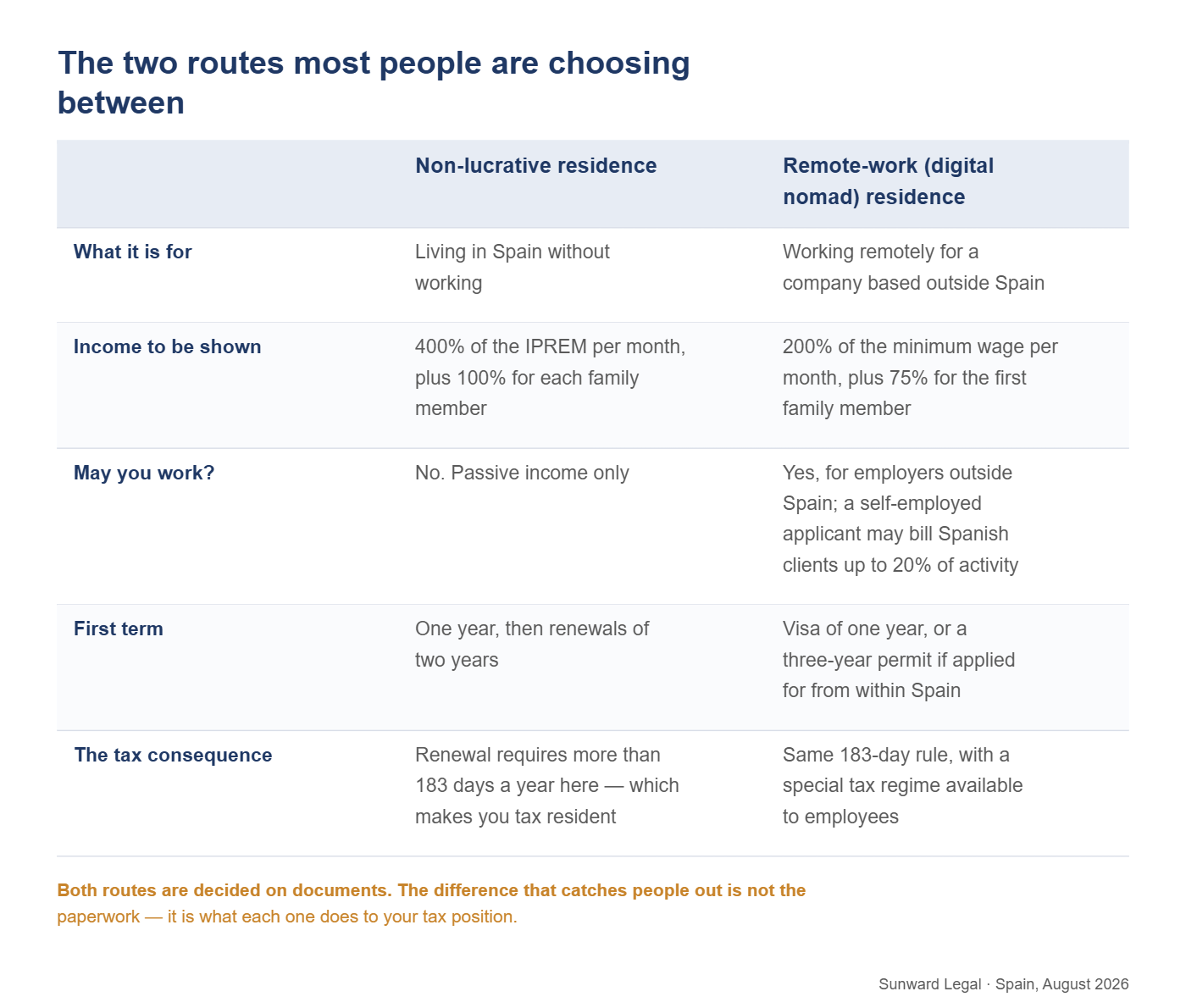
The two routes most people are actually choosing between
Since the residence-by-investment route — the “golden visa” — was repealed with effect from 3 April 2025, under the immigration regulation now in force, the realistic options for someone who is not being posted by an employer are two. What became of the investment route, and what has not replaced it, is set out in what happened to Spain’s golden visa.
Non-lucrative residence is for living in Spain without working. You evidence income of 400% of the IPREM per month, plus 100% of the IPREM for each accompanying family member — the IPREM being the official reference index, set at €600 per month in 2026. You take out private health insurance with an insurer authorised in Spain, with no co-payments. You may not work, in Spain or remotely for anyone else: passive income is the point of the route, and it is what evidences it. The permit runs for one year, then renews for two years at a time.
Remote-work residence, commonly called the digital nomad route, is for working from Spain for a company based elsewhere. The income threshold is 200% of the minimum wage per month — the minimum wage being €1,221 a month in fourteen payments in 2026 — with 75% more for the first family member and 25% for each additional one. You need at least three months of relationship with the employer or client, a company that has been trading for at least a year, and either a relevant qualification or three years of professional experience. A self-employed applicant may work for Spanish companies up to 20% of total activity; an employee may not work for a Spanish employer at all.
The full requirements are published by the Spanish administration for non-lucrative residence and for remote-work residence.
Each route has its own detail, and each has its own way of going wrong: the non-lucrative visa in practice and what disqualifies a digital nomad application.
The part immigration advice usually leaves out
A residence permit is not only a right to be here. It carries a tax consequence, and the two are decided by different rules that nobody joins up for you.
The current renewal rules for non-lucrative residence require you to have actually lived in Spain for more than 183 days in the calendar year. That is also, near enough, the first test of Spanish tax residence — and a Spanish tax resident is taxed on worldwide income, not on Spanish income. So the residence route that lets you spend your retirement here is the same route that moves your entire tax position to Spain, by design rather than by accident.
For remote workers there is a further layer: a special tax regime for people who move to Spain is available to employees who qualify, and generally not to a self-employed applicant on the ordinary route. Which side of that line you fall on is decided by how the work is structured, and the structure is settled at the point of the visa application, not afterwards.
None of this is a reason to avoid the move. It is a reason to decide the immigration route and the tax position together, in that order, before documents are filed. What the Spanish rules look like from the tax side is set out in the annual non-resident return and, for those who are only visiting a property they own, in buying property in Spain after Brexit.
Deciding between two routes? Book a free 20-minute call and we will map your income, your family and your timing against both, before you start gathering documents. No cost, in English, Spanish or Swedish.
What a lawyer does that a gestoría or the consulate does not
A gestoría is an administrative processing office. A good one is efficient at forms, appointments and filings, and there is nothing wrong with using one for what it does. It is not there to tell you that the route you have chosen is the wrong one, or to argue an appeal.
The consulate processes applications. It will tell you what documents its list requires; it will not advise you on whether your evidence will persuade, will not weigh two routes for you and cannot act for you.
What a lawyer adds is the judgement in between: choosing the route, building the evidence so that it answers the question the decision-maker is actually asking, coordinating the immigration and tax positions, and handling what happens if the answer is no. That is worth paying for when there is judgement to exercise, and not worth paying for when there is not — which is where this article started.
What goes wrong
Assets, not income. An applicant with substantial savings but modest recurring income presents a bank balance and is refused, because the file has to show means available across the period of residence, not a snapshot. The same person, with the same money, presented as a documented income stream, is a straightforward approval.
The 90-day clock running during the process. Someone comes to Spain as a visitor, decides to stay, and starts an application from here without checking whether the route allows it — while the 90-in-180 count is running, now recorded automatically at the border. Some routes can be applied for from within Spain and some must be applied for at a consulate. Establishing which, on day one, avoids an overstay.
Documents that expire before the appointment. Police certificates and medical certificates have limited validity, and apostilles and sworn translations take time. A file assembled in the wrong order arrives with the earliest document already out of date. The sequencing is mechanical, and getting it wrong costs a full application cycle.
Questions, answered
Can I apply for Spanish residence while I am in Spain as a visitor?
It depends on the route. The remote-work permit can be applied for from within Spain by someone lawfully present here, which is why many applicants use it that way and obtain a three-year permit directly. The non-lucrative route is applied for at the Spanish consulate for the district where you live. Getting this wrong wastes a whole cycle.
Does buying a property help my application?
Not in itself. Property ownership is not a route to residence — the investment route closed in April 2025 — and no permit is granted because you own a home here. A property may support an application indirectly, as evidence of accommodation or as a source of documented income if it is let, but it is not a qualification.
How long does an application take?
Long enough that it should not be planned against a fixed moving date. Timescales vary between consulates and change with volume, so no honest article gives you a number and no lawyer should promise one. What can be controlled is the sequencing of documents with limited validity, so that a delay does not force a restart.
Do I need a lawyer to renew?
Usually not, where nothing has changed. It becomes worth advice where something has: a change of income source, a marriage or separation, time spent outside Spain that may affect the residence requirement, or a renewal that falls close to the five-year point at which long-term residence becomes available.
What if my application is refused?
There is a limited window to respond, and the right response depends on the ground of refusal — a missing document is a different problem from an assessment that your means are insufficient. This is the situation where representation earns its cost most clearly, and where acting quickly matters more than in any other part of the process.
Where this leaves you
The useful question is not “do I need a lawyer” but “does my situation contain a judgement”. If the answer is no — an NIE, a padrón registration, a clean renewal — do it yourself and spend the money on something else. If the answer is yes — income that is not a salary, a family with more than one status, a refusal, or a move that shifts where you are taxed — get advice before the file is built rather than after it is refused.
And if you take one thing from this page, make it the tax point. The immigration decision and the tax decision are taken by different authorities, in different files, months apart, and nobody in either of them is responsible for noticing that the route you chose has moved your worldwide income to Spain. That connection is your lawyer’s job, and it is the reason to have one at the start rather than at the end.
Book a free 20-minute call, at no cost, in English, Spanish or Swedish. Tell us where your income comes from, who is moving with you and when, and we will tell you which route fits and what it does to your tax position.
General information on Spanish law, not advice on a particular application. It reflects the rules in force on 22 August 2026; thresholds, reference indices and administrative practice change. Sources: Real Decreto 1155/2024, Reglamento de la Ley Orgánica 4/2000, arts. 60 to 64 (non-lucrative residence and its renewal), arts. 182 to 185 (long-term residence) and art. 205 (NIE); Ley Orgánica 4/2000, arts. 30 bis, 31 and 32; Ley 14/2013 de apoyo a los emprendedores, arts. 74 bis to 74 quinquies, in the wording given by Ley 28/2022, and the joint instruction of the Directorate-General for Migration on international teleworkers; Real Decreto 126/2026, setting the minimum wage for 2026; disposición adicional centésima primera de la Ley 31/2022, on the IPREM, applicable under the extended budget; Ley Orgánica 1/2025, repealing residence by investment with effect from 3 April 2025; art. 93 Ley 35/2006 del IRPF, on the special regime for workers posted to Spain; art. 9 Ley 35/2006, on tax residence; Regulation (EU) 2017/2226 (Entry/Exit System).