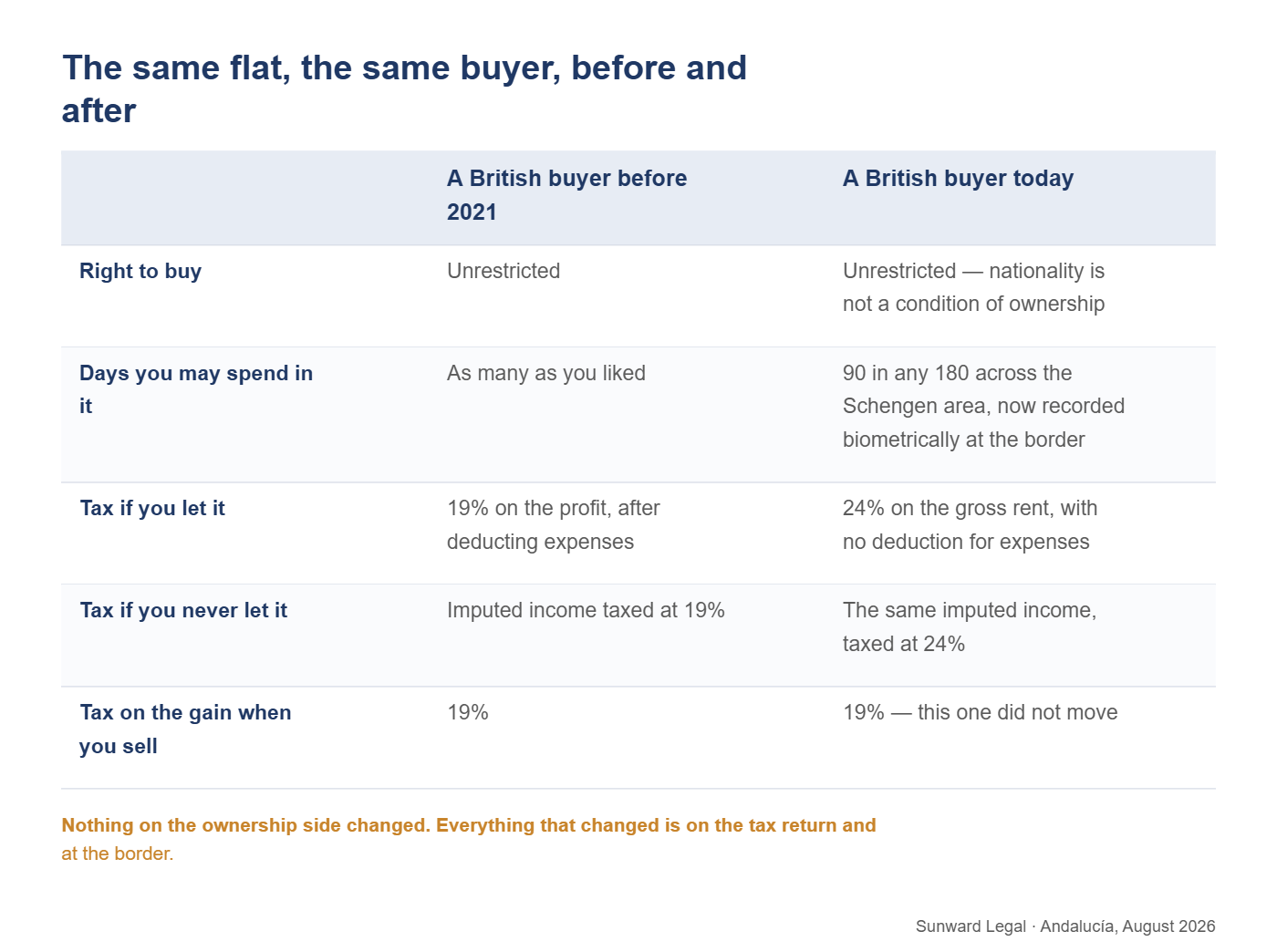
Brexit did not touch your right to buy a home in Spain: there is no nationality condition on owning Spanish property, and there was none before. What changed sits in two places — the tax you pay on the property every year, and the number of days you may spend in it. The purchase itself works exactly as it did.
Sunward Legal · Marbella. Last substantive review: 22 August 2026.
Can a British citizen still buy property in Spain?
Yes, on the same terms as anyone else. Buying property in Spain after Brexit is legally identical to buying before it. Spanish law does not condition the ownership of a home on the buyer’s nationality or residence, and no rule introduced since 2020 has changed that. You need a Spanish tax identification number — the NIE — a bank account or a way to move funds, and the same conveyancing steps a Spanish buyer goes through.
There is one narrow historic rule worth knowing about, because it is real even though it rarely bites. A 1975 statute on land in areas of interest for national defence requires prior military authorisation for purchases by non-EU nationals in certain designated zones — islands, border strips and a small number of coastal areas. EU citizens are exempt; since 2021 British buyers are not. It is a check your lawyer makes against the land’s location before you commit, not a reason to hesitate about buying on the mainland coast.
You may also have seen headlines about a proposed tax on property purchases by non-EU buyers, announced in early 2025. As at 22 August 2026 it has not become law: nothing creating such a charge has been published in the official gazette, and until something is, there is nothing to plan around.
So what did change?
Three things, all of them downstream of one fact: the United Kingdom is now a third country for Spanish tax and border purposes rather than a member state. The property is unaffected. The owner’s tax position and travel position are not.
The tax changes are the ones with a number attached. A non-resident owner from outside the EU and the European Economic Area pays the general rate of the non-resident income tax — 24% — where an owner resident in the EU or the EEA pays 19%. And an owner from outside that zone cannot deduct expenses from rental income: the tax falls on the gross rent, not on the profit. Both differences come from the same place in the non-resident income tax rules, and both apply to British owners today.
The travel change is the 90/180 rule. As a visa-exempt third-country national you may spend up to 90 days in any rolling 180-day period across the whole Schengen area, Spain included, without a residence permit. The UK government’s own entry guidance for Spain sets it out, and warns that overstaying can bring an entry ban.
And the residence-by-investment route — the “golden visa” that let a large enough property purchase carry a residence permit — was repealed with effect from 3 April 2025. Buying property in Spain no longer produces any right to stay longer, at any price.
What you now pay on the property each year
The annual bill has two components that surprise British owners, because neither has an English equivalent that behaves the same way.
| What you pay | When | The rate for a British owner |
|---|---|---|
| Non-resident income tax on rental income | Quarterly-style filings on form 210 | 24% of the gross rent, no expenses deducted |
| Non-resident income tax on an unlet second home | Once a year on form 210 | 24% of an imputed income of 1.1% or 2% of the cadastral value |
| IBI, the municipal property tax | Annually to the town hall | Set by the municipality; unrelated to the two above |
| Community charges | Monthly or quarterly to the building | Set by the community of owners |
The second line is the one nobody mentions at the viewing. Spain taxes a second home that sits empty: the law imputes a notional income to it, calculated as 1.1% of the cadastral value where that value results from a general revision in force in the last ten tax periods, and 2% otherwise. There is no deduction against it. It is small in absolute terms and it is owed every year, whether or not you set foot in the property, and whether or not you have ever heard of it. How it works, and what to do if it has never been filed, is the subject of our note on the annual non-resident return.
For rental income, the arithmetic of the third-country rate is worth doing once. On a gross rent, an EU-resident owner deducts mortgage interest, community charges, IBI, insurance, repairs and depreciation and pays 19% on what is left. A British owner pays 24% on the whole rent with nothing taken off. The gap between those two positions is much wider than the five points between the headline rates suggest.
The Spanish tax agency’s page on letting a property as a non-resident states the rule and the closed list of countries whose residents may deduct: the EU, Iceland, Norway and Liechtenstein.
What did not change, and is worth saying out loud
The tax on the gain when you sell. Capital gains on the transfer of Spanish property are taxed at 19% for every non-resident, with no distinction by country of residence. The rate a British seller pays today is the rate a British seller paid in 2019.
The buyer’s 3% withholding. When a non-resident sells, the buyer must retain 3% of the price and pay it to the tax office on account of the seller’s tax. That mechanism has nothing to do with EU membership; it applies to any non-resident seller, and it applied to British sellers before Brexit too. It is covered in our note on selling property in Spain.
The purchase taxes. Transfer tax on a resale in Andalucía is 7% of the taxable base, and new-build purchases carry 10% VAT plus stamp duty at 1.2%. None of these depend on the buyer’s nationality.
Mortgages. Spain’s mortgage law protects any individual borrowing against residential property in Spain. Its protections are drafted around the type of borrower and the type of property, not around nationality or residence, so a British buyer gets the ten-day reflection period on the binding offer and the free preliminary notarial appointment on the same terms as anyone else. What that process looks like is set out in getting a Spanish mortgage as a non-resident.
The conveyancing itself. Reservation, private contract, searches, deed before a notary, registration. The sequence is unchanged, and so are the things that go wrong in it, which we have collected in the pitfalls of buying property in Spain.
The border, in its current state
This is the part that has moved most recently, and the part most guides still describe as it was two years ago.
The EU’s Entry/Exit System is now running. It began operating on 12 October 2025 and became fully operational on 10 April 2026. It records the entries and exits of third-country nationals biometrically — face and fingerprints — and replaces the passport stamp across 29 countries. The practical consequence for a second-home owner is that the 90/180 count is no longer a matter of a border officer reading ink: it is calculated automatically. Registration lasts three years, so the first crossing takes longer than the ones after it. The European Commission’s page on the Entry/Exit System describes what is captured.
ETIAS, the travel authorisation that will sit alongside it, is not yet in operation as at 22 August 2026. The Commission’s official ETIAS page states that no applications are being collected and that the launch date will be announced in advance; UK government guidance expects operations to begin in autumn 2026. Any website selling you one today is a fraud — that warning comes from the UK government itself, not from us.
If 90 days a year is not enough, the answer is a residence permit, not a workaround at the border. The routes that exist are set out in do you need a Spanish immigration lawyer?.
Not sure where you stand? Book a free 20-minute call and we will go through your Spanish property, what you owe on it annually and what your days look like under the new border rules. In English, Spanish or Swedish.
What goes wrong
The owner who never knew about the imputed income. A couple buys in 2019, never lets the flat, uses it for four weeks a year and files nothing, because nobody told them there was anything to file. The liability accumulates quietly. It is fixable — a voluntary filing of the open years carries surcharges that are markedly lower than the penalties that follow a tax office letter — but the fix is much cheaper before the letter than after it.
The buyer who assumed the purchase brought residence. Someone buys at a price that would have qualified under the old investor route, expecting a permit to follow. That route closed in April 2025. The purchase gives ownership and nothing else; the right to spend more than 90 days in 180 has to be obtained on its own merits, through a residence application made from the UK.
The landlord still filing as if the UK were in the EU. A British owner lets the property and deducts mortgage interest and community charges, as was correct until 2020. The deduction is no longer available to a non-EU resident, and the filing understates the tax. This one is worth checking on the returns already submitted, not just on the next one.
Questions, answered
Do I need a visa to visit my own property in Spain?
No, not for stays within 90 days in any 180-day period. Ownership does not change the length of stay permitted, and it does not create any right of entry beyond the general visa-exempt rules. Longer stays require a residence permit applied for from the UK, at a Spanish consulate.
Is there an extra purchase tax for British buyers?
No. Transfer tax on a resale in Andalucía is 7% and new-build VAT is 10%, whoever is buying. A charge on non-EU buyers was announced in 2025 but has not been enacted, and as at 22 August 2026 there is no such tax in force.
Does owning property in Spain make me tax resident there?
No. Tax residence turns on where you actually are and where your interests are — broadly, more than 183 days in the Spanish calendar year, or your main base of economic interests here. A second home used for a few weeks a year does not cross either threshold; a 90-day pattern does not either.
Can I still get a Spanish mortgage as a British buyer?
Yes. Spanish mortgage law does not distinguish by nationality or residence, and its consumer protections apply to you. What varies between banks is the lending policy — how much they will advance and on what conditions — and that is a commercial matter, not a legal one, so no honest article can give you a percentage.
Has anything changed about inheriting or leaving Spanish property?
Not because of Brexit. The United Kingdom never took part in the EU succession rules in the first place, so its position was the same before and after. What that means for a will is set out in choosing the law that governs your estate.
Where this leaves you
The short version is that Brexit changed the running cost of a Spanish home and the calendar of the person who owns it, and left the property itself alone. If you are buying, budget the annual tax at the third-country rate from the start, and plan the year around 90 days in 180 rather than discovering the limit at a border that now counts automatically. If you already own, the two things worth checking this month are whether the annual return has been filed for every year you have owned the property, and whether any letting income was declared on the right basis.
One structural point that matters more than any rate. In a Spanish purchase the agent is paid on completion, the developer is selling and the notary — contrary to what most British buyers assume from the conveyancing they know — attests the deed without acting for either side or checking whether the deal is good for you. The only person at that table working solely for the buyer is a lawyer the buyer instructs.
Book a free 20-minute call, at no cost, in English, Spanish or Swedish. Tell us what you own or what you are about to buy, and we will tell you what it costs to hold each year and what the border rules mean for your time here.
General information on Spanish law, not advice on a particular transaction. It reflects the rules in force on 22 August 2026; rates and thresholds change. Sources: Real Decreto Legislativo 5/2004, texto refundido de la Ley del Impuesto sobre la Renta de no Residentes, arts. 13.1.h), 24.1, 24.6, 25.1.a), 25.1.f).3.º and 25.2; Ley 35/2006 del IRPF, arts. 9 and 85; Orden HAC/623/2026 on the filing periods of form 210; Ley 5/2021 de Tributos Cedidos de Andalucía, arts. 41, 43 and 50; Ley 37/1992 del IVA, art. 91.Uno.1.7.º; Ley 5/2019 reguladora de los contratos de crédito inmobiliario, arts. 2, 10, 14 and 15; Ley 8/1975 de zonas e instalaciones de interés para la Defensa Nacional, arts. 16 and 18, and Real Decreto 689/1978, art. 32; Ley Orgánica 1/2025, repealing the residence-by-investment scheme with effect from 3 April 2025; Regulation (EU) 2017/2226 (Entry/Exit System) and Regulation (EU) 2018/1240 (ETIAS); Regulation (EU) 2018/1806, Annex II, on visa-exempt nationals. The status of the announced purchase tax on non-EU buyers was verified as not enacted on 22 August 2026.