The income requirement for Spain’s remote-work visa is 200% of the Spanish minimum wage — €2,442 a month in 2026 — and most applicants clear it comfortably. What stops American files is somewhere else entirely: social security coverage. If you are a W-2 employee of a U.S. company, the requirement can only be satisfied in ways that involve your employer, and that is the conversation to have before anything else.
Sunward Legal · Marbella. Last substantive review: 22 August 2026.
What the visa actually is
Spain’s digital nomad visa is an authorization to live here while working remotely, using computer and telecommunication means, for a company based outside Spain. It was created by Spain’s 2022 startups law and sits inside the entrepreneurs regime, which is why it is processed by a specialized unit rather than through ordinary immigration channels.
Two formats exist and the difference is worth understanding at the outset. Applying from your home country produces a visa valid for up to one year. Applying from within Spain, while lawfully present here, produces a residence authorization of up to three years, renewable for two more, with access to long-term residence at five. Same route, materially different starting position — which is why many applicants who can arrange it enter as visitors and file here.
The Spanish administration publishes the requirements at the large-companies unit that processes these applications, and the underlying rules sit in the 2013 entrepreneurs law as amended in 2022.
The requirements, in the order they are checked
| Requirement | What it means in 2026 |
|---|---|
| Income | 200% of the minimum wage per month: €2,442, or €34,188 a year. Add 75% of the minimum wage for the first family member and 25% for each additional one |
| Relationship with the employer or client | At least three months before the application |
| The company | Real trading activity for at least one year |
| Qualification | A degree from a recognized university, vocational school or business school, or at least three years of professional experience in the field |
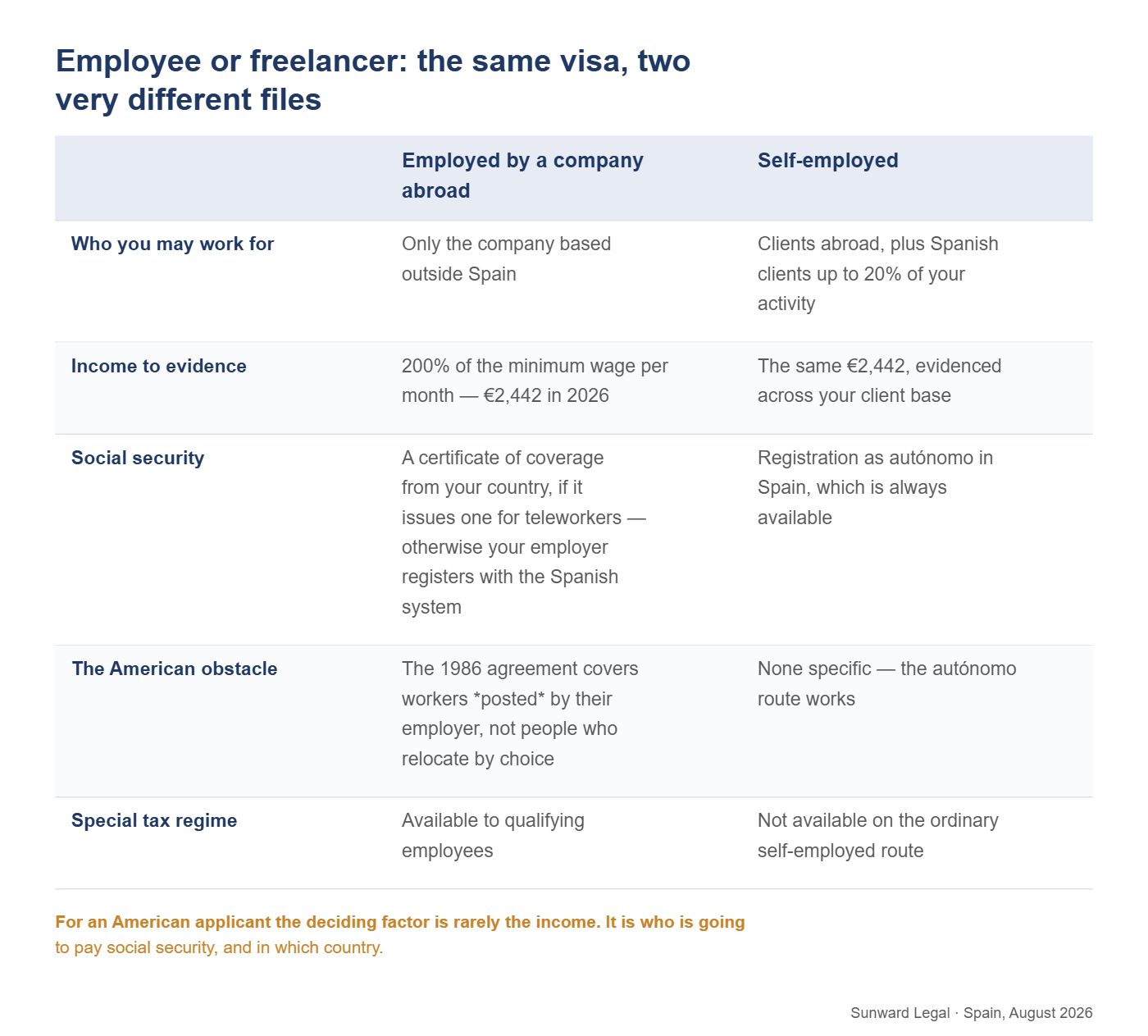
| Limit on Spanish work | An employee may not work for a Spanish employer at all. A self-employed applicant may bill Spanish clients up to 20% of total activity |
| Social security | Coverage arranged, one way or another. See below |
| Documents | Clean criminal record, apostilled and translated; private health insurance or Spanish coverage |
The minimum wage figure comes from the decree that set it for 2026 at €1,221 a month in fourteen payments; you can check it in the official minimum wage decree. The 200% multiplier and the family uplifts come from the administrative instruction that governs these applications, not from the statute itself — which is why they are stated identically by the processing unit and the consulates, and why they move when the minimum wage moves.
The requirement that decides American applications
Spain requires that you be covered by social security, and there are only two ways to satisfy it.
Route one: a certificate of coverage from your own country. This works where a bilateral social security agreement exists *and* the country issues such certificates for teleworkers. The Spanish consular network states the position bluntly: only some countries issue a certificate of coverage for teleworkers.
Route two: contributions in Spain. For an employee, that means the foreign employer registers with the Spanish social security system and pays contributions here for you. For a self-employed applicant, it means registering as autónomo in Spain, which is always available and entirely predictable.
Now the American specifics. The Social Security agreement between Spain and the United States dates from 1986 and covers, in relevant part, workers sent by their employer to the other country — a posting, for a limited period. Someone who decides on their own to move to Málaga and keep working for their U.S. employer is not a posted worker in that sense. Neither the agreement itself nor the official sources we could verify confirm that a certificate of coverage is issued for teleworkers who relocate by choice. In practice, American employees on this route are generally pushed toward route two: the U.S. employer registering with the Spanish system.
That is a real request to make of an employer, and it is the reason applications stall. It is better to make it in month one, in writing, than to discover it after the documents are apostilled.
A new bilateral agreement between Spain and the United States was signed in April 2024, and it is reported to broaden the treatment of postings and self-employment. It has not been confirmed as in force, and we do not treat it as such. Until it is published as in force, the 1986 agreement is the one that governs. Anyone telling you otherwise is describing a future that has not arrived.
Self-employed applicants have it easier here, and it is worth saying so plainly. Registering as autónomo in Spain is a known quantity, requires nobody’s permission but your own, and removes the single largest obstacle in the employee file.
Employer saying no, or saying nothing? Book a free 20-minute call and we will map what your file needs and what the realistic alternatives are. No cost, in English or Spanish.
The tax regime — and the trap inside it
Spain has a special tax regime for people who move here for work, widely called the Beckham regime. Where it applies, employment income is taxed at 24% up to €600,000 and 47% above that, instead of at the ordinary progressive rates, for the year of the move and the five following years. The condition is that you were not resident in Spain in the five tax periods before the move.
Since 2022, employees who telework using exclusively computer and telecommunication means can qualify, and holding the remote-work visa or authorization is treated as evidence that the condition is met. The tax agency sets out the regime on its page on the special regime for workers moving to Spain.
Here is the trap. A self-employed remote worker does not get there by the ordinary route. The regime opens to self-employed applicants only in narrow cases — an activity classified as entrepreneurial, or a highly qualified professional serving startups or working in training and research. The general freelancer working for foreign clients from Valencia is outside it.
So the two halves of this route point in opposite directions. The employee has the harder immigration file and the better tax outcome. The freelancer has the easier immigration file and, usually, ordinary Spanish progressive taxation. Anyone deciding whether to keep a job or convert to contracting before moving should model both, because that decision is effectively made once and is hard to reverse.
And whichever side you land on, more than 183 days in Spain makes you a Spanish tax resident on worldwide income, while the United States continues to tax you as a citizen wherever you live. Both systems apply, and the treaty relieves double taxation rather than eliminating a filing. That interaction is set out in Spanish tax residency for U.S. citizens.
What disqualifies an application
No route to social security coverage. The employer will not register in Spain, and no certificate of coverage is forthcoming. This is not a paperwork problem; it is structural, and it is the most common reason an otherwise strong American file goes nowhere.
A relationship with the employer that is too new. Three months is a hard minimum, and a job started in order to make the application will not qualify. Nor will a company that has been trading for less than a year.
Too much Spanish income. An employee working for a Spanish employer is disqualified outright. A freelancer whose Spanish clients exceed 20% of activity is outside the route, and this is a number that has to be maintained after the permit is granted, not just at the point of application.
Qualification not evidenced. Three years of experience is an alternative to a degree, but it has to be documented — letters, contracts, a coherent record — and not merely asserted in a CV.
Applying on the wrong route. People who cannot solve the social security problem sometimes try the non-lucrative visa instead. That route requires an undertaking to perform no work at all, including remotely, so it does not solve the problem — it substitutes a different one. The distinction is drawn in the Spanish non-lucrative visa for Americans.
Questions, answered
Can I apply from inside Spain as a tourist?
Someone lawfully present in Spain can apply for the residence authorization directly with the processing unit, and that route produces a three-year permit rather than a one-year visa. It is widely used. The reason to take advice on it is timing: the 90-day visa-free clock runs while you prepare, and it is now recorded automatically at the border rather than by passport stamp.
How long does the visa take at a U.S. consulate?
Consular practice in the United States indicates a decision on the visa within about ten days of filing, extendable if further documents or an interview are required. Treat that as an indication rather than a promise; volumes and consulates vary, and no lawyer can commit an administration to a timescale.
Can my spouse work in Spain?
Family members can be included in the application. Their access to the Spanish labor market is a separate question from your own remote-work status, and it should be settled at the application stage rather than assumed — particularly where a spouse intends to take a local job.
Does the 20% limit apply to me if I have one Spanish client?
If you are self-employed, yes: Spanish clients may not exceed 20% of your total professional activity, and the relationship must be professional rather than an employment relationship in disguise. If you are an employee, the rule is stricter still — no Spanish employer at all.
Is the visa a route to permanent residence?
Yes. The three-year authorization renews for two more, and five years of legal, continuous residence open access to long-term residence. The route is designed as a path, not as a long stay.
Where this leaves you
Do the requirements in the right order and the process is manageable. Start with social security, because for an American employee it is the requirement that either has an answer or does not, and everything else is wasted effort until it does. Then confirm the three-month relationship and the company’s trading history. Then evidence the income — the easy part. Then decide, deliberately, whether you are moving as an employee or as a freelancer, knowing that this choice drives both the difficulty of the file and your tax rate for the next six years.
And get the tax model built before the immigration file is submitted. The permit and the tax regime are granted by different authorities, on different applications, and nobody in either process is responsible for telling you that the structure you chose for one has cost you the other. Where this sits in the wider move is set out in moving to Spain from the U.S., and if you are weighing whether you need representation at all, do you need a Spanish immigration lawyer? answers it honestly.
Book a free 20-minute call, at no cost, in English or Spanish. Tell us whether you are employed or self-employed, where your income comes from and when you want to move, and we will tell you what your file needs and where it is likely to stick.
General information on Spanish law, not advice on a particular application. It reflects the rules in force on August 22, 2026; thresholds and administrative practice change. Sources: Ley 14/2013 de apoyo a los emprendedores y su internacionalización, arts. 74 bis to 74 quinquies, introduced by the disposición final quinta de la Ley 28/2022 de fomento del ecosistema de las empresas emergentes; the joint instruction of the Dirección General de Migraciones and the Dirección General de Economía Social on international teleworkers (2023), applying art. 62.3.f) of Ley 14/2013 to the income thresholds; Real Decreto 126/2026, de 18 de febrero, setting the minimum wage for 2026; art. 93 Ley 35/2006 del IRPF, in the wording given by the disposición final tercera de la Ley 28/2022, on the special regime for workers moving to Spain; Convenio de Seguridad Social entre España y los Estados Unidos de 30 de septiembre de 1986 (BOE of March 29, 1988), art. 5, on posted workers; art. 9 Ley 35/2006, on tax residence; Convenio hispano-estadounidense para evitar la doble imposición of February 22, 1990, as amended by the Protocol in force since November 27, 2019, art. 1.3. The availability of a U.S. certificate of coverage for teleworkers who relocate by choice, and the entry into force of the social security agreement signed in April 2024, were not confirmed and are presented in the text as unresolved.