Spain’s non-lucrative visa lets you live here on income you already have, without working. In 2026 you evidence 400% of the IPREM per month — the IPREM being €600 a month, so €2,400 monthly for the applicant, plus €600 for each family member. The rule Americans most often get wrong is not the money. It is that “non-lucrative” means no work at all, including remote work for a U.S. employer.
Sunward Legal · Marbella. Last substantive review: 22 August 2026.
What is the non-lucrative visa, in one paragraph?
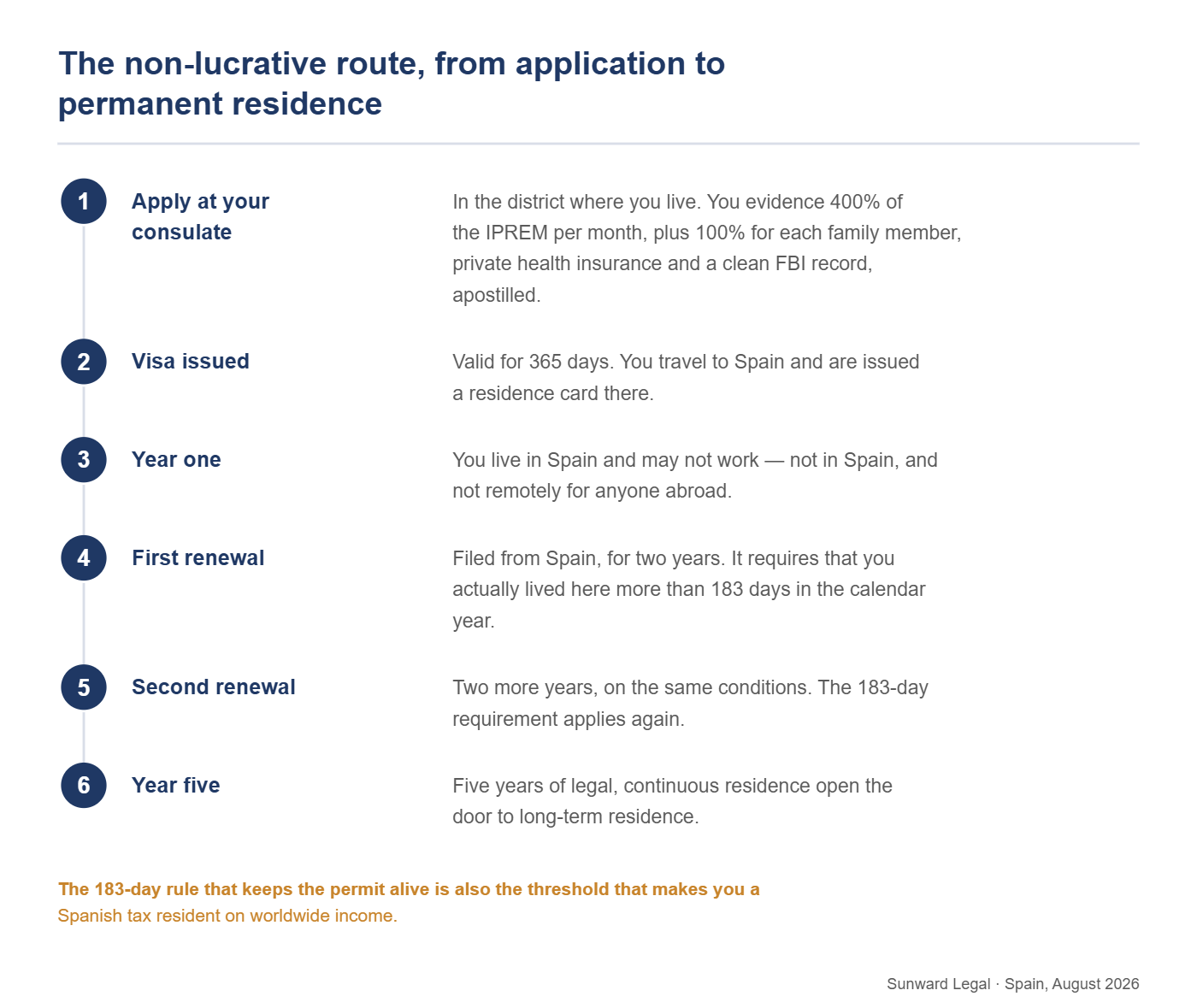
It is a temporary residence authorization for people who can support themselves in Spain without economic activity. You show sufficient recurring means, private health insurance and a clean criminal record; you receive a one-year authorization, renewable in two-year blocks; and at five years of legal, continuous residence you can apply for long-term residence. It sits in the Spanish immigration regulation and is the standard route for retirees, for people living on investment income, and for anyone taking an extended break who does not need to earn while they are here.
It is also the route that survived. The residence-by-investment program — the “golden visa” — was repealed with effect from April 3, 2025, so buying property no longer produces any right to stay. What replaced it, and what did not, is covered in what happened to Spain’s golden visa.
How much money do you have to show in 2026?
The threshold is expressed as a multiple of an official reference index called the IPREM, which stands at €600 per month in 2026.
| Who | Multiple | Monthly, 2026 |
|---|---|---|
| The main applicant | 400% of the IPREM | €2,400 |
| Each accompanying family member | 100% of the IPREM | €600 |
| A couple | — | €3,000 combined |
| A couple with two children | — | €4,200 combined |
Two points matter more than the numbers themselves.
First, the figures are monthly, and the means have to be shown as available across the period of residence you are applying for — not as a balance on one day. A pension statement, an annuity, documented dividends, rental income, or a portfolio with a demonstrable, sustained drawdown all work. A screenshot of a brokerage account, on its own, frequently does not.
Second, each U.S. consulate publishes its own dollar equivalent of these amounts and updates it periodically. Use the euro figure as the legal rule and your own consulate’s published figure as the practical target. The Spanish administration sets out the requirements for the non-lucrative residence authorization, and the consular network for the United States lists the documentary requirements at the Spanish consulates in the United States.
The rule Americans get wrong: you may not work
The authorization permits residence in Spain without carrying on any employed or professional activity. Spanish consulates in the United States put it beyond doubt: applicants are required to undertake not to perform any paid work, neither in person nor remotely, online.
That last clause is the one that matters. A software engineer who plans to keep her U.S. job and log on from Málaga is not a candidate for this visa, no matter how convenient it would be — the income is earned, the work is performed while physically in Spain, and the route exists precisely to exclude that. The correct route for that person is the remote-work permit, with its own thresholds and its own obstacles, set out in Spain’s digital nomad visa and what disqualifies you.
Passive income is different, and it is the point. Pensions, Social Security, annuities, dividends, interest, rental income from property you own — these are not work. They are what evidences the means. The line is between money that arrives because of assets you hold and money that arrives because of hours you put in while sitting in Spain.
Being clear about this at the application stage is not merely a matter of honesty. Consulates ask directly, and an application that describes ongoing remote employment as a source of means is describing its own denial.
The renewal rule that changes your tax life
Here is the connection almost nothing written about this visa makes.
Renewal requires that you have actually resided in Spain for more than 183 days during the calendar year. That is the current requirement under the immigration regulation in force since May 2025, and it is a condition of keeping the permit — the official page on renewing non-lucrative residence states it expressly.
More than 183 days in the Spanish calendar year is also the first test of Spanish tax residence. A Spanish tax resident is taxed on worldwide income — U.S. pensions, U.S. investment income, capital gains anywhere — and, above certain thresholds, must file an annual information return on assets held outside Spain.
For a U.S. citizen there is a second layer, and it does not go away: the United States taxes its citizens on worldwide income wherever they live, and the tax treaty with Spain expressly preserves that. You do not choose between the two systems. You file in both and use the treaty’s credit mechanism so the same income is not taxed twice over. How that works in practice is set out in Spanish tax residency for U.S. citizens.
None of this is a reason not to come. It is a reason to model the tax outcome before you file the visa application, because the immigration route and the tax result are decided by different authorities who will never speak to each other about your case.
Working out whether the numbers work? Book a free 20-minute call and we will go through your income sources, your family and the tax consequence of the 183-day rule. No cost, in English or Spanish.
What the file has to contain
Beyond the means, four elements decide most applications.
Private health insurance with an insurer authorized to operate in Spain, providing coverage equivalent to the public system, with no co-payments and no waiting periods or exclusions. Travel insurance does not qualify, and neither does a U.S. policy that merely covers you abroad. This is a common and entirely avoidable ground of refusal.
A criminal record certificate — for applicants filing from the United States, the FBI identity history summary, not a state-level check — issued within the last six months, carrying a federal apostille from the Department of State in Washington, D.C., and accompanied by a sworn translation into Spanish.
A medical certificate confirming you do not suffer from any disease with serious public-health implications under the International Health Regulations, generally issued within the previous three months.
The right consulate. The application is filed in person, or through a legal representative, at the Spanish consulate for the district where you live. Filing at the wrong consulate is a wasted cycle.
Because the United States is a party to the Hague Apostille Convention, U.S. public documents need an apostille and never consular legalization. The apostille is a separate step at a separate office and it takes time — which is why files are best assembled in reverse order, with the shortest-lived documents obtained last.
Why applications get denied
Means presented as a balance instead of an income. A large bank balance with no evidence of how it will support you month by month is the most frequent substantive refusal. Assets can support an application, but they have to be presented as a structured, documented source of means over the period applied for.
Insurance that does not meet the specification. A policy with co-payments, exclusions, a waiting period, or from an insurer not authorized in Spain. Buy the policy against the requirement, not against the price.
Documents out of date or unapostilled. The FBI certificate has a validity window; so does the medical certificate; the apostille is separate from both. A file assembled over four months often arrives with its first document already stale.
Disclosed remote work. Described honestly, it establishes that the applicant is on the wrong route. This is not a document problem and cannot be fixed by rewording — it is a route problem, and the answer is to apply for the remote-work permit instead.
Family members not properly evidenced. Marriage certificates and birth certificates need apostilles and sworn translations of their own, and dependency has to be shown where the relative is not a spouse or a minor child.
Questions, answered
How long does the process take?
Long enough that you should not book a move around it. The authorization phase is generally resolved within about a month of filing, with the visa issued afterward, but consular timelines vary and change with volume — no honest source gives you a single number. What you can control is the sequencing of documents with short validity so that a delay does not force you to start over.
Can I buy property on a non-lucrative visa?
Yes, and you can buy property without any visa at all — ownership is not conditioned on nationality or residence. What buying no longer does is give you a right to stay, since the investment route closed in April 2025.
Can I do any work at all — consulting, a board seat, writing?
Not on this route. The undertaking is to perform no paid employment or professional activity, in person or remotely. If income from activity is part of your plan, that plan needs a different permit, and it is better to establish that now than at renewal.
Can I use my U.S. Medicare in Spain?
Plan on the answer being no and insure privately, which the visa requires anyway. The Social Security agreement between Spain and the United States covers retirement, disability and survivor benefits — it does not extend to healthcare. What a retiree’s options look like after a year of residence is covered in retiring in Spain as an American.
What happens after five years?
Five years of legal and continuous residence open access to long-term residence, which is indefinite and no longer requires you to re-evidence income. Absences are limited along the way — broadly, no more than six continuous months at a time and no more than ten months in total across the five years — so long trips home need to be tracked rather than estimated.
Where this leaves you
Treat this as two decisions taken together rather than one. The immigration decision is documentary and reasonably predictable: show the means as an income, buy insurance that meets the specification, get the FBI certificate apostilled, file at the right consulate. The tax decision is the one that shapes the years afterward, because the 183-day rule that keeps your permit alive is the same threshold that moves your worldwide income into the Spanish system while the U.S. system keeps its claim on you as a citizen.
Model both before you file. The wider sequence of a move — the tax number, the registration, the healthcare and the timing — is set out in moving to Spain from the U.S..
Book a free 20-minute call, at no cost, in English or Spanish. Tell us what your income looks like and who is moving with you, and we will tell you whether this is the right route and what it means for your taxes.
General information on Spanish law, not advice on a particular application. It reflects the rules in force on August 22, 2026; thresholds, reference indices and consular practice change. Sources: Real Decreto 1155/2024, Reglamento de la Ley Orgánica 4/2000, arts. 60 to 63 (initial non-lucrative authorization and visa), art. 64 (renewal, including the requirement of more than 183 days of actual residence) and arts. 182 to 185 (long-term residence); Ley Orgánica 4/2000, arts. 30 bis, 31 and 32; disposición adicional centésima primera de la Ley 31/2022, setting the IPREM, applicable in 2026 under the extended budget; Ley Orgánica 1/2025, repealing residence by investment with effect from April 3, 2025; Convenio de Seguridad Social entre España y los Estados Unidos de 30 de septiembre de 1986 (BOE of March 29, 1988), art. 2, on its scope; Hague Convention of October 5, 1961 (Apostille); art. 9 Ley 35/2006 del IRPF, on tax residence; Convenio entre España y los Estados Unidos para evitar la doble imposición of February 22, 1990, as amended by the Protocol in force since November 27, 2019, art. 1.3. Consular processing times are not stated because they are not published as commitments.