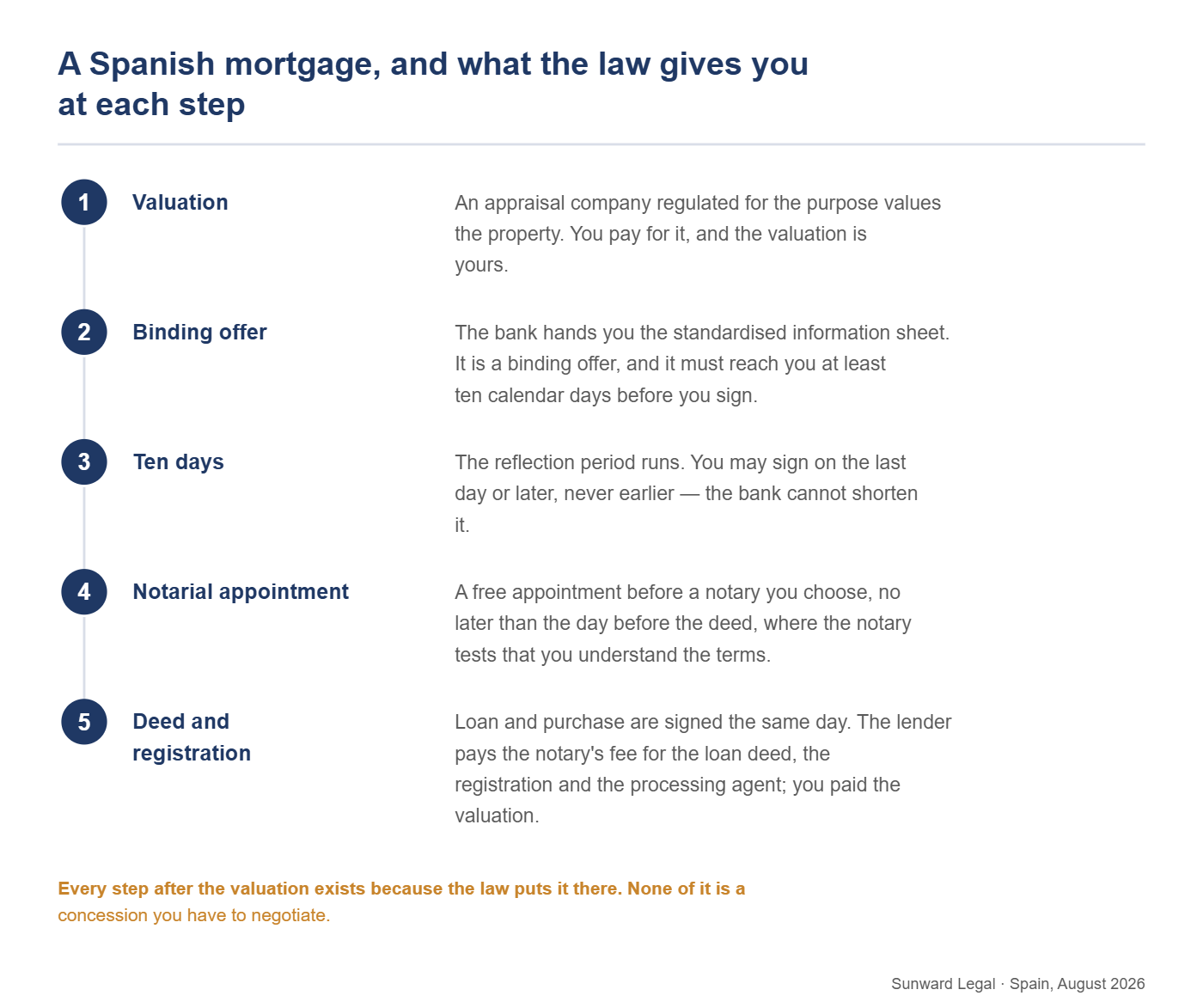
A Spanish mortgage runs on a legal timetable that the bank cannot compress: a binding offer in your hands at least ten calendar days before signing, and a free appointment before a notary you choose, at the latest the day before the deed. Those protections apply to you as a non-resident buyer on exactly the same terms as to a Spanish one. The part nobody hands you is the clause in the deposit contract that gets your money back if the loan does not come through.
Sunward Legal · Marbella. Last substantive review: 22 August 2026.
Does Spanish mortgage protection apply to a non-resident buyer?
Yes. Taking a Spanish mortgage as a non-resident gives you the same statutory protections as a Spanish borrower: the law applies whenever an individual borrows against residential property in Spain — the test is the kind of borrower and the kind of property, not the borrower’s nationality or where they live. There is no separate, thinner regime for foreign buyers. A British or Swedish purchaser borrowing on a flat in Marbella gets the ten-day reflection period, the free preliminary notarial appointment and the statutory allocation of costs.
What does differ between a resident and a non-resident buyer is the bank’s own lending policy: how much a given bank will advance against a given property to a borrower whose income arrives from abroad. That is commercial, it varies by institution and by month, and it is not published anywhere official. Any article that gives you a firm percentage is quoting a rumour. The honest answer is that the figure comes from the bank, in writing, in the binding offer — which is exactly the document the law makes them give you early.
You can read Spain’s mortgage law in full; what follows is the part that changes what you do.
The ten days that are yours
The centrepiece of the process is a standardised information sheet — the FEIN — which the bank must deliver to you and which counts as a binding offer. From the moment it reaches you, a minimum of ten calendar days must pass before you can sign the deed.
That period is not a formality and it is not waivable by agreement. It exists so that the terms arrive before the momentum does: the rate and how it is set, the term, the total cost, the early-repayment terms, any linked products. Ten days is enough to read it, to have someone read it for you, and to compare it with a second offer.
A practical consequence for a purchase running on a deposit contract with a fixed completion date: the mortgage timetable has to be built backwards from that date, and the ten days are a hard floor in the calculation. This is one of the commonest causes of a completion being pushed — not a refusal, simply an offer that arrived too late to allow the period to run.
The notarial appointment before the deed
Before the mortgage deed is signed, you attend a separate, free appointment before a notary of your own choosing. The notary goes through the documentation the bank has sent, answers your questions and records that you have received the information and understood the terms. It generates a notarial record without which the mortgage deed cannot properly be authorised.
Two features of it matter to a foreign buyer. First, the appointment carries no charge at all — the law says so expressly, and a fee for it would be wrong. Second, you choose the notary, not the bank and not the estate agent. That choice is worth exercising: the notary who will handle the purchase can be the same one, and a notary who is used to explaining a Spanish deed to a buyer working in a second language will do it properly.
It is also worth being clear about what this appointment is and is not. The notary verifies that the information reached you and tests your understanding of the terms; the notary is not your adviser and does not negotiate with the bank on your behalf. In a Spanish transaction the notary is impartial by design — which is precisely why a buyer needs someone whose only client is the buyer.
Who pays what
| Item | Who pays it |
|---|---|
| Property valuation | You, the borrower |
| Notary’s fee on the mortgage deed | The lender |
| Registration of the mortgage | The lender |
| Processing agent (gestoría) | The lender |
| The preliminary notarial appointment | Nobody — it is free by law |
| Copies of the deed | Whoever asks for them |
This allocation is set by statute and is not a matter for negotiation. The stamp duty on the loan deed also falls on the lender under the tax rules, rather than on the borrower as it once did. The valuation is the borrower’s cost, and there is a reason to be glad of that: because you commission and pay for it, the valuation belongs to you, and you can take it to another bank. The allocation is set out in the consolidated text of the mortgage law.
Note what is *not* on that table. These are the costs of the loan. The taxes and costs of the purchase — transfer tax at 7% on a resale in Andalucía, or 10% VAT — the rate confirmed in the tax agency’s published VAT rates — plus 1.2% stamp duty on a new build, plus the notarial and registration costs of the purchase deed itself and your own lawyer — sit outside it and are the buyer’s. As a rule of thumb, budget 10–13% of the price on top for the whole purchase; that figure is a market orientation rather than a legal rate, and it moves with the property and the financing.
Two things the bank will insist on, and what the law says about them
The valuation. It must be carried out by an appraisal company or service regulated for the purpose, working to recognised valuation standards, and independent of the lender. The bank cannot simply put its own number on the property. If the valuation comes in below the price you agreed, that is information about the price, not only about the loan.
Linked products. Tying the loan to other products — an insurance policy, a pension plan, a payroll account — is prohibited as a general rule, with defined exceptions. Where the bank may require an insurance policy, it must accept an equivalent alternative policy from another provider. Bundled offers you take up voluntarily, because the combined package is genuinely better, remain lawful. The line runs between “you may not have this loan unless you buy our insurance” and “here is a better rate if you also take our insurance”.
Read those two paragraphs together and you have the practical test: anything presented as a non-negotiable extra deserves a second look before you sign.
About to sign a deposit contract with a mortgage still pending? Book a free 20-minute call and we will look at the financing clause before you commit the deposit. In English, Spanish or Swedish.
The clause that protects the deposit
This is the part that has nothing to do with the bank and everything to do with the purchase contract — and it is where non-resident buyers lose real money.
A Spanish purchase typically runs on a private deposit contract signed weeks or months before completion, with 10% of the price paid over. If that contract is silent about financing and the mortgage is then refused, the buyer who cannot complete is the buyer who walks away — and under a penitential deposit arrangement, walking away costs the deposit.
The answer is a financing condition: a clause making the buyer’s obligation conditional on obtaining a mortgage on defined terms, by a defined date, with the deposit returned if it does not arrive. Drafting it well takes some care. The amount, the maximum rate and the deadline should be specific enough to be verifiable, and the clause should say what the buyer must do — apply to named lenders, within a set period, and produce the refusal in writing — so that the seller is not exposed to a buyer who simply changed their mind.
Note also that the character of the deposit itself is not a formality in Spain: a deposit is not treated as penitential — the kind you may forfeit in order to withdraw — unless the parties said so clearly. Which regime applies decides what happens when someone does not complete, and it is decided by drafting. We deal with that separately in Spanish, in las arras penitenciales no se presumen.
What goes wrong
The offer that arrives four days before completion. The valuation is late, the file sits with the bank’s risk department, and the binding offer lands with less than ten days to run. The ten days cannot be waived, so completion moves — and if the deposit contract set a hard date with forfeiture attached, the buyer is negotiating an extension from a weak position. Building the mortgage timetable backwards from the completion date, at the point the deposit contract is drafted, avoids the whole problem.
The buyer who assumed a pre-approval was an offer. An indication of what a bank might lend, given before the property was chosen and before it was valued, is not a commitment. The commitment is the binding offer, on this property, at this valuation. Signing a deposit contract on the strength of a pre-approval and no financing clause is the most expensive shortcut in this whole process.
The mortgage taken out on the wrong owner. Where the property is being bought in joint names, or through a company, or where one spouse is the earner and the other will be on the deed, the lender’s requirements and the ownership structure have to be settled before the offer is issued rather than at the notary’s table. Changing the buyer’s name after the offer means starting the process again — including the ten days.
Questions, answered
How much will a Spanish bank lend me as a non-resident?
There is no legal answer to that, and anyone giving you a firm percentage is guessing: lending ratios are each bank’s commercial policy and are not published by any official source. The binding offer is where you get a real figure, on a real property, and the law makes the bank give it to you early enough to compare with another.
Do I have to be in Spain to sign the mortgage?
You have to be represented. The mortgage deed and the preliminary notarial appointment can both be handled through a power of attorney granted before a notary at home and apostilled, or before a Spanish consulate. How a fully remote purchase works, step by step, is set out in buying property in Spain from the UK.
Can the bank charge me for the preliminary notarial appointment?
No. The law states that it generates no notarial fee at all. If a charge for it appears on a completion statement, it is wrong and should be queried before signing.
Does the mortgage change what I owe the Spanish tax office each year?
It changes what you may deduct only if you are resident in the EU or the EEA and you let the property. Owners resident outside that zone — British owners since 2021 — are taxed on gross rental income with no deduction for mortgage interest. The annual position is set out in the non-resident property tax return.
Will the bank ask where the money comes from?
Yes, and so will the notary. Banks and notaries are both subject to Spain’s anti-money-laundering rules: they must identify you, establish the beneficial owner where a company is involved, and understand the source of the funds. The means of payment are recorded in the deed itself. Assembling that evidence early — sale of a previous property, savings history, a gift properly documented — prevents a delay at the worst possible moment.
Where this leaves you
The Spanish mortgage process gives a non-resident buyer more protection than most people expect, and the two protections that matter most are calendar items: ten days with a binding offer in hand, and a free appointment with a notary you picked. Plan the purchase so that both of them fall comfortably before completion rather than against it.
Then spend the effort where the exposure actually is. The bank’s paperwork is regulated to within an inch of its life; the private deposit contract you sign months earlier is not, and it is the document that decides whether a mortgage refusal costs you 10% of the price or nothing at all. Get that clause right first. The rest of the purchase, and the checks that go with it, are set out in our Spanish conveyancing service and in the pitfalls of buying property in Spain.
Book a free 20-minute call, at no cost, in English, Spanish or Swedish. Send us the deposit contract and the bank’s offer, and we will tell you what the financing clause protects and what it does not.
General information on Spanish law, not advice on a particular transaction. It reflects the rules in force on 22 August 2026. Sources: Ley 5/2019, de 15 de marzo, reguladora de los contratos de crédito inmobiliario, arts. 2.1, 10.2, 13, 14.1.a), 14.1.e), 14.1.g), 15 and 17; Ley 2/1981 de regulación del mercado hipotecario and Orden ECO/805/2003 on valuation; Real Decreto Legislativo 1/1993 (TRLITPAJD), art. 29, on the taxpayer for stamp duty on the loan deed, in the wording given by Real Decreto-ley 17/2018; Ley 5/2021 de Tributos Cedidos de Andalucía, arts. 41, 43 and 50; Ley 37/1992 del IVA, art. 91.Uno.1.7.º; Ley 10/2010 de prevención del blanqueo de capitales, arts. 2 to 5; Código Civil, art. 1454, and Sentencia del Tribunal Supremo 583/2018 on penitential deposits; Real Decreto Legislativo 5/2004 (TRLIRNR), arts. 24.1, 24.6 and 25.1.a). Lending ratios for non-residents are not published by any official source and are not stated here. The 10–13% total purchase cost is a market estimate, not a legal rate.