You can obtain a Spanish NIE without leaving the United Kingdom, in one of two ways: apply at the Spanish consulate that covers where you live, or give a lawyer in Spain a power of attorney to do it for you. The third route, applying in person at a police station in Spain, is the fastest once you have an appointment and the hardest to get an appointment for. The form is the EX-15.
Sunward Legal · Marbella. Last substantive review: 14 August 2026.
What is the NIE, and what is it not?
The NIE is an identification and tax number that Spain assigns to foreigners with economic, professional or social interests in the country, under the immigration rules. It is a number, nothing more. It does not make you a resident, it does not make you a Spanish taxpayer, and it does not expire. Nor does the purchase it is normally requested for: Spain’s residence-by-investment permit was repealed outright with effect from 3 April 2025, and nothing took its place.
It gets confused with two other documents, and the confusion causes real delays. The TIE is the physical residence card issued to non-EU nationals who live in Spain. The EU registration certificate is what EU citizens obtain when they move here for longer than three months, and it requires proof of work, sufficient resources or student status under the EU free-movement rules. Both of those are immigration documents. The NIE is simply the number printed on them, and you can hold one for life while spending a fortnight a year in Spain.
When do you actually need it?
Earlier than most buyers assume. The hard deadline is completion: the deed of sale cannot be signed without an NIE for every buyer named in it, both spouses included. Banks are more flexible and will usually open a non-resident account on a passport, but no bank will complete a mortgage without the number. It outlasts the purchase as well: selling a Spanish property from abroad runs through the same NIE, and the obligations that appear there attach to the seller’s non-residence rather than to the property.
The sensible moment to start is the week you sign the reservation, not the week before completion. Having it early costs nothing. Having it late costs a completion date, and a missed completion date under an arras contract has a price attached to it. It is the first step in the legal sequence for buying a holiday home in Spain, and the one whose timing you control most easily. It is also the cheapest of the risks on a Spanish purchase that actually cost money to remove, because it is the only one that depends entirely on when you start.
The three routes, compared
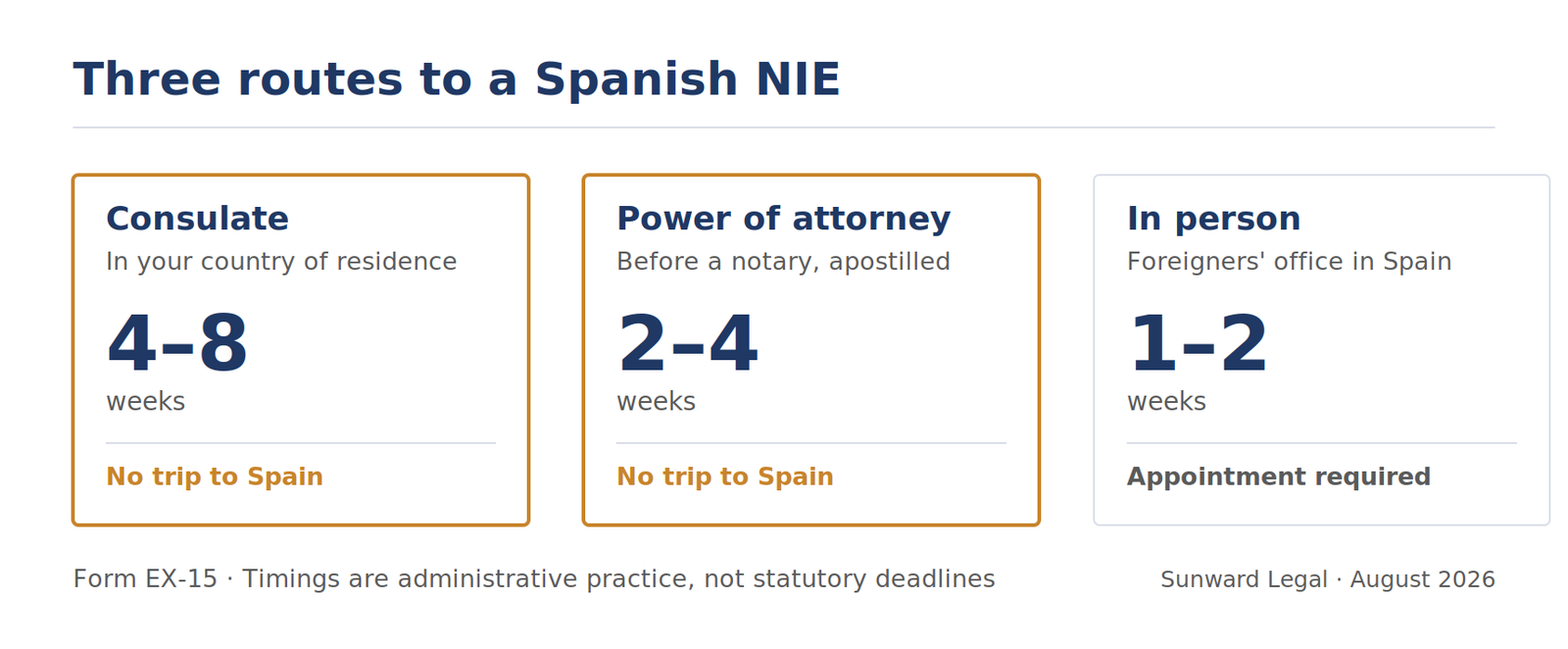
Three routes lead to the same number, and the cost is practically the same on all three; what differs is where you file and how long it takes. Two can be done without leaving the United Kingdom — the consulate and a power of attorney. The third is filed in person in Spain.
| Route | Where you apply | Realistic timing | Best for |
|---|---|---|---|
| Spanish consulate in the UK | London, Edinburgh or Manchester, depending on where you live | Four to eight weeks door to door | Buyers planning months ahead who prefer to finish paperwork before travelling |
| Power of attorney | Signed before a notary near you and apostilled, or at a Spanish consulate | Around two to four weeks from the day the power reaches Spain | Anyone who would rather not spend a trip on administration |
| In person in Spain | National Police foreigners’ office, by prior appointment | One to two weeks once the appointment is secured | Buyers already in Spain who can get a *cita previa* |
The timings above are ordinary administrative practice rather than statutory deadlines, and they move with the season. Build a margin into your purchase calendar rather than an excuse into your completion clause.
What goes in the application
Four items, whichever route you take: the EX-15 application form, your passport with a photocopy of the biographical page, evidence of the economic interest that justifies the number, and proof that the fee has been paid. The file is short, which is why the delay is almost never here.
- The EX-15 form, completed and signed. It is the official application for an NIE and for certificates relating to it.
- Your passport, plus a photocopy of the biographical page.
- Proof of why you need the number. For a buyer this is normally the reservation or arras contract. The requirement is an economic interest in Spain, and a signed purchase document is the clearest evidence of one.
- The fee, paid on form 790, code 012, at a Spanish bank before the appointment.
The bottleneck is never the paperwork
It is the appointment. The *cita previa* system releases slots online, and on the Costa del Sol during high season they disappear within minutes of being published — in large part because unofficial intermediaries harvest them in bulk and resell them. Nothing about that is your fault and nothing about it is likely to change soon.
Two practical responses. If Marbella shows nothing, look at neighbouring towns: any foreigners’ office can assign the number and the drive is often quicker than the wait. And if you are still abroad, the appointment problem is somebody else’s to solve — which is the real argument for the consulate route or a power of attorney, more than the saving on the flight.
Buying on the Costa del Sol this year? Book a free 20-minute call and we will tell you which of the three routes is fastest for your situation and what your purchase calendar can safely assume.
How the power of attorney route works
You sign a power of attorney before a notary in the United Kingdom, have it apostilled under the Hague Convention, and send it to Spain. Your lawyer then applies for the NIE and collects it on your behalf. That instruction normally sits inside a wider retainer for independent conveyancing in Spain, which is where the scope of the power gets settled alongside everything else.
The same power will usually cover more than the NIE: opening a bank account if the transaction needs one, signing the arras contract, and completing the purchase if you would rather not travel for that either. One signature at home can replace three trips. Whether you want it to go that far is a decision worth taking deliberately — a power of attorney is a serious document, its scope should be drawn precisely, and it should be time-limited.
What usually goes wrong
Only one spouse applies. Every buyer who will appear on the deed needs a number of their own, because the NIE is personal and cannot be shared between two people. Couples buying jointly discover this at the worst possible moment, which is when the notary reads the deed.
The application is left until the mortgage is agreed. By then the completion date is fixed and the margin has gone.
A certificate that has aged out. The number does not expire, but the paper can. The non-resident certificate is valid for three months from issue, and a bank or a notary may reasonably ask for a recent one. A duplicate can be requested at any time; it is an administrative errand, not a fresh application.
Questions, answered
Does the NIE expire?
The number does not — it is personal, unique and permanent. What can expire is the document evidencing it: a non-resident certificate is valid for three months from the date of issue, and a TIE card has its own validity period. If a bank asks for a “current NIE”, it is asking for a recent certificate.
Does having an NIE make me tax resident in Spain?
No. Tax residence depends mainly on spending more than 183 days a year in Spain, or having the main base of your economic interests here, under Spanish income tax rules. The NIE is an identifier, not a status. You can hold one and remain fully non-resident. Actually moving here is a separate decision with its own sequence, and where the Spanish tax line falls rests on more than the 183-day count.
Can my spouse and I share one number?
No. The NIE is personal and unique to each individual. Every buyer named in the deed of sale needs their own, which is why couples should apply together and early.
I am an EU citizen. Is anything different?
For a holiday-home purchase, no: the NIE alone is enough. It changes only if you move here. Stays beyond three months require registering with the Central Foreigners’ Register and proving employment, self-employment, sufficient resources or student status.
Can I use an old NIE from years ago?
Yes. If Spain assigned you a number at any point — a previous purchase, a job, a study period — that number remains yours. You do not apply again; you request a certificate confirming it.
Where to start
The useful sequence for a buyer: apply for the NIE the week you sign the reservation, decide then how far the power of attorney should reach, and have the reservation contract read before you pay it. Of the three, the NIE is the easiest to arrange and the most expensive to leave late.
Book a free 20-minute call, in English, Spanish or Swedish, and we will confirm the fastest route for your circumstances.
This article is general information about Spanish law and not advice on your particular case. It reflects the rules in force on 14 August 2026; administrative fees and processing times change. Sources cited: art. 205 of the Immigration Regulation approved by Royal Decree 1155/2024, which replaced Royal Decree 557/2011 with effect from 20 May 2025; Royal Decree 240/2007 on EU citizens; art. 9 of Ley 35/2006 on personal income tax; fee and forms as published by the Spanish National Police.