If you own a home in Spain and do not live here, Spain taxes you on it every year — even if you never let it and even if it stands empty for eleven months. The law imputes a notional income to the property, calculated on its cadastral value, and it is declared on form 210. Most owners find out about it years late, from a letter.
Sunward Legal · Marbella. Last substantive review: 22 August 2026.
What is the annual non-resident tax on a Spanish property?
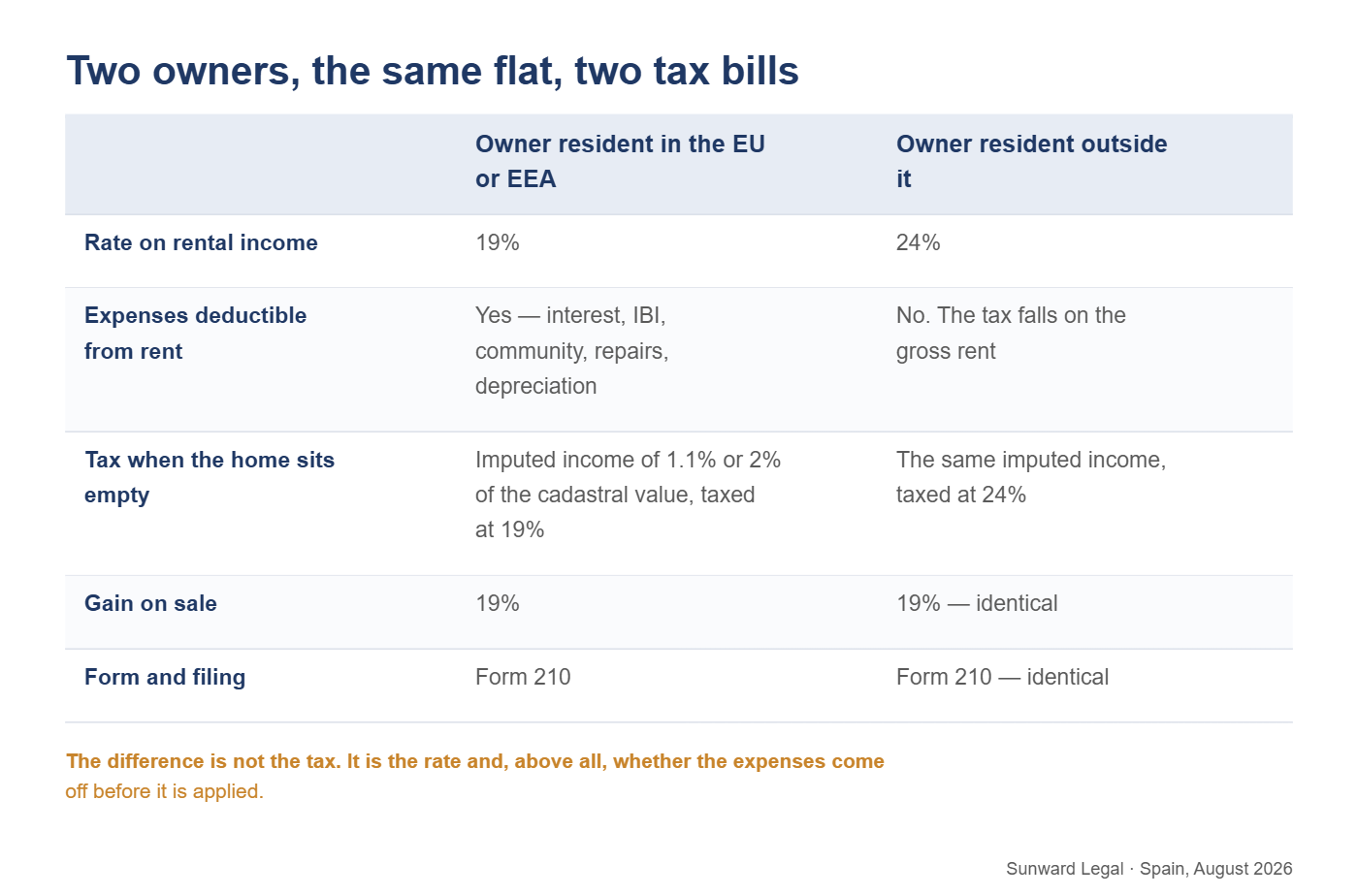
The non-resident property tax in Spain is, strictly, the non-resident income tax charged on the property itself. Where a second home is at your disposal and not let, the law treats it as producing an income and taxes that. The amount is 1.1% of the cadastral value where that value comes from a general revision in force in the last ten tax periods, and 2% otherwise — and the rate applied to it is 19% for owners resident in the EU or the EEA and 24% for everyone else.
Two features catch people out. Nothing may be deducted from the imputed income — not the mortgage, not the community charges, not the IBI. And it is due for every year you owned the property, prorated by days if you bought or sold mid-year, or if you let it for part of the year and it was at your disposal for the rest.
The Spanish tax agency’s page on imputed income from a property of one’s own use sets out the calculation.
Isn’t that what IBI is?
No, and this is the single most common misunderstanding in this area. They are different taxes, owed to different authorities, on different bases.
| IBI | Non-resident income tax | |
|---|---|---|
| Who charges it | Your town hall | The Spanish state tax agency |
| What it is | A local property tax on ownership | Income tax on the income the property is treated as producing |
| Base | The cadastral value, at a municipal rate | 1.1% or 2% of the cadastral value, at 19% or 24% |
| How it is paid | Usually a direct debit set up locally | You file form 210. Nobody sends you a bill |
That last line is the crux. IBI arrives; the non-resident return does not. There is no Spanish equivalent of a coding notice, no reminder, and no assessment. The obligation is to file on your own initiative — which is why an owner can hold a property for a decade in perfect good faith and never file once.
The 2026 deadlines, which are not the ones most guides give
The filing calendar changed for income arising from 2026 onwards, and a great deal of what is published still gives the old dates.
| What you are declaring | Filing period |
|---|---|
| Imputed income on an unlet home (accruals from 2026) | 1 April to 31 December of the following year |
| Rental income | 1 to 20 April |
| Gain on a sale | Within the period following the transfer, on the same form |
Set against the old regime — which ran the imputed-income filing through the whole of the following calendar year — the practical change is that the window now opens in April rather than in January. If you are working from an article written before the change, or from an accountant’s diary note that has not been updated, check the year the source was written.
The rate that applies to a British owner
24%, on gross rents, with no deduction for expenses. This is the substantive consequence of leaving the EU, and it is larger than the five-point gap in the headline rate suggests.
The deduction of expenses from rental income is available only to owners resident in the EU or the EEA with effective exchange of information — a closed list that runs to the EU member states, Iceland, Norway and Liechtenstein. An owner in that list deducts mortgage interest, IBI, community charges, insurance, repairs, agency fees and depreciation, and pays 19% on the profit. An owner outside it pays 24% on the whole rent.
Work an example. Two identical flats let for the same gross rent, one owned from Dublin and one from Bristol. The Dublin owner deducts the running costs and is taxed on what is left; the Bristol owner is taxed on the rent as it arrives. Where the running costs absorb a substantial share of the rent — which, with a mortgage, they usually do — the Bristol owner’s effective tax on actual profit is a multiple of the Dublin owner’s.
The list of who may deduct is on the tax agency’s page on letting a property as a non-resident, and the rates themselves on its table of non-resident tax rates. What else changed for British owners after 2020 is collected in buying property in Spain after Brexit.
The other annual tax, for larger holdings
Non-residents are also within the scope of Spanish wealth tax on assets situated in Spain, with a minimum exempt amount of €700,000 applying to them. Above that, the tax bites on the Spanish assets only.
A parallel state-level tax on large fortunes — aimed at net wealth above €3,000,000, with wealth tax already paid deducted from it — remains in force in 2026, and it reaches non-residents on the same basis of assets situated in Spain. Andalucía’s own treatment of wealth tax has been adjusted while that state tax exists, so the practical outcome for a property here depends on the interaction between the two; the Junta de Andalucía publishes the current position on wealth tax in Andalucía.
For the great majority of second homes in the 300,000 to 1,500,000 euro range, held individually or between two spouses, this is a check rather than a liability. It is worth doing the check once rather than assuming.
Never filed a form 210? Book a free 20-minute call and we will tell you which years are open, what they add up to and how the voluntary route works. In English, Spanish or Swedish.
What to do if you have never filed
First, the reassuring part: this is a common situation, it is fixable, and fixing it is a filing exercise rather than a dispute. The liability on an unlet flat is modest per year; what makes people anxious is the accumulation and the uncertainty, both of which end once the returns are in.
Second, the part that decides the cost, and it is worth knowing the numbers. A return filed on your own initiative, before the tax office writes to you, carries a surcharge of 1% of the tax due plus a further 1% for each complete month of delay — so a filing five months late carries 6%. Once more than twelve months have passed the surcharge is 15%, and late-payment interest runs from the end of that twelfth month. Two features make the voluntary route markedly cheaper: the surcharge excludes any penalty, and it is reduced by 25% where the assessment and the surcharge are paid within the period given. A filing prompted by a letter from the tax office loses all of that and opens the door to a penalty instead.
Third, the practical sequence. Establish the cadastral value from the IBI receipt and whether the municipality’s values were revised, calculate the imputed income year by year, identify which years remain open, and file them. Where the property was let for part of a year, the two regimes are split across the same year by days.
If the property is being sold, the position is different again: the buyer withholds 3% of the price on account of your tax and the gain is settled separately. That process is set out in selling property in Spain as a non-resident.
What goes wrong
The owner who lets through a platform and files nothing. Short-term letting income is Spanish-source income and is declared on form 210 in April. Platforms report; the tax office cross-checks. This is the version of the problem most likely to produce a letter rather than to lie undiscovered, and the one where filing voluntarily first is worth the most.
The estate that discovers ten unfiled years. The children inherit a flat in Andalucía and find that the annual return was never made. It surfaces at the worst moment — with an inheritance tax deadline running — and delays a sale. Filing the open years while the owner is alive is a small piece of admin; doing it inside an estate is not.
The owner who believed the agent’s “the IBI covers everything”. It does not, and the sentence is usually said in good faith by someone whose job ends at completion. The imputed-income return is nobody’s responsibility but the owner’s, which is why it goes unfiled for years.
Questions, answered
Do I have to file if my Spanish property is empty all year?
Yes. The tax is on an income the law imputes to a home that is at your disposal, not on income you actually received. An empty flat produces a return; only a property that was let for the whole year is taken out of the imputed-income regime, and then the rent is declared instead.
How much is it, roughly?
It is a function of the cadastral value on your IBI receipt, not of the market price. The taxable amount is 1.1% of that value where the municipality’s values were revised in the last ten tax periods and 2% where they were not, and the tax is 19% or 24% of that figure depending on where you live. It is generally a modest annual amount — which is exactly why leaving it unfiled for a decade is worse than it needs to be.
Can I deduct my mortgage interest?
Only if you are resident in the EU or the EEA, and only against actual rental income. Nothing at all may be deducted from imputed income, by any owner. A British owner letting a Spanish flat since 2021 is taxed on gross rent.
Do I need a fiscal representative in Spain?
Not as a general requirement for an individual owner filing form 210 from another country. In practice most non-resident owners appoint someone to handle the annual filings, keep the cadastral data current and receive correspondence in Spain, because the return has to be made on the owner’s own initiative and it is the forgetting, not the tax, that costs money.
If I sell, does the 3% withholding cover this?
No. That withholding is on account of the tax on the gain, and it is a separate matter from the annual returns. Unfiled annual returns remain due, and the sale tends to be the moment they surface — the more so because the buyer’s side will be looking at the property’s position. The mechanics are in selling property in Spain.
Where this leaves you
Two checks are worth doing this month, whatever else is going on with the property. Pull out the last IBI receipt and find the cadastral value; then ask whether a form 210 has been filed for every year you have owned the place. If the answer to the second is no, the years are calculable, the tax is modest and the route through it is a voluntary filing rather than an argument.
For a new purchase, the honest budgeting line is that the running cost of a Spanish second home is IBI plus community charges plus this return plus insurance, and that the last of those is the one nobody mentions at the viewing. It belongs in the numbers from the start, alongside the costs and checks of the purchase itself and the traps worth knowing about before you commit.
Book a free 20-minute call, at no cost, in English, Spanish or Swedish. Send us the IBI receipt and tell us when you bought, and we will tell you what is outstanding and what the annual position looks like from here.
General information on Spanish law, not advice on a particular case. It reflects the rules in force on 22 August 2026; rates and filing periods change. Sources: Real Decreto Legislativo 5/2004, texto refundido de la Ley del Impuesto sobre la Renta de no Residentes, arts. 13.1.h), 24.1, 24.6, 25.1.a), 25.1.f).3.º and 25.2; Ley 35/2006 del IRPF, art. 85.1; Orden HAC/623/2026, on the filing periods of form 210 for accruals from 2026; Real Decreto Legislativo 2/2004 (TRLHL), arts. 63, 64 and 75, on IBI; Ley 19/1991 del Impuesto sobre el Patrimonio, arts. 5.Uno.b), 28 and 37; Ley 38/2022, art. 3, on the temporary solidarity tax on large fortunes, extended by Real Decreto-ley 8/2023; Ley 5/2021 de Tributos Cedidos de Andalucía; Ley 58/2003 General Tributaria, art. 27, in the wording given by Ley 11/2021, on surcharges for returns filed late without a prior request from the tax authority.