If you are British and own a home in Spain, one clause in your will decides which country’s rules govern your estate: an express choice of the law of your nationality, made under the EU Succession Regulation. Without that clause, your estate is governed by the law of the country where you are habitually resident when you die — and if that country is Spain, Spanish law reserves two thirds of your estate for your children, whatever your will says.
Sunward Legal · Marbella. Last substantive review: 22 August 2026.
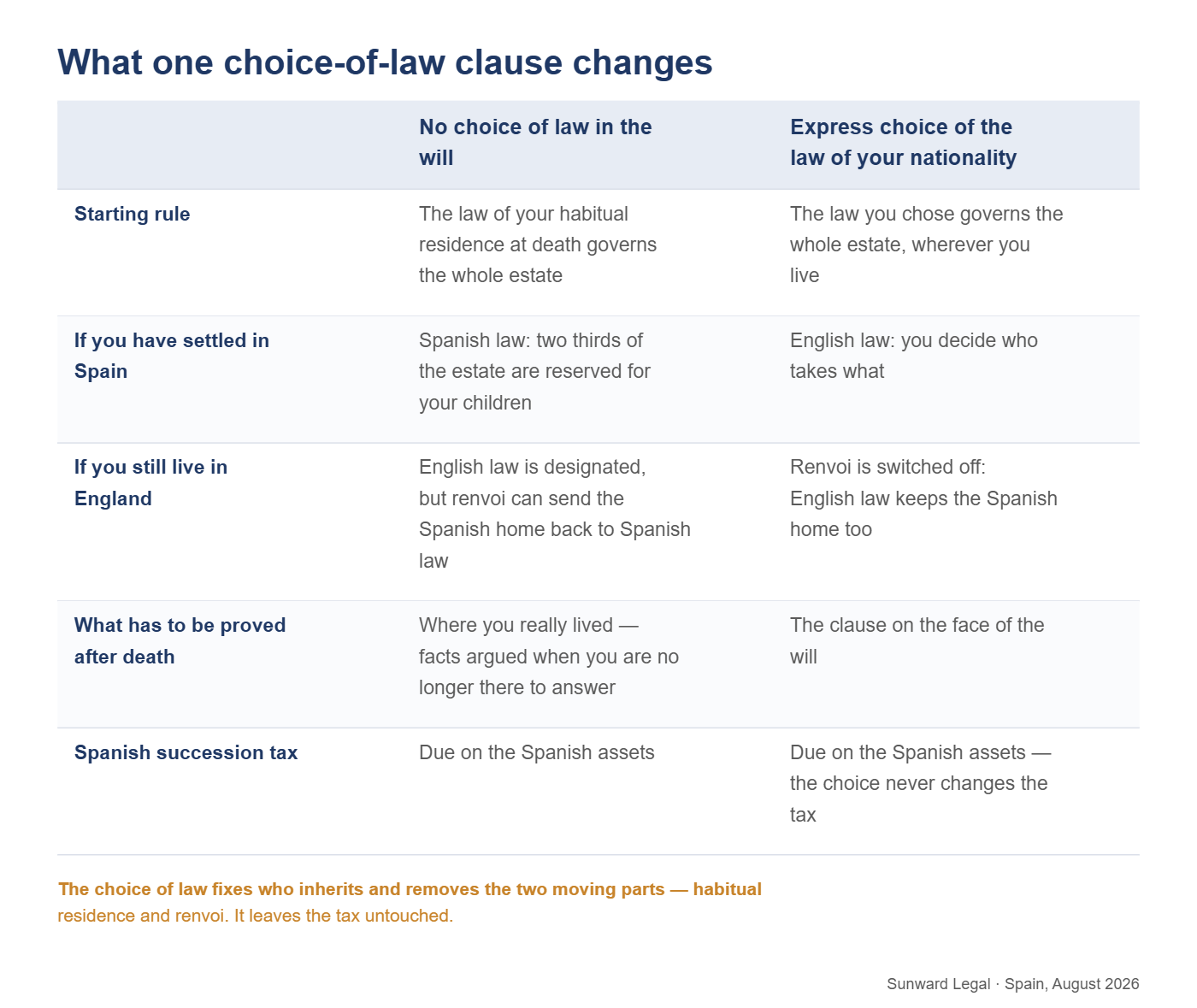
Which law governs your estate if your will says nothing?
The default rule is habitual residence. The EU Succession Regulation applies the law of the State in which you were habitually resident at your death to your whole estate — the Spanish flat, the English house, the bank accounts, all of it. A Briton who has genuinely settled in Spain dies under Spanish succession law.
Two features of that rule deserve attention. The first is unity: one law for everything, not one law per country where you own assets. The second is that habitual residence is a question of fact, weighed after your death from the pattern of your life — where you lived, for how long, with what ties. It is not a box you tick, and in a life split between Surrey and Marbella it can be genuinely arguable. An estate whose governing law is arguable is an estate whose outcome is arguable.
The Regulation has applied to the successions of people dying on or after 17 August 2015, whatever the date of the will.
Does the Regulation apply to a British estate at all?
Yes, whenever a Spanish authority deals with the estate. The EU Succession Regulation in Spain applies to every estate a Spanish notary or court handles, whatever the deceased’s nationality. The United Kingdom never took part in the Regulation — it stayed out when the rules were adopted in 2012, an original opt-out rather than a consequence of Brexit — but the Regulation applies universally: a Spanish notary or court applies whatever law it designates, even the law of a non-member country.
That is the whole architecture of a cross-border inheritance between the UK and Spain. Britain is what the Regulation calls a third State. English authorities are not bound by the Regulation and continue to apply their own rules; Spanish authorities are bound by it and will use it to decide which law governs your Spanish assets. Both things are true at once, which is why the estate has to be planned from both ends.
The full text of the EU Succession Regulation is public, and the European Commission’s e-Justice pages on succession summarise how each member state operates it.
The professio iuris: choosing the law of your nationality
The Regulation lets you displace the default. You may choose, as the law governing your succession as a whole, the law of the State whose nationality you hold — at the time of the choice or at the time of death. The choice is made in a will or other disposition of property upon death, and it works even though the United Kingdom is a third State: nothing in the rule limits it to the nationalities of member states.
Lawyers call it the professio iuris, and it is the single most useful clause in the will of a Briton with Spanish property. Made expressly, it means a Spanish notary handling your estate applies English law because your will says so — not because of an argument about where you really lived.
The choice can also be implicit. A will that refers to specific provisions or institutions of English law, or is otherwise plainly drawn on the footing of English law, can be treated as demonstrating a choice. That has rescued many older English wills. But rescued is the operative word: an implicit choice is something a notary or a court has to be persuaded of, possibly against an heir who does better under Spanish law. The express clause costs one sentence and ends the argument before it starts.
Why the choice matters even if you still live in England
Because of renvoi. When the Regulation designates the law of a third State, it takes that country’s own conflict-of-laws rules with it — and under the traditional English conflict rules, succession to immovable property is governed by the law of the country where the property stands. Designating English law can therefore send the Spanish home straight back to Spanish law.
Follow the chain for a Briton who lives in England and dies owning a flat in Marbella, with no choice-of-law clause. The Regulation points to English law as the law of the habitual residence. English law, asked which system governs a Spanish flat, traditionally answers: the law of the place where the land lies. The Spanish authorities accept that reference back. Result: the estate splits — English law for most of it, Spanish law, with its reserved shares, for the flat.
Now add the clause. The Regulation is explicit that renvoi is excluded where the law was chosen. An express choice of English law means English law applies to the Spanish flat as English internal law, with no detour through anyone’s conflict rules. That is the practical conclusion of this whole area: the express choice is what converts a set of interlocking rules into a certainty.
What Spanish law would impose: the reserved share
Where Spanish common law governs — and it is the version of Spanish law that governs in Andalucía — your children are forced heirs. Two thirds of the estate are reserved for them: one third in equal shares, and a second third that you may distribute among children and grandchildren as you wish. Only the remaining third is freely disposable.
A surviving spouse who concurs with children does not take a reserved share of ownership, but a life interest — a usufruct — over one of the reserved thirds. For a British couple whose wills leave everything to each other outright, that structure is not a variation on their plan; it is a different plan. The concept of forced heirship is set out in the Spanish Civil Code, and several Spanish regions with their own civil law apply different reserved shares again.
English law sits at the other pole: freedom of testation, corrected after death rather than restricted before it. Certain family members and dependants can ask an English court for reasonable financial provision out of the estate under the English rules on family and dependant provision — a claim to be assessed, not a fixed share. Choosing English law does not import a two-thirds reserve through the back door.
Not sure which law governs your estate today? Send us your will — English, Spanish or both — and book a free 20-minute call. We will tell you which law currently applies, and whether a choice-of-law clause would change the outcome.
Should you have a Spanish will as well as an English one?
You are not obliged to. Formal validity is generously protected: under an international convention to which Spain is party, a will is valid in form if it complies with the law of the place where it was made, of the testator’s nationality, domicile or habitual residence or, for immovable property, of the place where the property lies. An English will properly executed in England is not invalid in Spain.
What is common in cross-border practice — and this is professional practice, not a legal requirement — is to run two wills in parallel: a Spanish will limited to the assets in Spain, and an English will for everything else. The Spanish will lets the Spanish estate be dealt with before a notary without waiting for English formalities, and it is the natural place to state the choice of English law. Why a Spanish will is worth having is developed in our note on Spanish wills, and what an English will can and cannot do here in English wills and Spanish property.
Two wills create one risk of their own: accidental revocation. English wills conventionally open by revoking “all former wills and testamentary dispositions”. Sign a new English will with that clause after making your Spanish will, and you may have revoked the Spanish will without anyone noticing until after your death. The cure is drafting, not abstinence: each will expressly limited to its own assets, revocation clauses limited to the same scope, and the choice of law stated consistently in both. Whenever either will is updated, the other is reviewed. That is a coordination discipline, and it is precisely the kind of point nobody at a signing table is responsible for unless you have instructed a lawyer of your own to be.
Does choosing English law change the Spanish inheritance tax?
No. The Regulation governs the civil side only — who inherits, in what shares, under which law — and expressly does not apply to tax. Spanish succession tax is due on Spanish assets by whoever inherits them, under Spanish tax rules, whichever country’s succession law decided that they inherit.
The two questions are decided by different rules and should be planned together but never confused. What the Spanish tax looks like for a UK-resident heir — including the regional rules a non-resident may apply in Andalucía — is the subject of our separate note on Spanish inheritance tax for non-residents.
What goes wrong
The couple who retired and never updated the wills. English mirror wills from the 1990s, everything to each other; fifteen years of habitual residence in Marbella; no express choice of law. On the first death the estate is governed by Spanish law unless the old will can be read as an implicit choice of English law. It may be — but a child of a first marriage who stands to take a reserved share has every incentive to argue that it cannot. An express clause, added at any point in those fifteen years, would have left nothing to argue about.
The new English will that silently kills the Spanish one. A Spanish will is made in 2022, limited to Spain. In 2025 the English solicitor updates the English will, opening with a general revocation clause. Nobody connects the two documents. At death, the Spanish will is arguably revoked, and the Spanish estate falls back to whatever the surviving dispositions and the default rules produce. The fix costs one line in the drafting — a revocation clause limited to the will’s own scope — and a habit of reviewing both wills together.
The “property is in Spain, so Spanish law applies” shortcut. A family assumes the flat simply follows Spanish law, or the reverse — that an English will controls it without more. Neither assumption survives contact with the actual rules: the governing law depends on habitual residence, any choice made, and renvoi. The shortcut produces the wrong plan in both directions, and the answer is to establish the governing law first and draft afterwards.
Questions, answered
Does Brexit change any of this?
No. The United Kingdom never participated in the Regulation, so its position did not change when it left the EU. A Spanish authority applied the Regulation to a British estate before Brexit and applies it in exactly the same way now. The choice of the law of your nationality was available to Britons then and remains available today.
My English will is years old and never mentions any regulation. Is it a problem?
It is valid in form, and if it is plainly built on English law it may even amount to an implicit choice of that law. The question is whether you want your estate to depend on “may”. A review — and, where appropriate, an express choice-of-law clause — converts a defensible position into a certain one.
If I choose English law, can my children still claim two thirds of the Spanish flat?
The Spanish reserved share is a rule of Spanish substantive law. Where a valid choice means English law governs the succession, that reserved share does not apply to it. English law has its own, different safety valve: a court application for reasonable provision by certain family members and dependants, assessed on the circumstances rather than fixed in advance.
What is the European Certificate of Succession, and do I need one?
A certificate created by the Regulation so that heirs, legatees and administrators can prove their status in other member states. It does not replace national documents — neither the Spanish notarial deed nor an English grant of probate — and it does not bind the United Kingdom, which the Regulation does not cover. For a British estate with Spanish assets, the document that does the work in Spain is the Spanish deed; for assets in the UK, the English process still applies.
Where do I actually make the choice of law?
In a will. It can sit in an English will or in a Spanish will; where there are two, it should be stated consistently in both. In practice the Spanish will limited to the Spanish assets is the natural home for it, because that is the document a Spanish notary will work from first.
Where this leaves you
The sequence is short. Establish which law governs your estate today — habitual residence, any implicit choice, renvoi and all. Decide which law you want. If the two differ, or if the current answer merely depends on argument, put the express choice in your will and coordinate the English and Spanish documents so that neither undoes the other. What happens after a death — the notarial deed, the tax return, the registration — is mapped in our note on Spanish probate, and the same ground is covered in Spanish in testamento extranjero en España.
Worth saying plainly: after a death, the notary attests, the registrar checks and the tax office collects — none of them designed the succession, and none of them will tell you, while you are alive, that your two wills contradict each other. The only person at that table working solely for your family is the lawyer you instruct.
Book a free 20-minute call, in English, Spanish or Swedish. Tell us where you live, what you own in Spain and what wills exist, and we will tell you which law governs your estate now and what one clause would change. No cost, no obligation.
General information about Spanish and EU law, not advice on a particular estate. It reflects the rules in force on 22 August 2026. Sources: Regulation (EU) No 650/2012, arts. 1.1, 20, 21.1, 22, 34, 62 and 63, art. 83.1 on its application to deaths on or after 17 August 2015, and recitals 39 and 82; Spanish Civil Code, arts. 806, 808 and 834 on the reserved share and the spouse’s usufruct; Inheritance (Provision for Family and Dependants) Act 1975, s. 1; Hague Convention of 5 October 1961 on the conflicts of laws relating to the form of testamentary dispositions, ratified by Spain (BOE-A-1988-20377); HMRC Residence, Domicile and Remittance Basis Manual, RDRM20050, on the English conflict rules for movable and immovable property. The observations on running an English and a Spanish will in parallel, and on limiting revocation clauses, reflect professional drafting practice rather than a statutory rule. Tax is governed separately by Ley 29/1987 del Impuesto sobre Sucesiones y Donaciones and, in Andalucía, Ley 5/2021 de Tributos Cedidos de Andalucía.