Most of what is published about the pitfalls of buying property in Spain is a list of frights with no price attached. The risks that actually cost money are few, each has a specific legal mechanism, and every one is defeated by a document requested or a sentence inserted before a particular step. Here is each mechanism, and each sentence.
Sunward Legal · Marbella. Last substantive review: 15 August 2026.
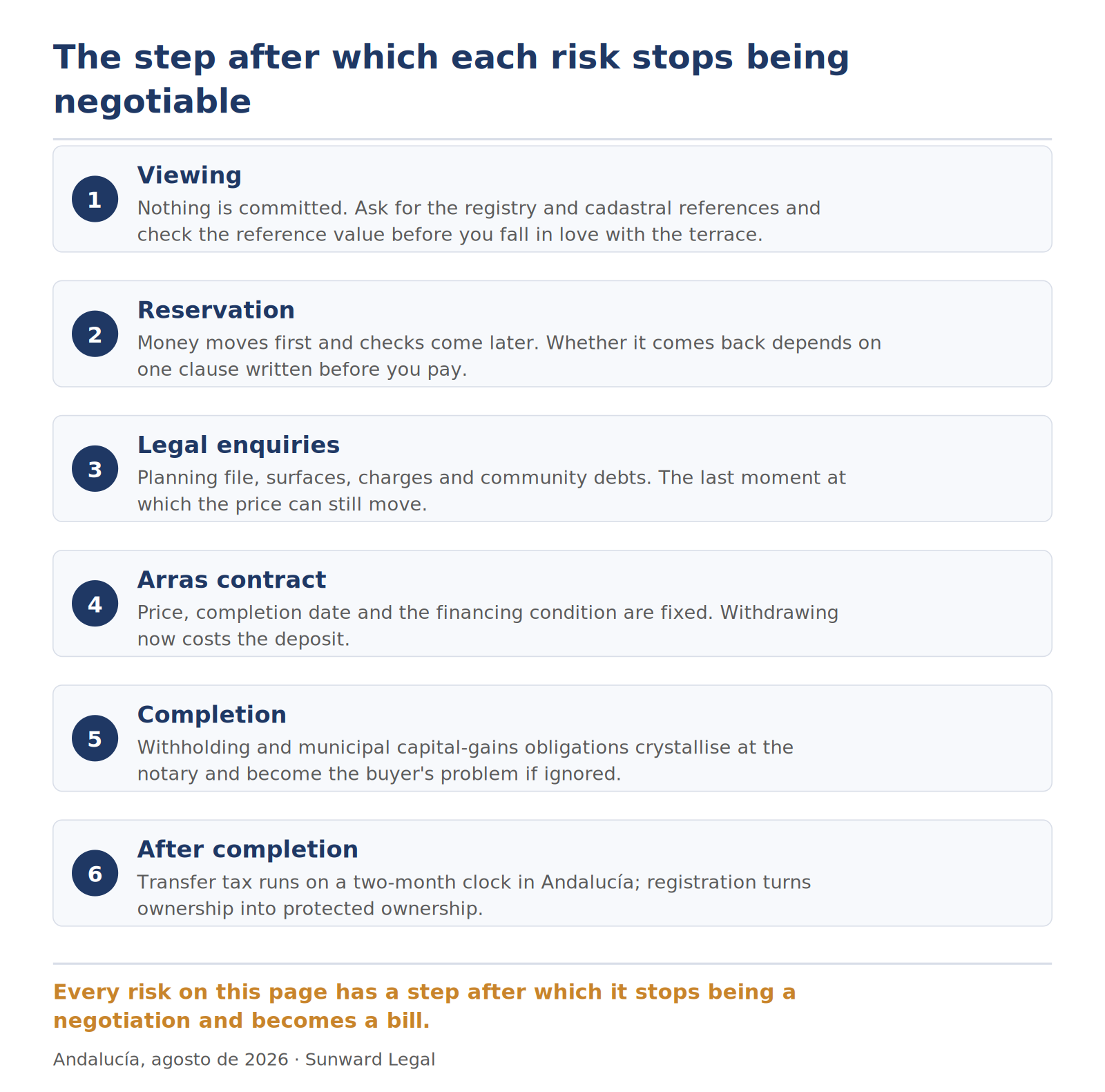
Which pitfalls actually cost money?
Eight. Three are contractual and are decided by wording you can still change. Three attach to the property itself and travel to you whatever the contract says. Two are tax obligations the law places on the buyer even though the money is the seller’s problem.
| Pitfall | What triggers the cost | Who ends up paying |
|---|---|---|
| Unlicensed extension | Works with no licence, or a building that is merely tolerated | Buyer: cannot extend, harder to finance, harder to resell |
| Non-refundable reservation | A defect appears after the deposit is paid | Buyer: the deposit |
| Arras with no financing clause | The bank refuses the loan after signature | Buyer: typically ten per cent of the price |
| No 3% withholding from a non-resident seller | Buyer failed to file form 211 | Buyer: the property answers for the seller’s tax |
| Municipal capital-gains tax unpaid | Seller is a non-resident individual | Buyer, as substitute taxpayer |
Position in Andalucía in August 2026. The rules behind each line are cited in full at the end.
The extension that was never licensed
Glazed terraces, extra bedrooms, pool houses and basements built without a municipal licence are common along this coast. Under the Andalusian planning act the town hall can act to restore planning legality while works are in progress and for six years after they are finished. Some cases have no time limit at all: public land, land subject to natural risks, the coastal protection strip, catalogued heritage, green zones and unlawful subdivisions of rural land.
Once those six years have run the building does not become legal. It becomes eligible for a status called *asimilado a fuera de ordenación* — assimilated to out-of-plan — recognised by the town hall on application, with a six-month resolution period. Here is the part most summaries get wrong: the AFO declaration expressly does not legalise the building. It permits connection to basic services and the conservation works needed to keep the property safe and habitable, and rules out extension, improvement and consolidation works. The status is noted in the Land Registry, so it follows the property to the next buyer.
The cost is rarely a demolition. It is the room you cannot regularise, the mortgage no lender will advance against unlicensed square metres, the letting licence that does not arrive, and the discount the next buyer’s lawyer will ask for.
How it is avoided. Ask the town hall for the planning position before the arras: licences granted, disciplinary files open, whether an AFO resolution exists. Then have an architect certify the age of the works, because that certificate decides whether the six years have actually run.
Three surfaces, and they rarely match
The property has a surface according to the Land Registry, a surface according to Catastro, and a surface you can measure with a tape. Where Catastro shows more square metres than the Registry, the usual explanation is works carried out and never declared. Where the building beats both, the usual explanation is works carried out without a licence.
The trap underneath is a belief that sounds sensible and is wrong: that if the extension appears in Catastro and you pay IBI on it, it must be lawful. Catastro is a fiscal register. It records physical reality, illegal reality included, and certifies nothing about planning. Far from protecting you, a cadastral record of the extension is documentary proof of its existence for the town hall.
A second signal sits in the *nota simple*, where almost no foreign buyer knows to look. A building registered as a new building by age — declared on a certificate of antiquity rather than a licence — was registered because time had run, not because anyone authorised it.
How it is avoided. Compare all three figures before signing, and read the registry history rather than only the current page.
The reservation deposit nobody has earned yet
On this coast the agent will ask for 3,000 to 10,000 € to take the property off the market. The form is normally the agency’s own, it is drafted for the seller, and it very often states the deposit is non-refundable — including where a lawyer later finds a planning irregularity or an undisclosed charge.
That is the whole mechanism: no rule makes a reservation deposit refundable, so the contract decides, and the contract was written by the other side. Money moves before anyone has read the *nota simple*.
How it is avoided. One sentence, inserted before payment: the deposit is returned in full if the legal enquiries reveal defects in title, planning status or charges. Asking costs nothing, and a seller who will not accept it has told you something worth knowing.
Arras signed with no financing condition
The arras contract is the private sale agreement, normally signed with ten per cent down. Under *arras penitenciales*, the deposit contract of article 1454 of the Civil Code, a buyer who withdraws loses the deposit and a seller who withdraws returns it doubled. Two things about it are less known, and both cost money.
Spanish law implies no mortgage condition. If your lender declines after you have signed and the contract says nothing about financing, the refusal is your risk, not a release: you withdraw and you lose the deposit. The provincial appeal courts decide these cases almost entirely on how the individual contract was drafted.
Penitential arras are not presumed. The Supreme Court reads the article restrictively and requires a clear, unequivocal intention from both parties; naming it in the contract is not enough (STS 583/2018). Where the drafting is ambiguous the deposit is treated as confirmatory, so neither side bought a right to walk away and the other party can demand the sale goes through. A buyer who thinks he paid for an exit, and discovers he paid the first instalment of a purchase he no longer wants, has a larger problem than a lost deposit.
How it is avoided. Write the financing condition in: a deadline, the lenders to be approached, an obligation to produce the refusal in writing, and the express consequence, which is full return of the deposit. And obtain a binding offer before the arras rather than after.
About to sign a reservation or an arras contract? Book a free 20-minute call and we will read the clause that decides whether your deposit is recoverable, while it can still be changed.
Debts that come with the flat, not with the seller
Two liabilities attach to the property rather than to the person who ran them up: unpaid community of owners charges and unpaid IBI. The property answers for the municipal tax years not yet time-barred, even though the debtor was the previous owner.
Neither appears on the *nota simple*, which is why they are missed. The Land Registry shows registered charges — mortgages, embargoes, easements, fiscal affections — and says nothing about what the community is owed, what the town hall is owed, or who is living there under an unregistered tenancy. In law the nota simple is purely informative and does not certify the content of the entries it reproduces.
For community charges the exposure is four annual periods, not three: the flat answers for the part of the current year’s charges already accrued when you buy, plus the three preceding calendar years. The wording of the horizontal property act reaches the buyer “even with title registered at the Land Registry”, so a clean registry page is not a defence: the debt travels with the flat.
How it is avoided. The seller must hand over a certificate of what is owed, issued by whoever acts as secretary of the community with the president’s approval, and without it the deed cannot be authorised — unless the buyer expressly releases him from producing it. That waiver, usually signed to save a week, removes your sight of the debt and not the debt: the flat still answers for those four periods. Ask for the certificate and the last IBI receipt before completion, and read the last two sets of community minutes. A special levy already approved but billed after completion is allocated between you and the seller by your contract, not by the law, which is why it belongs in the arras.
The 3% you must withhold when the seller lives abroad
If the seller is not resident in Spain, the buyer — resident or not — must withhold 3% of the agreed price and pay it to the tax office using form 211 within one month of the transfer. It is not optional and it is not a tax on you: it is a payment on account of the seller’s own non-resident income tax on the gain.
What happens if it is not withheld turns an administrative slip into a real cost. Where the buyer fails to withhold, the property itself becomes liable for the seller’s tax. You bought the flat and you bought the debt with it.
How it is avoided. Establish the seller’s tax residence early — it is not a question of nationality, and a British seller living in Spain and a Spanish seller living in London produce opposite answers. Then withhold at completion, file within the month and give the seller a copy of the form, which is what lets the seller reclaim any excess. The same obligation from the other side: selling a property in Spain as a non-resident.
Plusvalía municipal, and the two limits nobody mentions
The *plusvalía municipal* is the town hall’s tax on the increase in the value of urban land between two transfers, and on a sale the seller pays it. The buyer’s problem is not the calculation. It is that the buyer can be pursued for it.
How the buyer becomes liable. Where the seller is a non-resident, the buyer is designated substitute taxpayer, and if the tax goes unpaid the town hall comes to the buyer. Two limits define the exposure and almost no guide mentions them: the substitution operates only on transfers for consideration, and only where the seller is an individual. A non-resident company selling does not put the buyer in that position.
How it is avoided. Retain enough from the price at completion to cover the tax and pay it yourself, or make payment a condition of releasing the balance. Then confirm the position with the municipality, because the machinery for declaring and paying is run town hall by town hall.
The calendar error: two months, not thirty days
Transfer tax in Andalucía is self-assessed and paid within two calendar months from the day after completion. A great deal of English-language material still gives thirty working days: that is the national default, and it stopped applying in Andalucía in 2022. Following it produces a late filing, with surcharges, on the largest single item in the transaction.
Two more things are worth fixing first. The rate in Andalucía is 7% on a resale; the reduced rates of 3.5% and 6% exist but require the property to be the buyer’s main residence, so a holiday buyer never reaches them. And the taxable base is not necessarily your price: since 2022 it is the *valor de referencia* assigned by Catastro, and if the declared value or the agreed price is higher, the higher figure is taken. Buying below the reference value does not reduce the tax. The number is public and can be checked before you make an offer.
Questions, answered
Is a reservation deposit ever refundable?
Only if the contract says so. No general rule of Spanish law returns it. That is why the reservation form is read before payment rather than after, and why the clause returning the deposit if the enquiries reveal defects is worth insisting on.
Can I get out of the arras if my mortgage is refused?
Not unless you wrote that in. Spanish law implies no financing condition, so a refusal after signature is the buyer’s own risk and, under penitential arras, the deposit is lost. A clause with a deadline and a written refusal requirement solves it.
Does an AFO certificate mean the house is legal?
No. It expressly does not legalise the building: it allows connection to basic services and the conservation works needed for safety and habitability, and rules out extension, improvement and consolidation. It is tolerance recorded in the Land Registry, not a licence.
Does buying a property in Spain give me residency?
No. Residence by investment was repealed in full with effect from 3 April 2025, and not only the property route — what happened to the golden visa took public debt, shares and deposits with it. Non-EU buyers now plan around the 90/180-day rule or apply on another basis.
Do I need a lawyer if a notary is involved?
The notary guarantees the deed, not the building. Planning status, unlicensed works, community debts, the withholding obligations and the wording of your deposit clause sit outside the notarial role, which is why they are the work of an independent lawyer acting only for the buyer.
Where to start
Three things remove most of these risks and cost almost nothing: check the *valor de referencia* of anything you are seriously considering, start your NIE the week you reserve rather than the week you complete, and have the reservation form read before you pay it. The full sequence is in the legal checklist for buying a holiday home in Spain.
Book a free 20-minute call, in English, Spanish or Swedish. Tell us which property and which stage, and we will tell you which of these risks is still live. No cost and no obligation to instruct us.
General information about Spanish law, not advice on a particular transaction. Reflects the position in Andalucía on 15 August 2026; rates and deadlines change. Sources: Ley 7/2021 (LISTA), arts. 152, 153, 173 and 174; Real Decreto Legislativo 7/2015, arts. 11 and 28; Ley Hipotecaria (1946), art. 222.5; art. 1454 of the Civil Code and STS 583/2018; Ley 5/2021 de Tributos Cedidos de Andalucía; Real Decreto Legislativo 1/1993, as amended by Ley 11/2021; Real Decreto Legislativo 2/2004, as amended by Real Decreto-ley 26/2021; Real Decreto Legislativo 5/2004, art. 25.2; Ley 5/2019; Ley 49/1960, de 21 de julio, sobre propiedad horizontal, art. 9.1.e), en su redacción vigente; Ley Orgánica 1/2025.