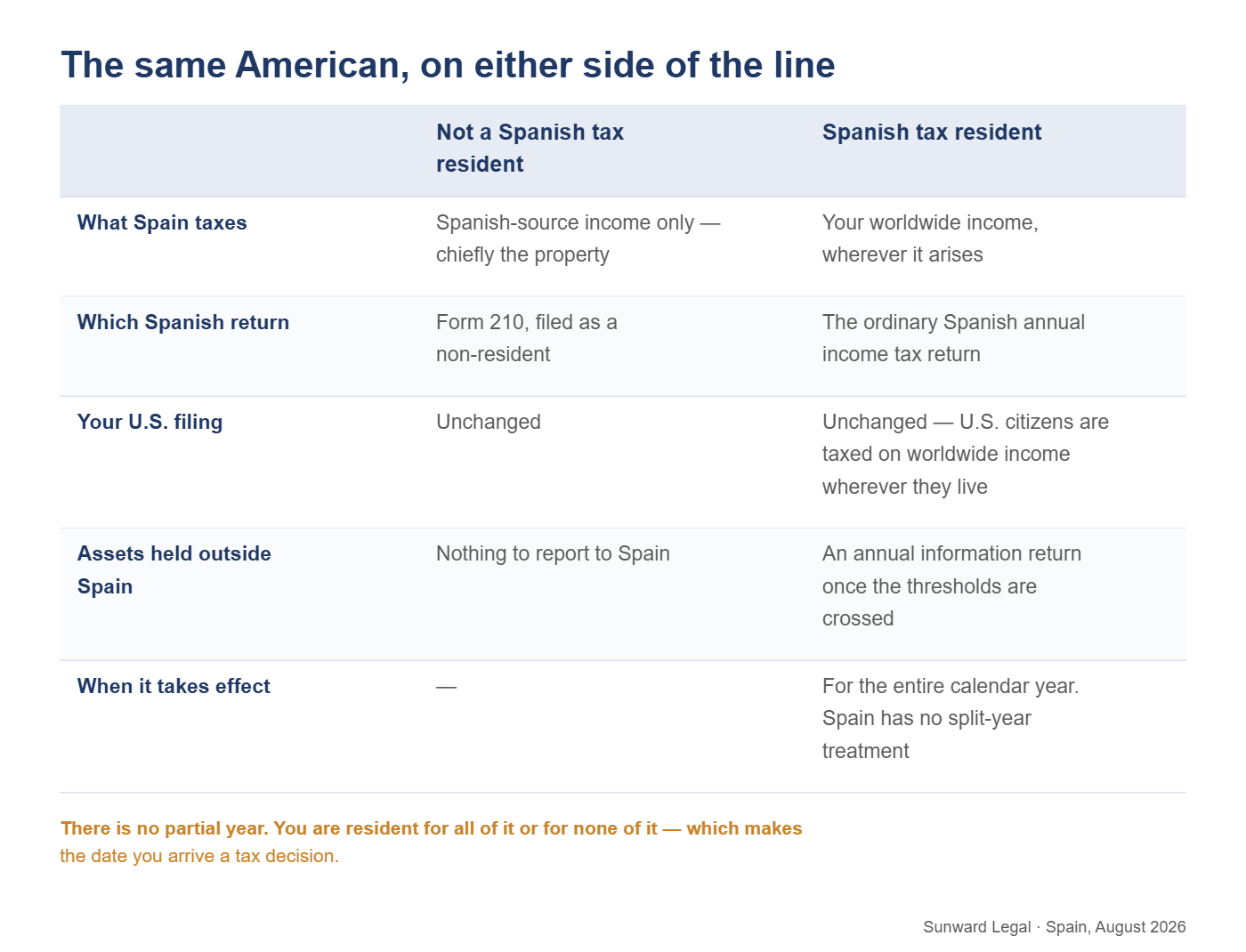
Spend more than 183 days of a calendar year in Spain and you become a Spanish tax resident, taxed here on your worldwide income — for the whole year, because Spain has no split-year treatment. What makes this different for an American is that the U.S. does not let go: the tax treaty expressly preserves the right of the United States to tax its citizens as if the treaty did not exist. You end up in both systems, not one.
Sunward Legal · Marbella. Last substantive review: 22 August 2026.
When does Spain treat you as a tax resident?
Spanish tax residency is decided by three tests, and any one of them is enough.
Days. You spend more than 183 days of the calendar year in Spanish territory. Temporary absences count toward that total unless you can prove tax residence in another country — so a month back in Chicago does not reset anything by itself.
Economic interests. Your main base of activities or economic interests is in Spain, directly or indirectly. This test has nothing to do with days. Someone who runs a business from here, or whose income-producing assets are here, can be resident on this ground alone.
Family presumption. Spain presumes, unless you prove otherwise, that you are resident if your non-separated spouse and dependent minor children habitually live in Spain. It is rebuttable, but the burden is on you.
The full text sits in Spain’s personal income tax law. The practical point is that most people count days and stop there, when the second and third tests catch cases the first one misses.
The rule people underestimate: no split year
Spain’s tax year is the calendar year, and there is no mechanism for being resident for part of it. You are resident for the whole of 2026 or for none of it.
Follow the consequence. Arrive in March, stay through December, and you cross 183 days — so Spain treats you as resident from January 1, including for income earned in the United States in January and February, before you had ever set foot here that year. Arrive in August and stay through December and you do not cross the threshold, so the same year is a non-resident year entirely.
This makes the arrival date a tax decision, and it is one that gets taken by accident — around a lease, a school term or a flight — far more often than it gets taken deliberately. If a large one-off item falls in your year of the move — a business sale, a stock disposal, a lump-sum distribution — the difference between a spring and an autumn arrival can be the difference between two entirely different tax outcomes.
What “worldwide income” actually covers
Once you are resident, the Spanish return reaches your income wherever it arises: U.S. pensions and Social Security, dividends and interest from U.S. accounts, capital gains on U.S. securities, rental income from a property in Florida, distributions from an IRA or a 401(k), and Spanish income too.
Investment income and capital gains go into a separate part of the Spanish return, the savings base, taxed on a progressive scale:
| Savings base | Rate |
|---|---|
| Up to €6,000 | 19% |
| €6,000 to €50,000 | 21% |
| €50,000 to €200,000 | 23% |
| €200,000 to €300,000 | 27% |
| Above €300,000 | 30% |
The scale is published in the tax agency’s annual return manual. Employment, pension and business income go into the general base and are taxed on the ordinary progressive scale, which combines a state and a regional component.
There is also an annual information return on assets held outside Spain — accounts, securities and real estate abroad — once the reporting thresholds are crossed. It survived a European court ruling in 2022; what that ruling removed was the special penalty regime and the absence of a limitation period, not the obligation itself. The Spanish tax agency maintains the page for the return of assets held abroad. For an American with a normal U.S. financial life, this is usually the most administratively demanding part of the first Spanish year.
Finally, wealth taxation. Spain’s wealth tax applies with a €700,000 exempt minimum, and a separate state-level tax on large fortunes — reaching net wealth above €3,000,000, with wealth tax already paid deducted — remains in force in 2026. Whether your base is worldwide or limited to Spanish assets follows from whether you are tax resident, which is one more reason the residence question is the first one to settle.
The saving clause: why the treaty does not get you out of the IRS
The treaty between Spain and the United States contains a provision that surprises people who expect a treaty to allocate them to one country. It preserves each State’s right to tax its residents and, in the case of the United States, its citizens, as if the treaty had not entered into force.
That is the whole architecture of the American expatriate tax position. Becoming a Spanish tax resident does not end your U.S. filing obligation; U.S. citizenship-based taxation runs in parallel with Spanish residence-based taxation. You file in both countries and the treaty relieves double taxation by credit: tax paid in one country is set against the liability in the other, within limits, rather than one country standing down.
The treaty’s tie-breaker — permanent home, then centre of vital interests, then habitual abode, then nationality, then agreement between the two administrations — is useful, but for a different problem. It resolves which country is your treaty *residence* for the purpose of applying the treaty’s rules; it does not switch off U.S. taxation of a U.S. citizen, because the saving clause is drafted to survive it.
The treaty text, as amended by the Protocol in force since November 2019, is published at the Spain–United States double taxation convention.
Planning a move, or already over the line? Book a free 20-minute call and we will map your income against both systems and the year in which each item falls. No cost, in English or Spanish.
Does Spain tax U.S. Social Security benefits?
This is the most searched question in this area and it deserves a careful answer rather than a confident one.
The treaty deals with pensions in two distinct rules. Private pensions — arising from past employment — may be taxed only in the country where the recipient is resident. So a Spanish tax resident’s private pension is taxed in Spain, and the wording is exclusive.
Social Security benefits fall under a separate rule, which provides that they may be taxed in the paying State. That wording is permissive rather than exclusive, and it produces a shared-taxation outcome: the paying State may tax, and the country of residence taxes as part of worldwide income while relieving double taxation by credit.
What that means for your actual bill depends on your full income picture and on how the credit computes in each country. Anyone who tells you flatly that Spain does not tax U.S. Social Security, or that only Spain does, is compressing a treaty provision into a slogan. Model it against your own numbers, in both countries, before relying on either version.
What goes wrong
The renewal that quietly makes you resident. Someone on a non-lucrative permit discovers that renewing requires more than 183 days of actual residence in the calendar year — which is exactly the Spanish tax residence threshold. The immigration route and the tax result are the same decision, taken once, in different offices. That link is drawn out in the Spanish non-lucrative visa for Americans.
The one-off item in the wrong year. A house sale, an equity grant vesting, a business sale. Because Spanish residence covers the whole calendar year, an item realized in January can be caught by a residence that only crystallized in July. Sequencing solves it; discovering it in the following April does not.
Assuming the treaty means one filing. People plan on filing in Spain and being done. The saving clause makes that impossible for a U.S. citizen, and the second filing has to be budgeted for — in time and in professional cost — from the first year.
Counting days as if absences reset the clock. Temporary absences count toward the 183 days unless tax residence elsewhere is actually proved. Long trips home do not, by themselves, keep you under the threshold.
Questions, answered
If I stay under 183 days, am I safe?
Safer, not automatically safe. Days are one of three tests. If your main base of economic interests is in Spain, or your spouse and minor children live here, you can be resident without crossing the day count. Someone splitting their year deliberately should have all three tests in view, not just the calendar.
Does owning a home in Spain make me tax resident?
No. Ownership is not one of the tests. What a non-resident owner does owe is the annual non-resident return on the property itself, which is a much smaller matter and is set out in the non-resident property tax return.
Can I use the special regime for people moving to Spain?
Only if you qualify. That regime is aimed at people who move here to work — including qualifying remote employees — and requires that you were not resident in Spain in the five tax periods before the move. Retirees on a non-lucrative permit, who by definition do not work, do not access it. The employee-versus-freelancer distinction is set out in Spain’s digital nomad visa.
Which country do I pay first?
They are not sequential in the way the question assumes: each country assesses its own liability and the credit mechanism reconciles them. What matters practically is that the two filings are prepared with sight of each other, so the credits claimed in one are consistent with the tax actually paid in the other.
What about my IRA or 401(k)?
Distributions are income, and once you are a Spanish tax resident they enter the Spanish return along with everything else, with the treaty determining how the two systems interact for that income and the credit mechanism preventing double taxation. Because the Spanish characterization of U.S. retirement accounts is not always intuitive, this is a point to settle with figures before the first distribution rather than after it.
Where this leaves you
The rule is simple and its consequences are not. More than 183 days, or your economic base here, or your family here, makes you a Spanish tax resident — for the whole calendar year, on worldwide income, with a reporting obligation for assets abroad. Meanwhile the United States continues to tax you as a citizen, and the treaty relieves double taxation without relieving you of a second return.
Two practical moves follow from that. Choose the arrival date deliberately, with any large one-off items in view, because the year is all-or-nothing. And build the two filings as one plan from the first year, rather than discovering in April that they contradict each other. Where this sits in a full relocation is set out in moving to Spain from the U.S., and the retiree’s version of the same problem in retiring in Spain as an American.
Book a free 20-minute call, at no cost, in English or Spanish. Tell us when you plan to arrive and what your income looks like, and we will tell you which year Spain will claim and what that changes.
General information on Spanish law, not advice on a particular case. It reflects the rules in force on August 22, 2026; rates and thresholds change. Sources: Ley 35/2006 del IRPF, arts. 2, 9.1.a) and 9.1.b), 12, 66 and 76; Real Decreto Legislativo 5/2004 (TRLIRNR), arts. 13.1.h), 24 and 25; disposición adicional 18.ª de la Ley 58/2003 (LGT) and arts. 42 bis, 42 ter and 54 bis of Real Decreto 1065/2007, on the return of assets held abroad, as amended by the disposiciones finales cuarta y quinta de la Ley 5/2022 following the judgment of the Court of Justice of the European Union of 27 January 2022 (C-788/19); Ley 19/1991 del Impuesto sobre el Patrimonio, arts. 5, 28 and 37; Ley 38/2022, art. 3, on the temporary solidarity tax on large fortunes, extended by Real Decreto-ley 8/2023; Convenio entre el Reino de España y los Estados Unidos de América para evitar la doble imposición, of February 22, 1990, as amended by the Protocol in force since November 27, 2019, arts. 1.3, 4, 6, 13, 20 and 24; Real Decreto 1155/2024, art. 64, on the residence requirement for renewal. The practical treatment of U.S. Social Security benefits under art. 20 is presented as requiring case-specific analysis.