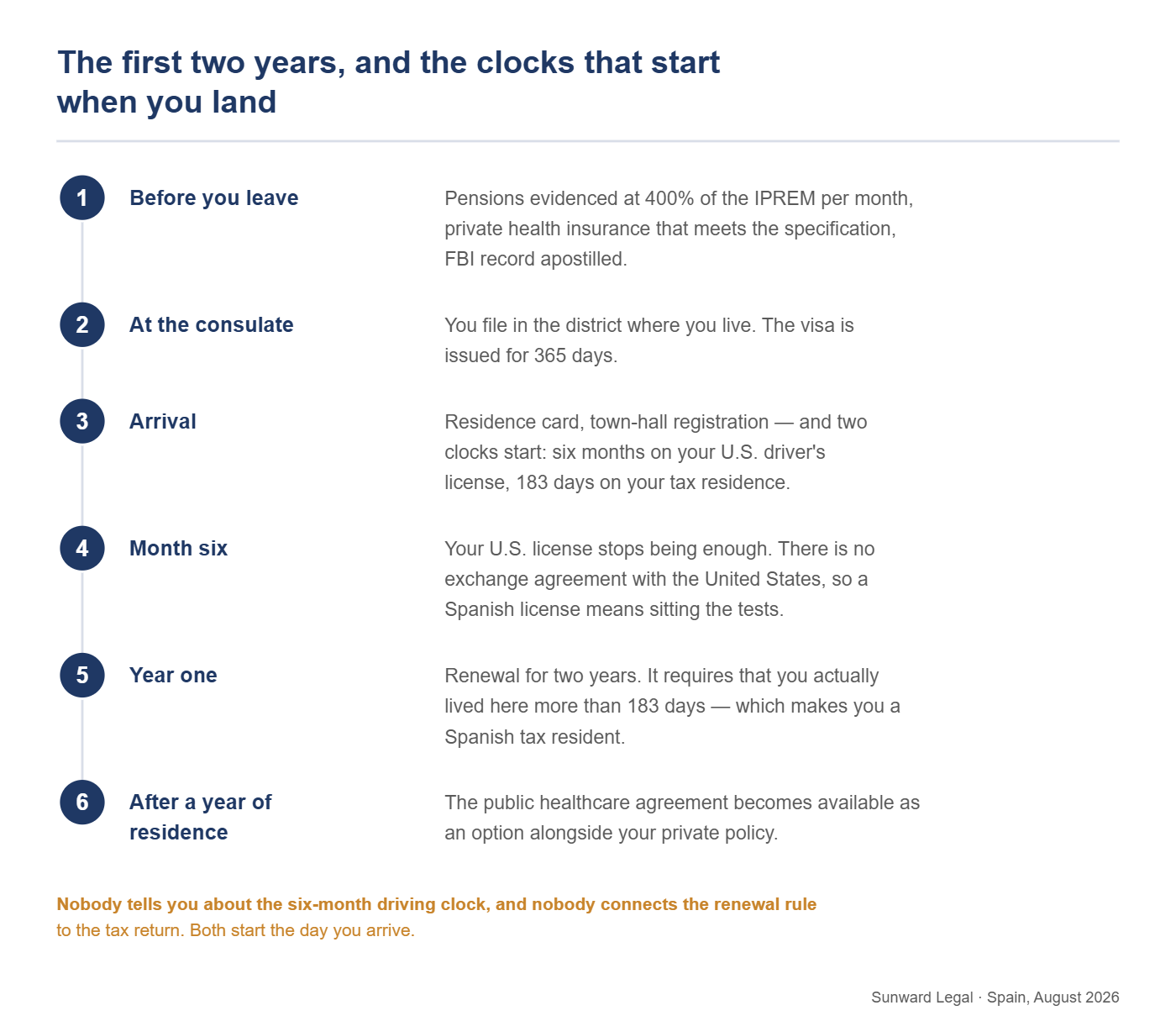
Spain has no retirement visa. American retirees come on the non-lucrative residence route, evidencing pension income of 400% of the IPREM per month — €2,400 in 2026, plus €600 for each family member. The two things that surprise people afterward are that your U.S. driver’s license stops being enough after six months, and that the rule keeping your permit alive is the same rule that makes you a Spanish taxpayer on worldwide income.
Sunward Legal · Marbella. Last substantive review: 22 August 2026.
Is there a Spanish retirement visa?
No. Retiring in Spain is done on another permit entirely — the list of national visas for applicants in the United States has no retirement category: it covers study, research, family reunification, employment, self-employment, entrepreneurship, remote work — and non-lucrative residence, which is the one retirees use. The residence-by-investment route that some people were counting on was repealed with effect from April 3, 2025, so buying a home in Spain no longer carries any right to stay.
The route sits in the Spanish immigration regulation in force since May 2025, and it fits a retiree well, because it is designed for exactly this situation: someone with means who is not going to work. Pensions — public or private — are accepted as evidence of those means, and pensions are the most persuasive form of evidence there is, since they are recurring, documented and verifiable.
The route in detail, including how the money must be presented and what gets applications denied, is set out in the Spanish non-lucrative visa for Americans. What follows is what is specific to retiring.
The money: what a retired couple has to show
| Who | Multiple of the IPREM | Monthly, 2026 |
|---|---|---|
| Main applicant | 400% | €2,400 |
| Spouse | 100% | €600 |
| Each additional dependent | 100% | €600 |
A retired couple therefore evidences €3,000 a month. Social Security benefits, a pension from a former employer, an IRA or 401(k) drawdown with a documented pattern, annuity payments and rental income all count. The requirement each consulate enforces is that these be shown as income across the period of residence, not as a balance on a single day — which is why a retiree with a pension usually has an easier file than a younger applicant with the same net worth held in investments.
Each U.S. consulate publishes its own dollar equivalent of the euro thresholds. Use the euro figure as the rule and your consulate’s published figure as the target; the official requirements for non-lucrative residence are the same across the network.
Healthcare: the part with no American shortcut
You must hold private health insurance with an insurer authorized to operate in Spain, with coverage equivalent to the public system, no co-payments and no exclusions or waiting periods. This is a visa requirement, not a suggestion, and travel insurance does not satisfy it.
There is no bilateral shortcut. The Social Security agreement between Spain and the United States covers retirement, disability and survivor benefits — it does not extend to healthcare. Whether Medicare covers anything you receive in Spain is a question for the U.S. side, and it should be confirmed there rather than assumed; either way, Spain requires the private policy.
What changes after a year is worth knowing in advance. Once you have been legally resident in Spain for a year, you can apply to join the public health system through a special healthcare agreement: a national scheme, administered by the regions, under which residents without other coverage pay a monthly contribution — set at one level below 65 and another above it — and access public healthcare. Prescriptions are not included. It is not automatic, it requires town-hall registration and evidence of the previous year’s residence, and it exists alongside private insurance rather than replacing your visa obligation. The Ministry of Health describes the special healthcare agreement.
Many retirees keep a private policy permanently, for the private-hospital network on this coast and for continuity. Others move across after the first year. Both are reasonable; what matters is knowing the option exists rather than discovering it in year four.
The driver’s license, which nobody warns you about
Spain has exchange agreements with a list of countries. The United States is not on it.
The practical consequence: your U.S. license lets you drive for six months from the date you acquire normal residence in Spain. After that, you need a Spanish license, and because there is no exchange agreement you obtain one the way a new driver does — by taking the theory test and the practical test, in Spain. Age and decades of driving experience do not shorten it.
Six months is enough time if you start early and considerably less comfortable if you start at month five. The DGT publishes the list of countries with a license exchange agreement, and it is worth looking at it yourself before anyone tells you otherwise at a dinner party.
Planning the move for next year? Book a free 20-minute call and we will map the visa, the healthcare route and the tax position against your own pension income. No cost, in English or Spanish.
The tax, which is the real decision
Here is the connection that most retirement content leaves out entirely.
Renewing non-lucrative residence requires that you actually lived in Spain for more than 183 days in the calendar year. That is also, in substance, the first test of Spanish tax residence — and a Spanish tax resident is taxed on worldwide income. Not on Spanish income: on everything.
For a U.S. citizen there is a second system that never switches off. The United States taxes its citizens on worldwide income wherever they live, and the tax treaty with Spain expressly preserves that power. You will file in both countries and rely on the treaty’s credit mechanism to avoid paying twice on the same income. There is also an annual Spanish information return on assets held abroad once thresholds are crossed, which catches U.S. brokerage and retirement accounts.
Within that framework, different kinds of retirement income are treated differently under the treaty:
- Private pensions — a pension from former employment — may be taxed only in the country where you are resident. For a Spanish tax resident, that means Spain.
- U.S. Social Security benefits fall under a separate rule which provides that they may be taxed in the paying State. That wording produces a shared-taxation outcome rather than an exclusive one, with the residence country relieving double taxation by credit. It is a point where the treaty language and the administrative practice deserve to be checked against your own numbers before you rely on any general statement, including this one.
The honest summary is that a U.S. retiree in Spain does not choose one tax system over the other; they operate in both, and the planning is about sequencing, credits and timing. The mechanics are set out in Spanish tax residency for U.S. citizens.
One planning point with real consequences: Spanish tax residence attaches to the whole calendar year, because Spain has no split-year treatment. Whether you land in November or in February can change which country taxes an entire year’s income. That is a decision to take before the flights are booked.
What goes wrong
The retiree who arrives in October. Nothing is wrong with the visa, but the arrival date, combined with the following year’s stay, produces a Spanish residence year nobody modeled. A move planned around the calendar rather than around the weather can be materially cheaper.
The license that expires quietly. Six months pass, the U.S. license is still in the wallet, and the driver assumes it remains valid because nothing happened. It has no effect until it does — at an insurance claim, or at a roadside check.
Insurance bought on price. A policy with co-payments or a waiting period is refused at the consulate, and the application is delayed by the time it takes to buy the right one and reissue the documents.
Assuming the property does the work. People still arrive believing that buying a home supports a residence application. It does not, and has not since April 2025. You can buy freely — nationality is no obstacle, as set out in can Americans buy property in Spain? — but the residence application stands on its own.
Questions, answered
Can I live in Spain part of the year and avoid all this?
Yes, and many people do. Without a residence permit you may spend up to 90 days in any 180-day period in the Schengen area, which is now recorded biometrically at the border rather than by passport stamp. Stay within that and you are a visitor: no permit, no Spanish tax residence, and your U.S. license remains valid for driving as a visitor.
Does my spouse need a separate application?
Family members are included in the application, with their own documents — marriage and birth certificates, apostilled and translated — and the income threshold rises by 100% of the IPREM for each of them. The evidence should show that the means support the whole household.
Will Spain tax my Social Security?
Once you are a Spanish tax resident, your worldwide income enters the Spanish system, and the treaty allocates the taxing rights between the two countries for each type of income. For U.S. Social Security specifically, the treaty allows the paying State to tax, with double taxation relieved in the country of residence. Because the outcome depends on your full income picture, this is one to model with your actual figures rather than to settle from an article.
What happens after five years?
Five years of legal, continuous residence open access to long-term residence, which no longer requires you to re-evidence income each cycle. Absences are limited in the meantime — broadly no more than six continuous months, and no more than ten months in total across the five years — so extended trips back to the United States need to be tracked.
Can I work part-time once I am settled?
Not on this route. The non-lucrative authorization requires an undertaking to perform no employed or professional activity, including remote work for a U.S. employer. If earning is part of the plan, the remote-work permit is the route to look at instead: Spain’s digital nomad visa and what disqualifies you.
Where this leaves you
Retiring to Spain from the United States is a well-worn path, and the visa itself is the most predictable part of it. Show pension income at the threshold, buy insurance that meets the specification, get the FBI certificate apostilled, file at your consulate.
Spend your preparation time on the three things that are not on the consulate’s checklist. Model the tax outcome across both countries before you choose an arrival date, because Spain taxes the whole calendar year. Start the driving license process in your first month, not your sixth. And decide deliberately whether your healthcare will run privately or through the public agreement after year one. Get those three right and the rest is logistics — which is the subject of moving to Spain from the U.S..
Book a free 20-minute call, at no cost, in English or Spanish. Tell us what your retirement income looks like and when you want to move, and we will tell you what the visa needs and what the tax year looks like.
General information on Spanish law, not advice on a particular case. It reflects the rules in force on August 22, 2026; thresholds, reference indices and administrative practice change. Sources: Real Decreto 1155/2024, Reglamento de la Ley Orgánica 4/2000, arts. 60 to 64 and 182 to 185; disposición adicional centésima primera de la Ley 31/2022, setting the IPREM, applicable in 2026 under the extended budget; Ley Orgánica 1/2025, repealing residence by investment with effect from April 3, 2025; Convenio de Seguridad Social entre España y los Estados Unidos de 30 de septiembre de 1986 (BOE of March 29, 1988), art. 2, on its material scope; Real Decreto 576/2013, arts. 3 and 6, on the special healthcare agreement; Reglamento General de Conductores and the DGT’s official list of countries with a license exchange agreement, which does not include the United States; art. 9 Ley 35/2006 del IRPF, on tax residence, and art. 2 on worldwide taxation; disposición adicional 18.ª de la Ley 58/2003 (LGT), as amended by Ley 5/2022, on the return of assets held abroad; Convenio entre España y los Estados Unidos para evitar la doble imposición of February 22, 1990, as amended by the Protocol in force since November 27, 2019, arts. 1.3, 4, 20 and 24. The practical treatment of U.S. Social Security benefits under art. 20 is flagged in the text as requiring case-specific analysis.