You can buy a home in Spain without ever boarding a plane. The instrument that makes it possible is a power of attorney — granted before a notary in the UK and apostilled, or before a Spanish consulate — which lets a person you choose sign the deposit contract and the deed on your behalf. What cannot be delegated is who you are and where the money came from.
Sunward Legal · Marbella. Last substantive review: 22 August 2026.
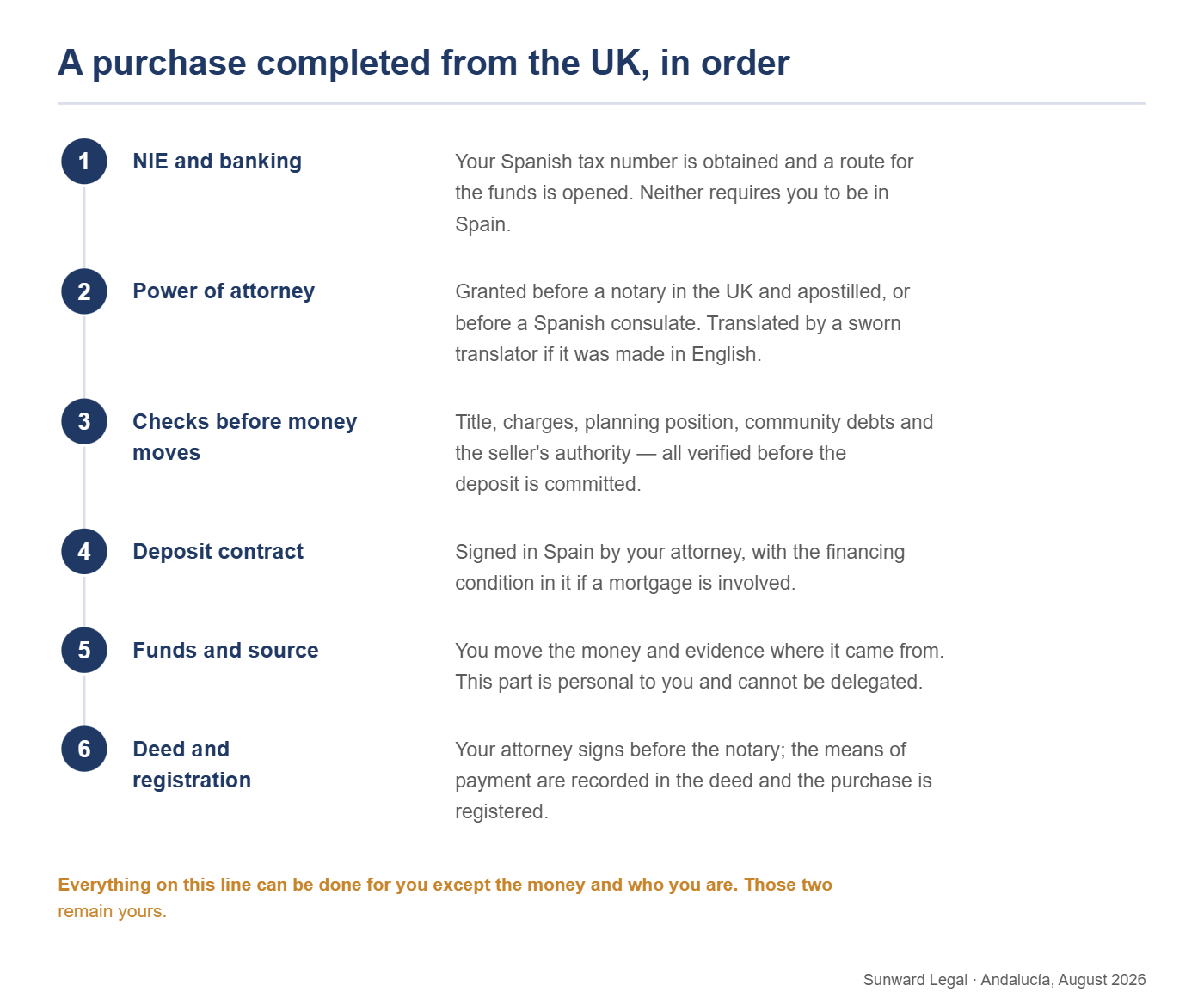
Can a purchase in Spain really be completed in your absence?
Yes, and it is ordinary rather than exotic. Buying property in Spain from the UK without travelling is a routine way to complete. Spanish conveyancing runs on public deeds signed before a notary, and a deed can be signed by an attorney acting under a properly granted power. The notary does not need the buyer in the room; the notary needs an instrument that clearly confers the power to do what is being done.
That single fact reframes the purchase. Instead of coordinating flights around a completion date that will almost certainly move, you settle the paperwork once, at home, and the transaction proceeds on Spanish time. It is also what rescues a purchase when a completion date slips into a week you cannot travel — which, on this coast, happens often enough to plan for.
Two things follow. The power has to be granted early, because the apostille and the translation take longer than people expect. And it has to be drafted for this transaction, because a notary who cannot find the specific power in the document will not proceed.
The two ways to grant the power
| Before a UK notary | At a Spanish consulate | |
|---|---|---|
| Where | Any notary public in the UK | The Spanish consulate for your district |
| Language | Usually English, or bilingual | Drawn in Spanish |
| Extra steps | Apostille, then translation by a sworn translator for use in Spain | None — it is already a Spanish public document |
| Appointment | Usually quick to arrange | By appointment; waiting times vary |
| Use outside Spain | Possible, depending on drafting | For use in Spain only |
The United Kingdom, Spain and the United States are all parties to the Hague Apostille Convention, so a document notarised in the UK needs only an apostille to be recognised in Spain — never consular legalisation. You can confirm the position of any country on the Hague Convention’s status table.
Which route is better depends on timing rather than on principle. The consular route produces a document that is ready to use, with no translation step, and the Spanish Consulate in London sets out how its notarial service works in its notarial FAQ. The local-notary route is usually faster to book but adds an apostille and a sworn translation. If your completion is weeks away rather than months, count the working days for each before choosing.
One practical note on drafting: whichever route you use, the text of the power should be prepared in Spain by the lawyer who will use it, and then taken to the notary or the consulate. A power drawn from an English precedent, without reference to what a Spanish notary and registrar will look for, is the usual reason one gets rejected.
What the power has to say
A Spanish notary must reach a formal conclusion — recorded in the deed — that the powers held by the attorney are sufficient for the specific act being carried out. The notary describes the instrument, states that in their judgement the powers suffice, and takes responsibility for that judgement; the registrar afterwards checks the description and the consistency of that judgement, not the underlying document.
The consequence for you is that generality is a risk, not a safeguard. The power should identify the property, authorise the purchase at or below a stated price, and cover the acts the transaction will actually require: signing the private contract, paying the price and giving receipt, signing the deed, applying for the tax number, filing and paying the purchase taxes, registering the purchase, and — if there is finance — signing the mortgage and attending the preliminary notarial appointment that Spanish mortgage law requires.
The mortgage point is worth isolating. Where a purchase is financed, the borrower has a right to a free preliminary appointment before a notary of their choice and a ten-day reflection period on the binding offer. Both of those can be handled through an attorney, but only if the power says so. A power that covers the purchase and forgets the loan will stop the transaction at the last step. The rest of the financing process is set out in getting a Spanish mortgage as a non-resident.
What still has to be done by you
Three things do not travel through a power of attorney, and it is better to know which they are before you plan around them.
Your identity. You appear in person before whoever grants the power — the UK notary or the consul — with your passport. That is the moment your identity enters the chain, and everything downstream relies on it.
The money and where it came from. Spanish notaries and banks are both subject to Spain’s anti-money-laundering rules. They must identify you, establish the beneficial owner where a company is involved, and understand the purpose of the transaction and the source of the funds. In practice that means documentary evidence: the sale of a previous property, a savings history, a documented gift, a business sale. Assemble it at the start. This is the single most common cause of a completion being delayed by days at the very end, and no power of attorney solves it.
The decisions. An attorney signs; an attorney does not decide whether the price is right or whether a planning irregularity is acceptable. Those choices remain yours, made on information sent to you, which is why the reporting during a remote purchase matters more than in a purchase where you are present.
The tax number itself — the NIE — can be arranged without travelling, and how that works from the UK is set out in getting a Spanish NIE number from the UK.
Completion date approaching and you cannot travel? Book a free 20-minute call and we will tell you exactly what the power of attorney needs to contain and how long each route takes. No cost, in English, Spanish or Swedish.
The checks that matter more when you are not there
A remote buyer never walks the property, never meets the neighbours and never sees the building. Everything therefore has to come from documents, and the documents have to be requested rather than waited for.
The title and charges position, taken from the land registry and read against what the seller says. The planning position of the property and of any extension — on this coast, an addition without permission is the most common defect, and it does not appear on a photograph. Whether the seller has the authority to sell, which is a live question where there is an estate, a divorce or a company. And the debts that follow the property rather than the person: under the Horizontal Property Act, unpaid community charges bind the flat for the current year and the three preceding calendar years, and the seller must produce a certificate of the community’s account before the deed can be authorised. Unpaid IBI attaches to the property too.
None of this is different from what a careful purchase requires anyway. What is different is that a buyer standing in the notary’s office may notice something is off; a buyer in Surrey cannot. The reporting has to substitute for presence, and it either does or it does not.
The wider set of traps is collected in the pitfalls of buying property in Spain, and the shape of a full purchase in our Spanish conveyancing service.
What goes wrong
The power that arrives without the apostille. Signed before a UK notary, sent to Spain, and rejected — because the apostille is a separate step at a separate office, and nobody mentioned it. The purchase waits for the post twice. Building the apostille and the sworn translation into the schedule from the outset removes the problem entirely.
The power that does not cover the tax filing. The deed is signed, and then the attorney cannot file and pay the transfer tax, which in Andalucía must be settled within two months of the transaction. The remedy is a second power, granted from the UK, while the clock runs. A properly drafted power covers the filings as well as the signature.
The attorney who is on the other side of the deal. An agent or a seller’s contact offers to hold the power “to make it simple”. Powers should be held by someone whose only duty is to you. This is not a suspicion about anyone in particular; it is the basic structure of the transaction. The agent is paid on completion, the seller is selling, and the notary is impartial by design — attesting the deed without acting for either party or checking whether the deal is good for you. In a remote purchase, where you cannot see anything for yourself, having someone at the table whose only client is you stops being a preference.
Questions, answered
How long is a Spanish power of attorney valid?
Until it is revoked, unless the document itself sets a time limit. Many are drafted for a single transaction, which is the safer approach: it cannot be reused for anything else afterwards. Revocation, if you need it, is done by a further notarial act and notified.
Can my UK solicitor hold the power?
Anyone with capacity can be an attorney, and the choice is yours. What matters more than the profession is that the person acts only for you, understands what they are signing in Spanish and is available on the day. In practice most remote buyers appoint the Spanish lawyer conducting the purchase, precisely because that person is the one reading the deed.
Does a power of attorney let someone take my money?
The power should be drafted so that it does not. A power limited to a named property, a maximum price and a defined set of acts is very different from an open power over your affairs, and there is no reason to grant the latter for a purchase. Funds should also move to accounts you can identify, not through intermediaries.
Do I have to come to Spain at any point?
Not for the purchase itself. You will want to see the property at some stage, and most buyers do so before committing rather than after, but the legal steps — contract, deed, registration, tax filings — can all be handled under the power. If a mortgage is involved, the preliminary notarial appointment can be too, provided the power says so.
Is buying remotely more expensive?
The purchase costs are the same: transfer tax at 7% on a resale in Andalucía, or 10% VAT plus 1.2% stamp duty on a new build, plus notarial, registration and legal costs — as a market rule of thumb, in the region of 10–13% of the price on top. The power of attorney adds a notarial step at home, an apostille and a translation. Against a cancelled flight and a moved completion, it usually pays for itself the first time it is used.
Where this leaves you
Treat the power of attorney as the first item on the timetable rather than a piece of paperwork to sort out near the end. Have its text drafted in Spain for the transaction you are actually doing, grant it as soon as a property is in view, and get the apostille and translation done while the searches are running. Then use the time you would have spent travelling on the part that decides whether the purchase is a good one: reading what comes back from the land registry, the town hall and the community of owners.
The rest is ordinary conveyancing conducted at a distance. It works well, provided the person signing on your behalf is someone whose only interest in the transaction is yours.
Book a free 20-minute call, at no cost, in English, Spanish or Swedish. Tell us where you are and when completion is expected, and we will tell you which route to the power of attorney fits your timetable.
General information on Spanish law, not advice on a particular transaction. It reflects the rules in force on 22 August 2026. Sources: Convention of 5 October 1961 Abolishing the Requirement of Legalisation for Foreign Public Documents (Hague Apostille Convention), in force for Spain, the United Kingdom and the United States; Ley 24/2001, art. 98, on the notary’s judgement of sufficiency of representative powers and the registrar’s review; Ley del Notariado, art. 24, and Reglamento Notarial, art. 177, on the identification of the means of payment in the deed; Ley 10/2010 de prevención del blanqueo de capitales, arts. 2 to 5; Ley 49/1960 de Propiedad Horizontal, art. 9.1.e), on the charge over the property for community debts of the current year and the three preceding years and on the certificate of debts; Real Decreto Legislativo 2/2004 (TRLHL), art. 64, on the property’s liability for IBI; Ley 5/2021 de Tributos Cedidos de Andalucía, arts. 41, 43, 50 and 69, on transfer tax, stamp duty and the two-month filing period; Ley 37/1992 del IVA, art. 91.Uno.1.7.º; Ley 5/2019 reguladora de los contratos de crédito inmobiliario, arts. 10, 14 and 15; Real Decreto 1155/2024, art. 205, on the NIE. The 10–13% total purchase cost is a market estimate, not a legal rate.