No. Spain’s residence-by-investment permit was not trimmed back — it was repealed in full, with effect from April 3, 2025, and nothing took its place. Spain’s golden visa status in 2026 is that no investment route into Spanish residence exists any more, in real estate or in anything else. What is left is the ordinary immigration system, and it asks for income and activity instead of capital.
Sunward Legal· Marbella. Last substantive review: August 15, 2026.
What exactly was repealed, and from when
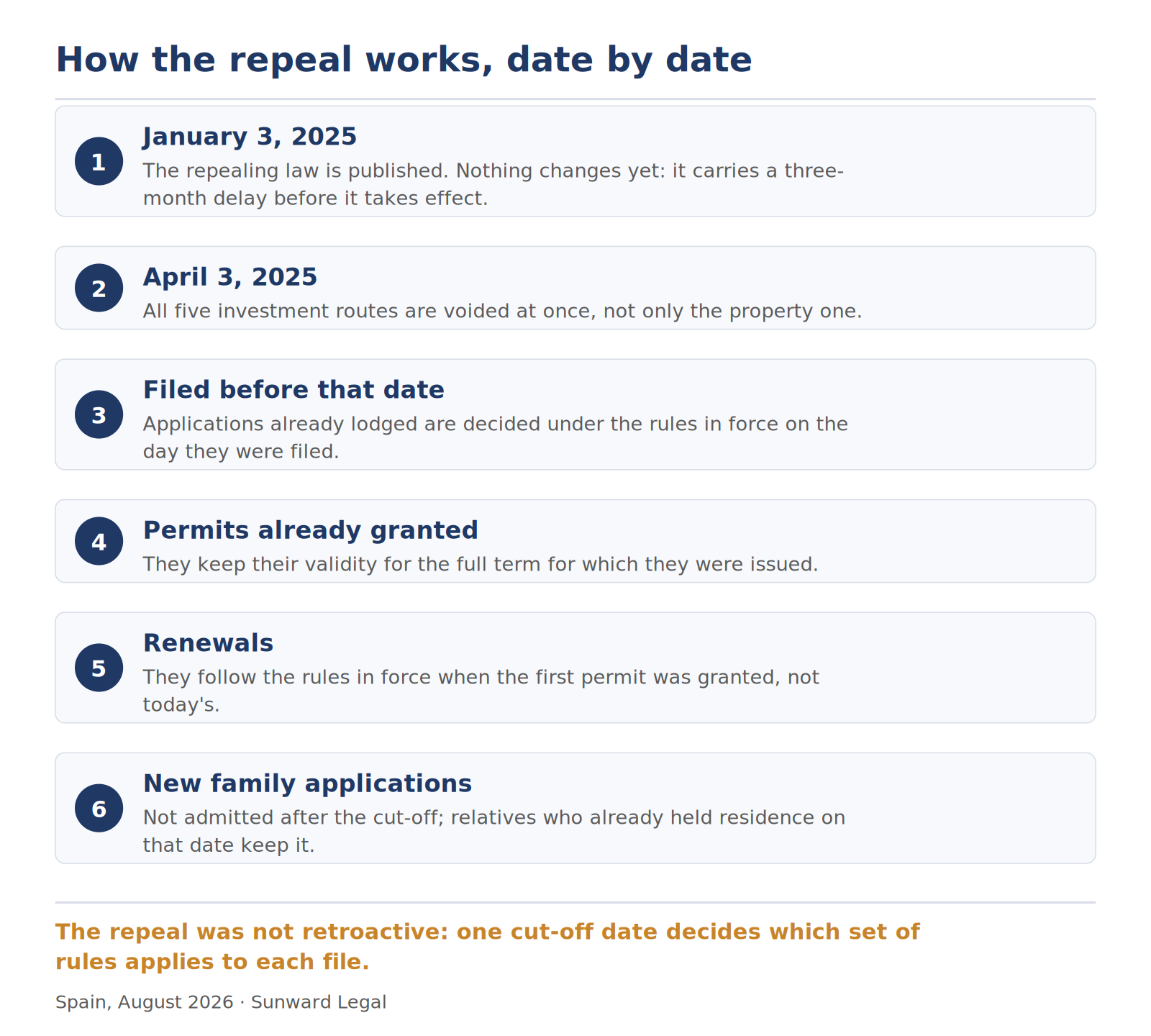
All five investment routes fell at once, not just the property one. The law that repealed them stripped the content out of the entire investor chapter of Spain’s 2013 entrepreneurs act, with effect from April 3, 2025. There is no successor program and no window for new applicants.
The five ways of qualifying, all now gone:
- Spanish public debt from 2.000.000 €.
- Shares or holdings in Spanish companies from 1.000.000 €.
- Bank deposits in Spanish institutions from 1.000.000 €.
- Real estate from 500.000 €.
- A business project classified as being of general interest.
Two dates get confused. The repealing law is dated January 2, 2025 and was published the next day, but it carried a three-month *vacatio* — a gap between publication and legal effect. The operative date is April 3, 2025. The office that used to process these files, the immigration unit for large companies, puts it in one line: those articles were left without content.
The second confusion is the costly one. The bill that started the process targeted only the 500.000 € property route, and much published material still describes the outcome that way. The text that passed went further. “Only the real estate golden visa ended” is not a simplification; it is inaccurate.
What happened to people who already had one, or had already applied
The repeal was not retroactive. Three rules were added to the 2013 act for files that were already open, and each turns on the same cut-off date.
Applications filed before April 3, 2025 are decided under the rules in force on the day they were filed. Permits and visas already issued keep their validity for the full term granted; nobody lost a permit. Renewals follow the rules that applied when the first permit was granted, not a general-immigration equivalent.
One restriction is easy to miss, and the migration authority set it out in criteria issued on June 10, 2025. Relatives who already held residence on April 3, 2025 keep it and renew with the rest of the file. New applications for family members lodged after that date are not admitted, so a spouse or adult child who never applied in time now has to qualify separately.
Which Spanish residence routes actually exist in 2026
Six figures survive, and none can be bought. Each asks either for income you already have or for an activity you will genuinely carry out. The table covers the four a non-EU applicant most often weighs up.
| Route | May you work in Spain? | What you have to show | Duration and renewal |
|---|---|---|---|
| Non-lucrative residence | No — not even remotely, for a foreign employer | 400 % of the IPREM: 2.400 € a month in 2026, plus 600 € per dependent, and health cover valid in Spain | One-year permit, renewed for two years at a time |
| International telework (“digital nomad”) | Yes, for employers and clients outside Spain | 200 % of the SMI: from 2.442 € a month in 2026, three months with the employer or client, and a degree or three years’ experience | Visa of up to one year, then a three-year permit· renewal length is not set out in the official guidance |
| Highly qualified professional, including the EU Blue Card | Yes, in the qualifying job | A qualifying job with an employer established in Spain | Three years, or the length of the contract plus three months if that is shorter, then two-year renewals |
| Intra-company transfer | Yes, in the posting | A posting within the same group of companies | Capped at three years for managers and specialists, one year for trainees· renewal length is not set out in the official guidance |
Two more survive: the researcher route, with a three-year permit — or the length of the hosting agreement, if shorter — and a two-year extension, and the entrepreneur route, which starts with a one-year visa. Behind them sits the general immigration system, itself replaced in May 2025 — anything still citing the 2011 regulations is out of date, whatever else it says.
Where the honest answer stops: which of these counts toward permanent residence. Long-term residence asks for five years of legal, continuous residence in Spain. Absences do not break the count while they stay under six months at a time and ten months in total across the five years, or eighteen months where the absence is for work. What no published rule sets out is a list of which permits count, one by one. Time as a student is the only case with a rule of its own, counted at half its length for the EU version of long-term residence. The doubt is not academic for one of them: European law treats the intra-company transfer as expressly temporary migration, which is a reason to ask before, not after.
If you have capital but no job: the non-lucrative route
The non-lucrative residence permit is for someone who can support themselves here from income or assets they already hold, and who will not work in Spain. It is where most former golden visa candidates land.
The financial test is a percentage of the IPREM, a public reference index, not of the minimum wage: 400 % of it for the applicant and 100 % more per dependent family member. With the IPREM at 600 € a month in 2026, that is 2.400 € a month, or 28.800 € a year, plus 600 € a month per dependent. You also need health cover from an insurer authorized to operate in Spain, and the consular guidance for applicants in the United States asks that it match the Spanish public system.
The catch is in the name. The permit authorizes you to live in Spain without carrying out any employment or professional activity, and the official conditions make no exception for work done remotely for an employer abroad. That is precisely why the telework visa was created. If you plan to keep your job, this is the wrong route.
Were you counting on residence through a purchase? Book a free 20-minute call, in English or Spanish, and we will tell you which live route your situation fits before you commit to a property.
If you keep working for a US employer: the telework route
This route lets you live in Spain while working for companies established outside it, and it is where the still-active investor profile usually lands.
Here the financial test is a percentage of the SMI, Spain’s statutory minimum wage — not the IPREM. This is the most repeated error in English-language material on the subject, and it moves the figure by more than a thousand euros a month. With the SMI set at 1.221 € a month for 2026, the applicant shows 200 % of it: 2.442 € a month on the monthly figure, or roughly 2.849 € where the calculation runs on the annual minimum in fourteen payments, which is the basis the unit handling these files has used. Plan for the upper end. Add 75 % of the SMI for a second family member and 25 % for each further one. You also show that the foreign company has genuinely traded for at least a year, that your relationship with it is at least three months old, and either a qualification or three years’ experience.
Two conditions decide most files. If you are self-employed, work billed to companies located in Spain may not exceed 20 % of your professional activity, and it has to be professional work rather than employment. If you are an employee there is no 20 % margin: you work exclusively for companies established outside Spain. Being in Spain irregularly also disqualifies the application, so a bad start cannot be fixed later. The visa is applied for at the consulate, which decides within ten days of the day after filing.
One advantage rarely gets mentioned. Spain’s special tax regime for inbound workers, usually called the Beckham regime, expressly lists this visa as a qualifying reason for relocating. Someone arriving on a non-lucrative permit cannot use that regime at all: it requires a relocation tied to an activity, and the non-lucrative permit rules activity out. Selling the Beckham regime to a retiree is the commercial error that follows the golden visa error most closely.
Why some websites still offer a Spanish golden visa
Because pages age and nobody updates them. That is a verifiable fact rather than an accusation: a page offering residence in Spain today in exchange for buying property describes a regime that stopped existing on April 3, 2025, and both the repealing law and the immigration authority’s own notice say so. It helps to know who is paid for what. A firm paid only for legal advice has no stake in whether you buy; an intermediary paid on the transaction does.
A related change catches people who decide to keep visiting instead. A US citizen still needs no visa for short stays, capped at 90 days in any 180-day period, but the EU Entry/Exit System has been fully operational since April 10, 2026. It records your face and fingerprints at the border and has replaced manual stamping, so the 90/180 count is now automatic. ETIAS, the separate pre-travel authorization, is not running yet: the Commission expects it in the last quarter of 2026.
Frequently asked questions
Can I still get Spanish residence by buying a property?
No. That route was repealed with effect from April 3, 2025, together with the four others, and no equivalent has been created. Buying a home in Spain remains perfectly possible for a non-resident and still requires a Spanish tax number, but it grants no right to reside here.
I already have a golden visa. Do I lose it?
No. Permits issued before the repeal keep their validity for the full term granted, and renewals follow the rules that applied when the first permit was granted. What you cannot do is add a new family member: applications for relatives lodged after April 3, 2025 are not admitted.
Is there any Spanish visa based purely on savings?
The nearest is the non-lucrative residence permit, but it is not an investment route: it tests income and means rather than a purchase, and forbids work of any kind, including remote work for a foreign employer. The threshold is 2.400 € a month in 2026, plus 600 € per dependent.
What are the income figures for the digital nomad visa in 2026?
They are calculated on the statutory minimum wage, not the IPREM. With the SMI at 1.221 € a month in 2026, twice the SMI is 2.442 € a month — or about 2.849 € if the calculation runs on the annual minimum in fourteen payments, so plan for the upper end — plus 75 % of the SMI for a second family member and 25 % for each further one. Any figure quoted from the IPREM here is wrong.
Where this leaves you
If your plan was to buy a Spanish property in order to live here, the purchase and the residence are now two separate projects. The property side is unchanged: the legal checks to make before signing a Spanish purchase have nothing to do with immigration status, and the Spanish tax number you need for it works the same wherever you apply from. The residence side starts from a different question: what income do you have, and what will you be doing here. If you are relocating from the United States, that sequence is in our guide to moving to Spain from the US; the purchase runs through our Spanish conveyancing service.
Book a free 20-minute call, in English or Spanish. Tell us your income, where it comes from and whether you plan to keep working, and we will tell you which live route fits.
General information on Spanish law, not advice on a specific case. Rules in force on August 15, 2026; immigration rules and reference figures change. Sources: Organic Law 1/2025, of 2 January, final provisions twenty-first and thirty-eighth, which left articles 63 to 67 of Law 14/2013 without content with effect from 3 April 2025 and added two transitional provisions to it; Law 14/2013, of 27 September, articles 61, 62, 68 to 74, 74 bis to 74 quinquies and 76; Directive (EU) 2021/1883, Directive (EU) 2016/801 and Directive 2014/66/EU, article 12.1; Royal Decree 1155/2024, articles 175 to 178 and 182 to 185, and Organic Law 4/2000, article 32, on long-term residence; criteria of the Directorate-General for Migration Management of 10 June 2025; Organic Law 4/2000 and the Immigration Regulations approved by Royal Decree 1155/2024, articles 60 to 63, in force since 20 May 2025 and amended by Royal Decree 316/2026; Law 28/2022 and article 93 of Law 35/2006; Royal Decree 126/2026, of 18 February (SMI 2026); IPREM published by the SEPE; European Commission, Entry/Exit System and ETIAS.