Moving to Spain from the US turns on one decision made before anything is booked: which residence route you apply for. It is filed at a Spanish consulate in the United States, months ahead, and it fixes whether you may work once you arrive. Two things then follow that do not happen to a European: the United States keeps taxing you because you are a citizen, wherever you live, and you arrive from outside the EU with a 90-day Schengen clock already running.
Sunward Legal · Marbella. Last substantive review: August 15, 2026.
Which residence route fits, and why it comes before the flight
Two routes cover most Americans not being posted here by an employer, and both start at the consulate. The non-lucrative residence permit is for someone living on income or assets they already hold and who will not work. The international telework permit is for someone who keeps working for companies outside Spain.
| Non-lucrative residence | International telework | |
|---|---|---|
| May you work? | No, and that includes remote work for a foreign employer | Yes, for employers and clients outside Spain |
| Income to show (2026) | 400 % of the IPREM: 2.400 € a month, plus 600 € per dependent | 200 % of the SMI: from 2.442 € a month, plus 75 % of it for a second family member and 25 % for each further one |
| Also required | Health cover from an insurer authorized in Spain | Employer trading a year or more, three months with it, degree or three years’ experience |
| Duration | One-year permit, then two-year renewals | Visa of up to one year, then a three-year permit, renewable |
| Beckham tax regime | Not available | Available: this visa is a qualifying cause |
The two figures are indexed to different things. The non-lucrative threshold is a multiple of the IPREM, a public reference index of 600 € a month in 2026; the telework threshold is a multiple of the SMI, the statutory minimum wage, 1.221 € a month for 2026. Material quoting an IPREM figure for the telework route is wrong by over a thousand euros a month.
The telework figure is also a range rather than a single number: twice the monthly SMI is 2.442 €, but the same decree fixes an annual minimum in fourteen payments, and that basis lifts the requirement to roughly 2.849 € a month. Nothing settles which one governs, and the unit handling these files has used the annual figure. Budget for the upper end.
A third route no longer exists: residence in exchange for investment was repealed in full on April 3, 2025, so buying property is not a way in — what happened to the golden visa.
What you file at the consulate, and what you can only do from Spain
The visa and the permit are two documents from two authorities: the consular office covering where you live in the United States issues the visa, and the Spanish administration grants the permit.
On the non-lucrative route, silence after one month in the authorization procedure means refusal, not approval: a file that goes quiet has been turned down, and the time limit for challenging it is already running. On the telework route the consulate decides within ten days of the day after filing, and the permit follows from Spain in the last sixty days of the visa.
What you cannot do is arrive as a tourist and sort it out here: being in Spain irregularly disqualifies a telework application outright. A US passport still allows 90 days in any 180-day period, but the EU Entry/Exit System has been fully operational since April 10, 2026, so the count is automatic now.
Your first weeks here: NIE, town hall register, residence card
Three pieces of paper, in a rough order. The NIE is your Spanish identification number, and everything else — a bank account, a utility contract, a deed of purchase — is built on it. It is not residence and not a tax status, and the NIE application works the same way from outside Spain as from inside.
The TIE, the physical residence card, is applied for within one month of entering Spain, so book the appointment before you fly.
The empadronamiento — registration with the town hall where you actually live — sits between the two in practice, and other procedures run on the certificate it produces, a public document that is the ordinary proof of where you really live. Anyone living in Spain has to register in the municipality where they habitually live, whatever their immigration status: the register is not a residence title and does not ask to see one. You give the number on a Spanish document in force or, failing that, a passport, and you do not need a lease in your own name: written authorization from an adult already registered there, who holds the title to the home, does the job. A non-EU national without long-term residence renews the entry every two years, or the town hall cancels it.
Both routes require health cover from day one, from an insurer authorized in Spain and matching what the public system covers. Medicare does not travel: it pays for nothing here.
When you become a Spanish tax resident, and why 183 days is only one of three tests
Spanish law gives three tests, and any one of them on its own makes you resident. It is the most misunderstood point in American relocation planning: two of the three are invisible to a day-counting spreadsheet.
The first is presence: more than 183 days in Spain in the calendar year, with sporadic absences counted in unless you can prove tax residence elsewhere. The second is economic: the main center or base of your activities or economic interests is in Spain, directly or indirectly. The third is a rebuttable presumption: if your non-separated spouse and dependent minor children habitually live in Spain, so do you.
So an American who spends 150 days a year in Marbella but runs a business from here can be a Spanish tax resident. The tax office’s own guidance is blunt: residence is a question of fact, not something you choose by declaring an address. And the unit is the calendar year, not a rolling twelve months — arriving in July and arriving in February give you different first years, which is sometimes reason enough to move a departure date.
Not sure which side of the line your year falls on? Book a free 20-minute call, in English or Spanish, and we will map your intended dates against the three tests before you commit.
Spain taxes your worldwide income. The US keeps taxing you anyway
Once you are a Spanish tax resident, Spain taxes the whole of your income wherever in the world it arose, subject to the treaties. And the United States does not let go: the IRS puts it in one sentence — “If you are a U.S. citizen or a resident alien of the United States and you live abroad, you are taxed on your worldwide income.”
That is the American difference. A German retiring to Spain files in Spain and stops filing in Germany. You file in both.
The two systems are reconciled rather than merged. The Spain–US tax treaty, signed in 1990 and substantially amended by a protocol in force since November 27, 2019, allocates taxing rights between the two states. On the US side, relief runs through the foreign tax credit and the foreign earned income exclusion, which are not cumulative on the same income.
Two allocation rules matter most. Pensions from previous employment are taxable only in the state of residence, which after the move is Spain; public-service pensions follow a separate rule. US Social Security is the one everybody gets wrong. The treaty says those benefits *may* be taxed in the state that pays them. It does not say *only*. Spain, as your state of residence, still brings them into your worldwide income and then applies the treaty’s relief mechanism. Anyone telling you Social Security “is only taxed in the US and is not declared in Spain” is reading a word that is not in the text.
The treaty also carries a saving clause preserving each state’s right to tax its own citizens as if it had never entered into force. It removes the double charge, not the US return.
Where our work stops. We advise on the Spanish side: when residence starts, what Spain taxes, how the treaty splits it. Your US return is prepared by a US tax professional, and the two have to talk in the same year. A firm claiming both ends of this is claiming something no Spanish license covers.
Reporting what you left behind: the modelo 720
The Spanish obligation to report assets held abroad is alive and well: in January 2022 the Court of Justice of the European Union struck down its consequences, not the obligation, and the special penalty regime went with the reform that followed. For an American, the point is accumulation rather than substitution — the Spanish modelo 720 and the US FBAR and FATCA filings are separate obligations with separate rules, and satisfying one does nothing for the others.
The 720 has three blocks — accounts with financial institutions abroad; securities, rights, insurance and annuities placed abroad; and real estate abroad — each with its own 50.000 € threshold, measured on the joint value of everything inside that block. Below it the block is not reported; above it, all of it is, between January 1 and March 31 of the following year. After the first return, a block comes back only when its joint value grows by more than 20.000 € over the last one, or when you cease to be the owner. Crypto held abroad through a custodian has its own return, the modelo 721, with a separate 50.000 € threshold and the same window.
Buying a home: before residence, or after?
Buying gives you no immigration advantage, so what is left is tax and timing. A non-resident can buy freely — a NIE, and nothing else by way of status — but is taxed worse as an owner than a European: the imputed income declared on form 210 for a home kept for personal use, and rent if you let it, is charged at 19 % for residents of the EU and the EEA and 24 % for everyone else, with no expenses deductible in the second group.
So buy when the purchase stands on its own merits, and wait when it exists only to support a visa application, because no live route rewards it. The checks do not change, and they are in what goes wrong when buying property in Spain. Note who is in the room at signing: the notary represents neither side and the agent is paid when the sale closes, so the only person there paid to look for reasons not to sign is your own attorney.
What usually goes wrong
The scouting trip that became a plan. A couple spends 89 days looking around, decides to stay, and tries to convert to a telework permit from inside Spain. Being here irregularly disqualifies the application, so they fly home and start again at a consulate.
The 170-day spreadsheet. Someone counts days, stays under 183, and moves their consulting business here in the meantime. The economic-interests test makes them resident on its own.
Frequently asked questions
Can I move to Spain from the US without a job offer?
Yes. The non-lucrative permit is built for exactly that: it tests income and means rather than employment, asking for 2.400 € a month in 2026, plus 600 € per dependent, and health cover. The condition is that you do not work at all, including remotely for a US employer.
Is my US Social Security taxed in Spain?
Not exclusively in the US, which is what most sources imply. The treaty says these benefits *may* be taxed in the paying state, not *only*. As a Spanish resident you declare worldwide income, Social Security included, and the treaty’s relief mechanism removes the double charge.
Can Americans use the Beckham regime?
Yes — there is no nationality requirement — but only if the move is tied to one of its listed causes, such as an employment contract, a company directorship or the international telework visa. It taxes employment income at 24 % up to 600.000 € and 47 % above, for six tax years. A non-lucrative permit is not one of those causes, which is why selling this regime to a retiree is the most common commercial error in the market.
How long before I could apply for Spanish citizenship?
Ten years of legal, continuous residence immediately before the application, for a US national. The two-year rule applies to nationals of Ibero-American countries, Andorra, the Philippines, Equatorial Guinea and Portugal, and to Sephardic Jews. Tourist stays do not count.
Where to start
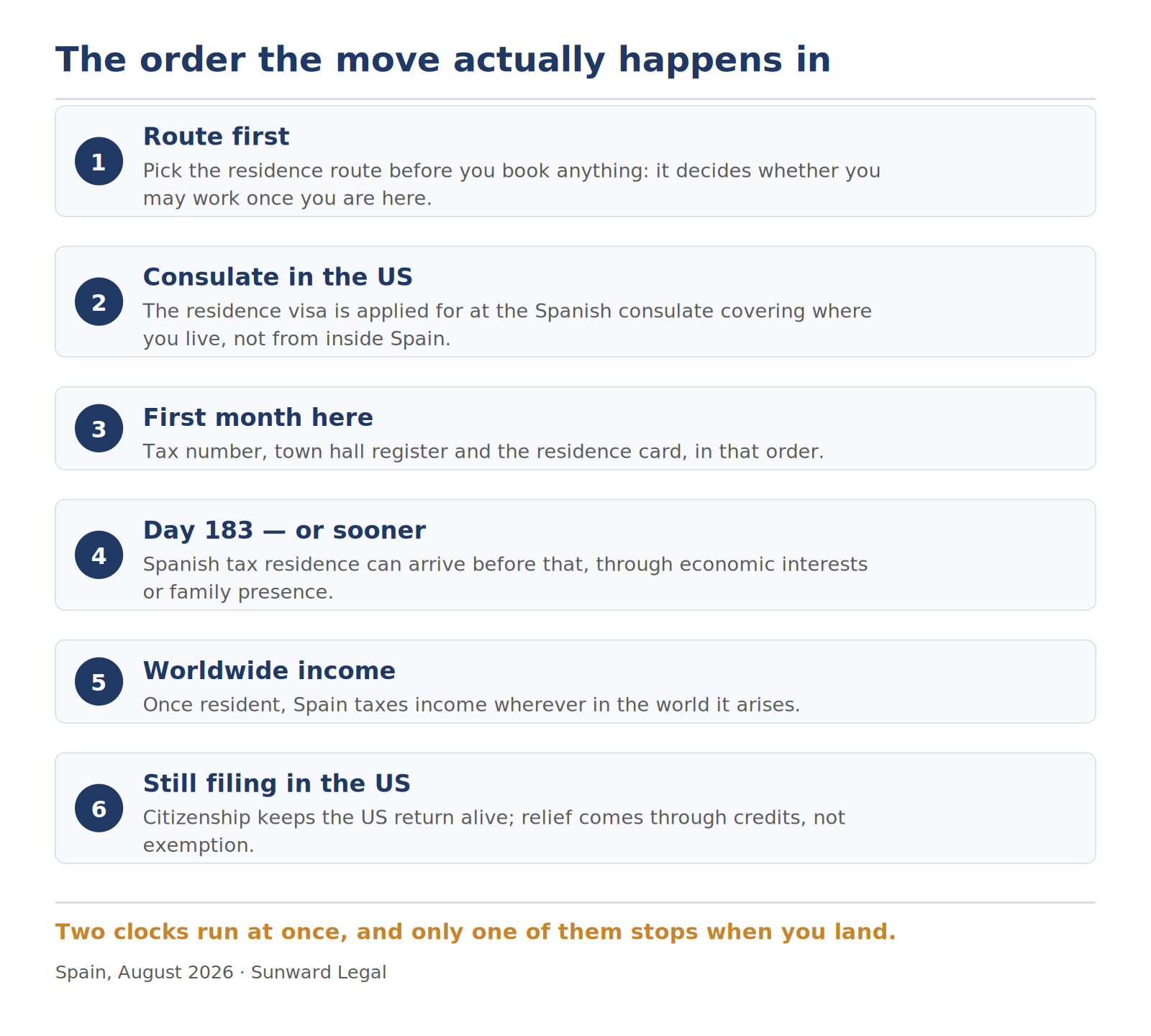
The order that saves the most money is unglamorous: route, then dates, then housing, then the purchase if there is one. Deciding the route first is what stops you discovering in March that the permit you applied for in November forbids the work you have been doing since January. If a property is part of the plan, it runs through our Spanish conveyancing service, on a separate track.
Book a free 20-minute call, in English or Spanish. Tell us your income, your intended arrival date and whether you plan to keep working, and we will tell you which route fits and where your first Spanish tax year would fall.
General information on Spanish law, not advice on a specific case, and not United States tax advice: your US filing position should be confirmed by a qualified US tax professional. Rules in force on August 15, 2026. Sources: Law 35/2006, articles 2, 5, 9 and 93, the last as amended by Law 28/2022; Law 14/2013, articles 74 bis to 74 quinquies; Organic Law 4/2000 and the Immigration Regulations approved by Royal Decree 1155/2024, articles 60 to 63; Royal Decree 126/2026 (SMI 2026) and IPREM published by the SEPE; Convention between Spain and the United States of 22 February 1990 and its Protocol of 14 January 2013, in force 27 November 2019, articles 1 and 20; Royal Legislative Decree 5/2004, articles 24 and 25; judgment of the Court of Justice of the European Union of 27 January 2022, case C-788/19, and Law 5/2022; General Tax Act 58/2003, eighteenth additional provision, and Royal Decree 1065/2007, articles 42 bis, 42 ter, 42 quater and 54 bis, with Order HAP/72/2013 and Order HFP/886/2023; Law 7/1985, articles 15 to 17, and the padrón instructions published on 2 May 2020; IRS, foreign tax credit and foreign earned income exclusion; European Commission, Entry/Exit System.